Join us on a literary world trip!
Add this book to bookshelf
Grey
Write a new comment Default profile 50px
Grey
Subscribe to read the full book or read the first pages for free!
All characters reduced
Silent Moonlight - cover

Silent Moonlight

Pasquale De Marco

Publisher: Publishdrive

  • 0
  • 0
  • 0

Summary

Immerse yourself in the enchanting world of moonlight as this captivating collection of essays and poems explores its profound impact on our emotions, dreams, and perceptions. From ancient civilizations to modern times, the moon has held a special place in our hearts and minds, inspiring artists, poets, and musicians throughout history.

Within these pages, you'll find a treasure trove of literary gems that capture the essence of moonlight's allure. From the gentle shimmer of a moonlit night to the haunting beauty of a lunar eclipse, these writings paint a vivid picture of the moon's many moods and meanings.

Delve into the mysteries of the moon's influence on our emotions and discover how its cyclical phases can mirror our own inner rhythms. Explore the moon's role in dreams and premonitions, and uncover the secrets of lunar rituals and traditions.

Through the eyes of poets and writers, you'll witness the moon's transformative power as it illuminates our path, casts long shadows, and stirs our deepest feelings. From the tranquility of a moonlit stroll to the passion of a moonlit rendezvous, the moon's presence in literature is a testament to its enduring ability to evoke a wide range of emotions.

This book is an invitation to journey under the silver veil of the moon, to explore its many facets and discover its enduring power to shape our world. With its blend of scientific insights, cultural perspectives, and personal reflections, this collection offers a unique and thought-provoking exploration of the moon's influence on our lives.


If you like this book, write a review!
Available since: 06/02/2025.
Print length: 158 pages.

Other books that might interest you

  • 1980 Nomination Acceptance Address - cover

    1980 Nomination Acceptance Address

    Ronald Reagan

    • 0
    • 0
    • 0
    Cover Art Photo: Ronald Reagan giving his acceptance speech at the Republican National Convention at Joe Louis Arena, Detroit, Michigan. July 17, 1980. 
    In his acceptance speech, Reagan envisioned “a new consensus with all those across the land who share a community of values embodied in these words: family, work, neighborhood, peace and freedom.” Reagan’s acceptance focuses on “three grave threats to our very existence, any one of which could destroy us. We face a disintegrating economy, a weakened defense and an energy policy based on the sharing of scarcity.” 
    Reagan places responsibility on the “Democratic party leadership-in the White House and in Congress-for this unprecedented calamity which has befallen us.” He says his first act will be “to impose an immediate and thorough freeze on federal hiring” and “to conduct a detailed review of every department, bureau and agency that lives by federal appropriation.” Reagan calls for “a 30 percent reduction in income tax rates over a period of three years” and reminds us that “every major tax cut in this century has strengthened the economy, generated renewed productivity and ended up yielding new revenues for the government”. 
    On the issue of national defense, Reagan asserts that we “know only too well that war comes not when the forces of freedom are strong, but when they are weak. It is then that tyrants are tempted.” While calling for a strong military, Reagan reiterates his long-held belief that government is too big and the “time is now to limit federal spending; to insist on a stable monetary reform and to free ourselves from imported oil.” 
    Search online for “Ronald Reagan major speeches” to see both a text version and a video version of this speech. Audio recording courtesy of the Ronald Reagan Presidential Library. AspenLeafMedia.com
    Show book
  • The Great Stone Face - cover

    The Great Stone Face

    Nathaniel Hawthorne

    • 0
    • 0
    • 0
    Immerse yourself in the captivating world of Nathaniel Hawthorne's "The Great Stone Face." This beloved short story explores themes of identity, destiny, and the power of perseverance. Hawthorne's writing is both enchanting and thought-provoking, and his characters are richly drawn with nuance and depth. Follow the story of a young boy named Ernest who is convinced that one day he will meet the man whose face perfectly matches the great stone face on the mountain. Join Ernest on his journey of self-discovery and learn about the true meaning of greatness.
    Show book
  • The Healer Archetype - How to Hold Space Heal Yourself and Help Others Transform - cover

    The Healer Archetype - How to...

    Magickal Spot

    • 0
    • 0
    • 0
    What if your deepest wounds could become the source of your greatest wisdom? 
      
    In The Healer Archetype audiobook, you’ll discover how to support healing without losing yourself, hold space for others with compassion, and understand the difference between rescuing and truly helping.  
      
    This audiobook explores the Healer as the archetype of restoration, emotional wisdom, self-healing, sacred service, and transformation. 
      
    Inside, you’ll learn: 
     What the Healer archetype really representsWhy healing is about restoring wholeness, not fixing what is brokenHow to develop deep listening, compassion, and healing presenceThe importance of boundaries in healing workHow to support others without becoming codependent or overwhelmedDifferent forms of healing, including emotional, physical, mental, and spiritual healingWhy your own healing journey matters if you want to help othersHow wounds can become wisdom and pain can become medicineThe shadow side of the Healer archetype, including rescuing, martyrdom, burnout, and people-pleasingHow to build a sustainable, healthy relationship with helping others 
      
    Whether you are a therapist, coach, caregiver, healer, empath, teacher, parent, or simply someone who wants to understand healing more deeply, this audiobook offers a grounded introduction to the Healer archetype. 
      
    You do not need to save everyone. You do not need to carry everyone.  
    You are allowed to heal too. 
     This audiobook also includes a companion guide with journaling prompts, reflection questions, affirmations, and self-check-ins to help you explore your healing journey more deeply.
    Show book
  • Psychology and Social Sanity - cover

    Psychology and Social Sanity

    Hugo Munsterberg

    • 0
    • 0
    • 0
    In Psychology and Social Sanity, pioneer Hugo Münsterberg argues that modern social problems stem from mental conditions. Moving psychological science out of the lab, Münsterberg analyzes how suggestion, habit, and perception quietly shape human behavior. He applies these insights to early 20th-century life, examining jury decisions, the traps of advertising, investments, and community health.
    Show book
  • History of Italy The - Etruscans Roman Emperors Wealthy City-States and the Renaissance - From Antiquity through Cultural Flowering and National Unification - Global Basics 101 - Your Series for Modern Knowledge Folge 15 (unabridged) - cover

    History of Italy The - Etruscans...

    Bert Alexander Petzold

    • 0
    • 0
    • 0
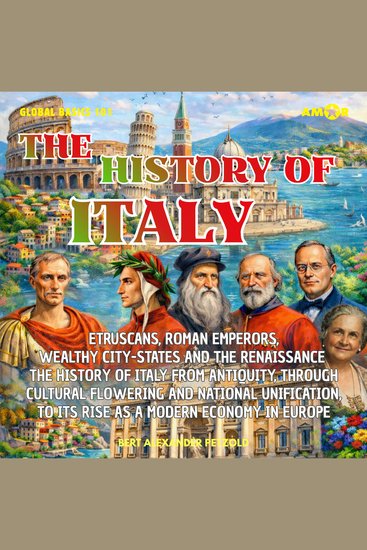
    How did Italy become the country that set political standards with the Roman Republic, enchanted the world with its art and today fascinates as a tourist magnet with a luxury industry? This audiobook leads listeners into the history of a country that shaped the Western world.
    
    Bert Alexander Petzold takes listeners on a journey through the history of Italy and conveys knowledge in an accessible, fact-rich form. Italy's geography and Mediterranean climate created the conditions for a rich history of settlement, stretching from the Stone Age through Etruscan culture and deep into the Roman era.
    
    During Roman antiquity, Rome rose to become the capital of a world empire whose influence can still be felt today. The ideas of the Roman Republic, including the separation of powers, jurisprudence and civic participation, became foundations of modern democratic systems. Rulers such as Augustus and Constantine the Great shaped epochs of world-historical importance. Under Theodosius I, Christianity was elevated to the status of state religion. Rome and St Peter's Basilica thereby remained a spiritual centre of Europe.
    
    In the Middle Ages and the Renaissance, Italy experienced a flourishing of art, culture and scholarship. Cities such as Venice, Pisa, Siena, Florence and Rome became centres of trade, power and beauty. The Medici supported geniuses such as Michelangelo and Leonardo da Vinci. Works such as "David", "The Creation of Adam", "The Last Supper" and "Mona Lisa" stand for that creative power through which Italy became a world leader in art.
    
    From the sixteenth to the eighteenth century, Italy remained a mosaic of city-states, duchies and kingdoms. It was only Giuseppe Garibaldi and King Victor Emmanuel II who brought about the unification of Italy in 1861. This phase appears as the path towards national unity and modern self-awareness.
    
    The twentieth century brought severe upheavals. The First World War triggered instability and social unrest. In the 1920s, Benito Mussolini established a fascist dictatorship and in 1936 allied himself with criminal Nazi Germany under Adolf Hitler. After war, liberation and a new beginning, the Italian Republic was founded in 1946. From the 1950s onwards, the country developed into a major industrial nation.
    
    At the same time, Italy's appeal is evident in its cultural diversity. The luxury industry, with brands such as "Gucci", "Armani", "Ferrari" and "Lamborghini", stands for Italy's global standing just as much as Renaissance art, the UNESCO World Heritage Sites "Pompeii", "Herculaneum" and "Paestum", cuisine, film, music, theatre, opera and enthusiasm for sport. Italy is a member of NATO, belongs to the seven leading industrial nations and democracies of the world, and remains a significant actor.
    
    Bert Alexander Petzold combines historical precision with vivid presentation. The audiobook shows how modern Italy emerged from early settlements, Roman power, Christian influence, urban wealth, artistic flourishing, national unification, the experience of dictatorship and a republican new beginning. It situates turning points in context and shows why Italy remains, to this day, a place of memory, a land of culture, an economic power and a destination of longing. The audiobook is ideally suited to preparation for examinations leading to a university entrance qualification and for study at university.
    
    Anyone wishing not only to travel through Italy, but to understand it in its historical depth, political significance and cultural radiance, will find in this audiobook a compelling and well-founded account. Discover Italy as a history of republic and empire, of Renaissance and republican foundation, of a world leader in art, a tourist magnet with a luxury industry and a modern democracy. Secure this audiobook and experience Europe anew.
    Show book

  • Nothing Exciting - Our journey with traumatic brain injury and severe autism across three countries - cover

    Nothing Exciting - Our journey...

    Emil Brune

    • 0
    • 0
    • 0
    In 1997, a drunk driver slammed into Emil and Fran's car, leaving their nine-week-old son Timmy with a traumatic brain injury that led to severe autism, visual impairment, left hemiplegia, and the need for 24-hour care. Fran overcame her own severe injuries to fuel Timmy's joyful progress.
    From the chaos of the ICU, they launched into an unforeseen three-decade odyssey of special-needs parenting across three countries. Raising Timmy alongside their younger children Emma and Luke, they faced medical crises, exhaustion, ignorance, and plenty of idiots along the way — yet discovered hope, community, love, laughter, and unexpected joy.
    Nothing Exciting is an unflinching dad's memoir and practical guide. With his signature heartfelt voice and humour, Emil shares raw, vivid stories of resilience, family fun, and laugh-out-loud moments that prove even the toughest days can hold unexpected comedy — while delivering hard-won "top tips" in every chapter.
    Organised around ten essential themes - Community, Adaptation, Resilience, Joy, Self-Care and more - the book weaves moving anecdotes and cultural insight with immediately usable advice.
    Whether you're raising a child with special needs or supporting someone who is, this book delivers the wisdom, tools, and hope you need — with heart, humour, and the realisation that nothing exciting can still be truly epic.
    Show book