Join us on a literary world trip!
Add this book to bookshelf
Grey
Write a new comment Default profile 50px
Grey
Subscribe to read the full book or read the first pages for free!
All characters reduced
Secondary Dynamics of Data Reviews - cover

Secondary Dynamics of Data Reviews

Pasquale De Marco

Publisher: Publishdrive

  • 0
  • 0
  • 0

Summary

In the realm of data analysis, uncovering actionable insights requires a keen eye for detail and a systematic approach to data reviews. "Secondary Dynamics of Data Reviews" emerges as an invaluable guide, providing a comprehensive roadmap to navigate the complexities of data scrutiny and unlock the hidden potential within your datasets.

This book delves into the intricacies of data reviews, empowering readers with the knowledge and skills to critically assess their data, identify potential issues, and extract meaningful conclusions. Through a series of engaging chapters, you'll embark on a journey to master the art of data validation, ensuring the accuracy and integrity of your findings.

With clarity and precision, the book introduces the fundamental principles of data quality assessment, guiding you through the process of identifying and correcting errors, inconsistencies, and missing values. You'll discover the nuances of data visualization techniques, transforming raw data into compelling and informative visual representations that illuminate patterns and trends.

Furthermore, you'll delve into the realm of statistical methods, gaining a solid foundation for analyzing data and drawing inferences. Hypothesis testing, regression analysis, ANOVA, and time series analysis are just a few of the statistical tools you'll master, enabling you to uncover hidden relationships, predict outcomes, and make informed decisions based on data-driven insights.

The book also addresses the challenges posed by missing data and outliers, providing practical strategies for handling these common issues and ensuring the integrity of your analysis. Additionally, it explores the ethical considerations surrounding data analysis, emphasizing the importance of responsible and transparent practices in the digital age.

By the end of this comprehensive guide, you'll have acquired the skills and knowledge necessary to conduct thorough and effective data reviews, ensuring the validity and reliability of your research findings. "Secondary Dynamics of Data Reviews" is an essential resource for researchers, data analysts, and students seeking to elevate their data analysis capabilities and extract maximum value from their datasets.


If you like this book, write a review!
Available since: 06/02/2025.
Print length: 171 pages.
Other books that might interest you

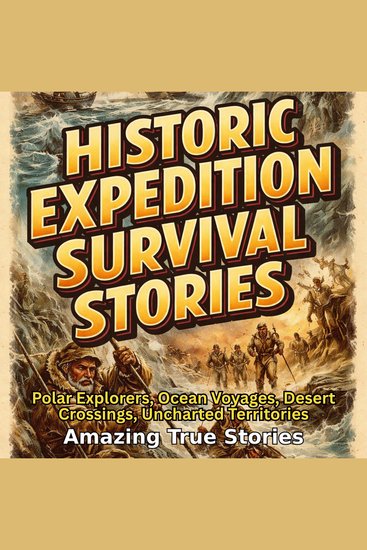
  • Historic Expedition Survival Stories: Polar Explorers Ocean Voyages Desert Crossings Uncharted Territories - cover

    Historic Expedition Survival...

    Amazing True Stories

    • 0
    • 0
    • 0
    This audiobook is narrated by an AI Voice.   
    Journey into the most harrowing survival stories from history's greatest expeditions. Experience the life-or-death struggles of legendary explorers who pushed beyond the edges of known civilization, facing starvation, extreme weather, hostile encounters, and terrain that tested the limits of human endurance. From Lewis and Clark's perilous 8,000-mile trek through uncharted American wilderness to the tragic fate of the Donner Party trapped in Sierra Nevada blizzards, these gripping accounts reveal how ordinary people summoned extraordinary courage when confronted with nature's deadliest challenges. Discover polar expeditions battling frostbite and scurvy in Arctic wastelands, ocean voyages where shipwrecked crews drifted thousands of miles on makeshift rafts, and desert crossings where a single wrong turn meant certain death. Each meticulously researched story combines historical accuracy with heart-pounding narrative, bringing listeners face-to-face with grizzly bears, raging rapids, cannibalistic desperation, and the raw determination that separated survivors from victims. Perfect for history enthusiasts, adventure seekers, and anyone fascinated by tales of human resilience, this collection explores how leadership, preparation, and sheer willpower meant the difference between triumphant return and forgotten graves. These aren't just adventure stories—they're profound lessons in survival psychology, group dynamics, and the indomitable human spirit when pushed to absolute extremes.
    Show book
  • Are We Bodies or Souls? - cover

    Are We Bodies or Souls?

    Richard Swinburne

    • 0
    • 0
    • 0
    What are humans? What makes us who we are? 


    Many think that we are just complicated machines, or animals that are different from machines only by being conscious. In Are We Bodies or Souls? Richard Swinburne comes to the defense of the soul and presents new philosophical arguments that are supported by modern neuroscience. When scientific advances enable neuroscientists to transplant a part of brain into a new body, he reasons, no matter how much we can find out about their brain activity or conscious experiences we will never know whether the resulting person is the same as before or somebody entirely new. Swinburne thus argues that we are immaterial souls sustained in existence by our brains. Sensations, thoughts, and intentions are conscious events in our souls that cause events in our brains. While scientists might discover some of the laws of nature that determine conscious events and brain events, each person's soul is an individual thing and this is what ultimately makes us who we are.
    Show book
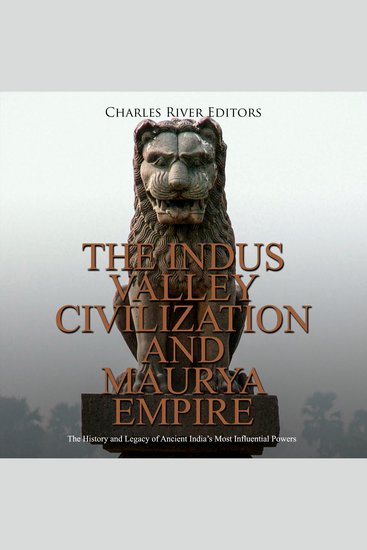
  • Indus Valley Civilization and Maurya Empire The: The History and Legacy of Ancient India’s Most Influential Powers - cover

    Indus Valley Civilization and...

    Editors Charles River

    • 0
    • 0
    • 0
    India’s oldest civilization, known as the Indus Valley Civilization or the Harappan Civilization, was contemporary with ancient Mesopotamia and ancient Egypt and had extensive contacts with the former, making it one of the most important early civilizations in the world. Spread out along the rivers of the Indus River Valley, hundreds of settlements began forming around 3300 BCE, eventually coalescing into a society that had all of the hallmarks of a true civilization, including writing, well-developed cities, a complex social structure, and long-distance trade. 
    During the last centuries of the first millennium BCE, most of the Mediterranean basin and the Near East were either directly or indirectly under the influence of Hellenism. The Greeks spread their ideas to Egypt, Mesopotamia, and Persia and attempted to unify all of the peoples of those regions under one government. Although some of the Hellenistic kingdoms proved to be powerful in their own rights – especially Ptolemaic Egypt and the Seleucid Empire, which encompassed all of Mesopotamia, most of the Levant, and much of Persia during its height – no single kingdom ever proved to be dominant. The Hellenic kingdoms battled each other for supremacy and even attempted to claim new lands, especially to the east, past the Indus River in lands that the Greeks referred to generally as India. But as the Hellenistic Greeks turned their eyes to the riches of India, a dynasty came to power that put most of the Indian subcontinent under the rule of one king. The dynasty that came to power in the late 4th century BCE is known today as the Mauryan Dynasty, and although the ruling family was short-lived and their power was ephemeral, its influence resonated for several subsequent centuries and spread as far east as China and into the Hellenistic west.
    Show book
  • Romantic Things - A Tree A Rock A Cloud - cover

    Romantic Things - A Tree A Rock...

    Mary Jacobus

    • 1
    • 1
    • 0
    Our thoughts are shaped as much by what things make of us as by what we make of them. Lyric poetry is especially concerned with things and their relationship to thought, sense, and understanding. In Romantic Things, Mary Jacobus explores the world of objects and phenomena in nature as expressed in Romantic poetry alongside the theme of sentience and sensory deprivation in literature and art. Jacobus discusses objects and attributes that test our perceptions and preoccupy both Romantic poetry and modern philosophy. John Clare, John Constable, Rainer Maria Rilke, W. G. Sebald, and Gerhard Richter make appearances around the central figure of William Wordsworth as Jacobus explores trees, rocks, clouds, breath, sleep, deafness, and blindness in their work. While she thinks through these things, she is assisted by the writings of Maurice Merleau-Ponty, Jacques Derrida, and Jean-Luc Nancy. Helping us think more deeply about things that are at once visible and invisible, seen and unseen, felt and unfeeling, Romantic Things opens our eyes to what has been previously overlooked in lyric and Romantic poetry.
    Show book
  • Strangers and Scapegoats - Extending God's Welcome to Those on the Margins - cover

    Strangers and Scapegoats -...

    Matthew S. Vos

    • 0
    • 0
    • 0
    We live in a world of oppositional relationships and increasing in-group/out-group divisions. Christian sociologist Matthew Vos explains how the problem of the stranger lies at the root of many problems humanity faces, such as racism, sexism, and nationalism. He applies classic sociological theory on "the stranger" to matters of faith and social justice, showing that an identity in Christ frees us to love strangers as neighbors and friends. The book also includes two guest chapters, one on intersex persons and the church and one on stranger-making in the "correctional" system.
    Show book
  • The Communist Manifesto - cover

    The Communist Manifesto

    Karl Marx

    • 0
    • 0
    • 0
    "Workers of the world, unite! You have nothing to lose but your chains".
    The Communist Manifesto lays out the principles of Marxism, analysing the historical development of class struggles and the dynamics of capitalism. Marx and Engels argue that all history is the history of class conflict, and that capitalism, like previous systems, contains the seeds of its own destruction. Written in 1848, The Communist Manifesto remains one of the most influential political documents ever written, presenting a laser-sharp critique of inequality and presenting a vision for a radically different, classless society where "the free development of each is the condition for the free development of all."
    
    But the Manifesto is most valuable as an historical document, one that led to the greatest political upheavals of the nineteenth and twentieth centuries and to the establishment of the Communist governments that until recently ruled half the globe.
    Karl Marx (1818–1883) was a German philosopher, historian, sociologist, economist, and revolutionary socialist best known for co-authoring The Communist Manifesto and writing Das Kapital. Due to his political writings, he was forced to live in exile in London, where he continued to develop his thought in collaboration with German thinker Friedrich Engels and publish his writings. His ideas have had enormous influence on political and philosophical thought, laid the foundation for modern communism and have influenced political movements worldwide.
    Friedrich Engels (1820–1895) was a German philosopher, social scientist, and political theorist best known for his collaboration with Karl Marx. Born in Barmen, Prussia (now Wuppertal, Germany), Engels came from a wealthy textile manufacturing family. His early experiences in the family business exposed him to the harsh realities of industrial capitalism, which shaped his views on class struggle and social justice. Engels was a strong advocate for workers' rights and played a key role in the development of Marxist thought. He died in 1895 in London, leaving a lasting legacy in political theory.
    Show book