Join us on a literary world trip!
Add this book to bookshelf
Grey
Write a new comment Default profile 50px
Grey
Subscribe to read the full book or read the first pages for free!
All characters reduced
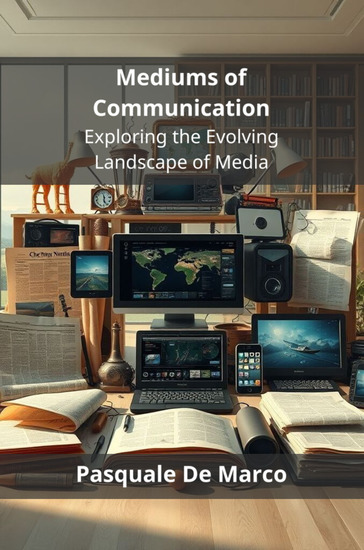
Mediums of Communication - Exploring the Evolving Landscape of Media - cover

Mediums of Communication - Exploring the Evolving Landscape of Media

Pasquale De Marco

Publisher: Publishdrive

  • 0
  • 0
  • 0

Summary

In Mediums of Communication: Exploring the Evolving Landscape of Media, we take a comprehensive look at the ever-changing world of media and its profound impact on society. From the rise of digital technologies to the convergence of media platforms, we delve into the forces that are shaping the way we consume information and entertainment.

We examine the intricate relationship between media and culture, exploring how the media shapes public opinion, influences cultural values, and portrays different cultures. We also consider the role of media in identity formation and the construction of social reality.

We then turn our attention to the nexus of media, politics, and power, examining the role of the media in political campaigns, the regulation of media content, and the relationship between media and government. We also consider the impact of media on public policy and the balance of power in society.

Furthermore, we explore the economic impact of media industries, the role of media in advertising and marketing, and the relationship between media and consumer behavior. We also discuss the impact of media on economic development and the global economy.

Looking to the future, we consider the impact of emerging technologies, such as artificial intelligence and virtual reality, on the media landscape. We also discuss the challenges and opportunities facing the media industry in the years to come.

Mediums of Communication is an essential read for anyone interested in understanding the changing landscape of media and its impact on society. With its comprehensive analysis and insightful perspectives, this book provides a deeper understanding of the role of media in our lives and its implications for the future.


If you like this book, write a review!
Available since: 06/02/2025.
Print length: 162 pages.

Other books that might interest you

  • Endemic - A Post-Pandemic Playbook - cover

    Endemic - A Post-Pandemic Playbook

    Monica Gandhi M.D.

    • 0
    • 0
    • 0
    A Blueprint for Navigating Future Pandemics: Embrace an Endemic Reality Discover a roadmap to coexisting with new respiratory diseases and their variants using reason, science, courage, and compassion. This approach acknowledges that eradicating these viruses may be challenging, but controlling them is possible. By utilizing existing tools, we can coexist with these viruses without disrupting society. In this book, Dr. Gandhi offers insights into the story, science, and politics of our journey so far, highlighting successes and challenges. With her expertise, clear reasoning and a 10-point plan, Dr. Gandhi equips readers to understand and prepare for the future, ensuring a well-informed and resilient society.
    Show book
  • 10 Ways the World Could End - From Natural Disasters to Man-Made Catastrophes - cover

    10 Ways the World Could End -...

    John Harpoon

    • 0
    • 0
    • 0
    Our planet is an extraordinary place, teeming with life and natural wonders. Yet, beneath the beauty and stability of our world lies an inherent fragility that we must never overlook. From the forces of nature to the actions of humanity, numerous threats exist that could drastically alter the course of life on Earth. These dangers range from natural disasters such as volcanic eruptions and asteroid impacts to man-made catastrophes like nuclear war and the consequences of climate change. While these events may seem distant or improbable, they are very real and have the potential to affect us all in profound ways. 
    To fully grasp the magnitude of these threats, it is crucial to understand how they arise and their potential consequences. Many of the dangers that could lead to the end of the world are rooted in forces that have shaped our planet for millions of years. However, modern society faces new, unique risks that previous generations never imagined. Natural disasters, though unpredictable, are part of the Earth's natural cycles, while human actions—whether through pollution, warfare, or technological mismanagement—have introduced entirely new categories of risk. As technology advances and our global interconnectedness grows, the potential for widespread disaster becomes more complex and difficult to anticipate. 
    When examining the ways the world could end, it is essential to distinguish between natural and man-made catastrophes. Natural disasters, like earthquakes, tsunamis, and pandemics, have been occurring throughout Earth's history, long before humans arrived on the scene. These events have shaped ecosystems, driven evolutionary processes, and, at times, caused mass extinctions. On the other hand, man-made catastrophes, such as nuclear warfare or the unchecked expansion of artificial intelligence, are unique to modern civilization.
    Show book
  • The Internet Is Not What You Think It Is - A History a Philosophy a Warning - cover

    The Internet Is Not What You...

    Justin E. H. Smith

    • 0
    • 0
    • 0
    An original deep history of the internet that tells the story of the centuries-old utopian dreams behind it—and explains why they have died today 
     
    Many think of the internet as an unprecedented and overwhelmingly positive achievement of modern human technology. But is it? In The Internet Is Not What You Think It Is, Justin Smith offers an original deep history of the internet, from  
    the ancient to the modern world—uncovering its surprising origins in nature and centuries-old dreams of radically improving human life by outsourcing thinking to machines and communicating across vast distances. Yet, despite the internet’s  
    continuing potential, Smith argues, the utopian hopes behind it have finally died today, killed by the harsh realities of social media, the global information economy, and the attention-destroying nature of networked technology. 
     
    Ranging over centuries of the history and philosophy of science and technology, Smith shows how the “internet” has been with us much longer than we usually think. He draws fascinating connections between internet user experience,  
    artificial intelligence, the invention of the printing press, communication between trees, and the origins of computing in the machine-driven looms of the silk industry. At the same time, he reveals how the internet’s organic structure and  
    development root it in the natural world in unexpected ways that challenge efforts to draw an easy line between technology and nature. 
     
    Combining the sweep of intellectual history with the incisiveness of philosophy, The Internet Is Not What You Think It Is cuts through our daily digital lives to give a clear-sighted picture of what the internet is, where it came from, and where it might be taking us in the coming decades.
    Show book
  • The Story of Space - From Spirit Realms to Spacetime and Beyond - cover

    The Story of Space - From Spirit...

    Ylia Callan

    • 0
    • 0
    • 0
    This audiobook is narrated by an AI Voice.   
    The Story of Space – From Spirit Realms to Spacetime and Beyond takes listeners on an extraordinary journey through humanity’s evolving relationship with the cosmos. From the earliest myths of sacred skies and heavenly realms, to the philosophical concept of the aether, to the scientific revolutions of relativity and quantum theory, this audiobook traces the ever-shifting ways we have understood the nature of space itself. 
    Blending history, philosophy, science, and culture, this sweeping narrative reveals how each era has projected its deepest ideas, fears, and aspirations onto the vast expanse above us. Explore how space has been imagined not only by scientists and philosophers, but also by poets, artists, and dreamers - across cultures, languages, and spiritual traditions. 
    From the timeless myths of creation to Einstein’s curved spacetime, from the quantum void to the imaginative frontiers of science fiction, The Story of Space uncovers the many dimensions - physical, cultural, psychological, and spiritual - of this endless mystery. 
    If you’ve ever looked up at the night sky and wondered what it truly means, this audiobook offers a guide to the evolving tapestry of ideas that have shaped our vision of the universe.
    Show book
  • Rare & Severe Infections - From the Uncommon to the Deadly (3 in 1) - cover

    Rare & Severe Infections - From...

    Lilly Richardsen

    • 0
    • 0
    • 0
    Uncommon infections represent the frontiers of medical challenge, where diagnostic complexity, rapid progression, and severe outcomes converge to create some of the most daunting scenarios in clinical medicine. This comprehensive exploration delves into three distinct yet equally consequential infections—Meningitis, Elephantiasis (Lymphatic Filariasis), and Legionella pneumophila infection—each exemplifying the remarkable diversity of microbial pathogenesis and the profound ways in which rare infections can transform human health and lives. 
    The narrative of rare and severe infections extends beyond their medical rarity; it encompasses the intricate biological mechanisms, unique transmission patterns, and complex clinical presentations that make these conditions simultaneously fascinating to researchers and devastating to patients. By examining the neurological inflammation of meningitis, the disfiguring lymphatic disruption of elephantiasis, and the respiratory assault of Legionella, this book illuminates how different pathogenic organisms exploit specific biological vulnerabilities to produce extraordinarily consequential diseases. Readers will journey through the epidemiological landscapes where these infections emerge—from the global burden of meningococcal disease to the tropical endemic regions of lymphatic filariasis and the modern built environments where Legionella thrives—while exploring the scientific advances in diagnosis, treatment, and prevention that offer hope against these formidable pathogens.
    Show book
  • The Vagus-Immune Connection - Harness Your Vagus Nerve to Manage Stress Prevent Immune Dysregulation and Avoid Chronic Disease - cover

    The Vagus-Immune Connection -...

    JP Errico

    • 0
    • 0
    • 0
    This comprehensive guide delves into the intricate relationship between the vagus nerve and immune regulation, providing invaluable insights and practical strategies for understanding chronic illnesses like migraine, anxiety, BPD, cognitive dysfunction, stroke, hypertension, IBS, and more. 


    Engineer, inventor, and vagus nerve expert J. P. Errico distills the latest scientific research and technological advancements to bolster your immune system and enhance resilience against pathogens and diseases. With The Vagus-Immune Connection, you will: 


    ● Gain a deep understanding of how the vagus nerve influences the immune system, from its role in controlling inflammation to its impact on autoimmune conditions 


    ● Discover practical techniques to effectively manage stress, a major contributor to immune dysregulation 


    ● Enhance immune resilience and disease prevention 


    ● Optimize cellular energy metabolism to improve neurodevelopment and cognitive function 


    Whether you're seeking to boost your immune resilience, prevent disease, or address immune-related conditions, this book offers a comprehensive roadmap to unlock the potential of your immune system through vagus nerve modulation.
    Show book