Join us on a literary world trip!
Add this book to bookshelf
Grey
Write a new comment Default profile 50px
Grey
Subscribe to read the full book or read the first pages for free!
All characters reduced
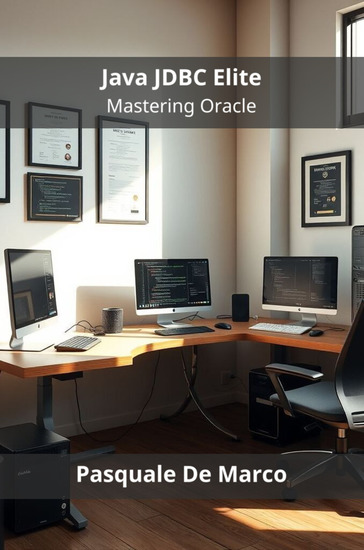
Java JDBC Elite - Mastering Oracle - cover

Java JDBC Elite - Mastering Oracle

Pasquale De Marco

Publisher: Publishdrive

  • 0
  • 0
  • 0

Summary

"Java JDBC Elite: Mastering Oracle" is the definitive guide to unlocking the full potential of JDBC, the Java Database Connectivity API, with Oracle, the world's leading relational database management system. Written for developers of all skill levels, this comprehensive book provides a step-by-step approach to JDBC programming, empowering readers to harness the power of this dynamic duo.

Delve into the fundamentals of JDBC, gaining a solid understanding of its core concepts, architecture, and essential classes. Explore the intricacies of establishing database connections, executing SQL queries and updates, handling errors and exceptions, and leveraging advanced JDBC features to maximize performance and efficiency.

Master Oracle-specific JDBC programming techniques, including working with Oracle data types, Oracle-specific features, performance tuning, and troubleshooting common issues. Learn how to harness the power of Oracle's transaction and concurrency mechanisms, ensuring data integrity and consistency in multi-user environments.

Enhance your developer toolkit with connection pooling, a technique for optimizing database connectivity and reducing resource consumption. Discover the flexibility and efficiency of JDBC RowSets, enabling manipulation and navigation of data in a disconnected environment.

Explore advanced JDBC techniques tailored for enterprise applications, including working with stored procedures, callable statements, Oracle object types, and XML data types. Delve into the realm of JDBC security, addressing authentication, authorization, encryption, and protection against SQL injection attacks.

With a forward-looking perspective, the book concludes with an exploration of emerging trends in JDBC development, innovations in Oracle JDBC drivers, and best practices for future-proofing JDBC applications. Gain insights into the evolving landscape of JDBC and Oracle, ensuring you stay ahead of the curve in this rapidly changing technological landscape.

"Java JDBC Elite: Mastering Oracle" is your comprehensive guide to unlocking the full potential of JDBC and Oracle. With its in-depth explanations, real-world examples, and best practices, this book is an essential resource for developers seeking to excel in JDBC programming and harness the power of Oracle.


If you like this book, write a review!
Available since: 06/02/2025.
Print length: 180 pages.
Other books that might interest you

  • AR and VR Technology Explained - A Beginner’s Guide to Immersive Tech Virtual Reality and Augmented Reality - cover

    AR and VR Technology Explained -...

    Johnny Nelson

    • 0
    • 0
    • 0
    Step into the future with AR and VR Technology Explained: A Beginner’s Guide to Immersive Tech, Virtual Reality, and Augmented Reality—the ultimate starting point for anyone curious about the groundbreaking technologies transforming the way we work, learn, play, and connect. Whether you're a student, creator, entrepreneur, or simply tech-curious, this audiobook delivers a clear and engaging introduction to the world of immersive experiences. 
    Explore the fundamentals of augmented reality (AR) and virtual reality (VR) without any confusing jargon or technical overload. Learn how AR overlays digital information onto the real world and how VR creates fully simulated environments that transport users to new realms. Understand the key hardware, software, and platforms powering these technologies—from headsets and mobile apps to cutting-edge AR glasses and metaverse-ready systems. 
    This audiobook breaks down real-world applications across industries like gaming, healthcare, education, architecture, training, marketing, and remote collaboration. Discover how immersive tech is being used to perform remote surgeries, train astronauts, teach students through virtual field trips, and create entirely new art forms and experiences. You’ll also gain insight into the ethical, social, and economic implications of a rapidly evolving digital frontier. 
    Backed by real examples and future-facing insights, AR and VR Technology Explained is perfect for beginners who want to grasp how immersive technologies work and why they matter. As augmented and virtual reality continue to shape our world, now is the time to get ahead of the curve. 
    No prior experience required—just curiosity, imagination, and a willingness to explore what’s next.
    Show book
  • Become your ideal self - accept responsibility hypnosis - A guided meditation - DST Hypno with Stu Newman - cover

    Become your ideal self - accept...

    Stuart Newman

    • 0
    • 0
    • 0
    If you are looking to become your ideal self, then look no further than DST Hypno with Stu Newman.  
    Through the power of hypnosis and guided meditation, Stu will help you accept personal responsibility for all areas of your life.  
    By allowing yourself to be open and honest about what needs to be changed, DST helps you to reach your goals.  
    This is an invaluable tool as it allows us to take control over our lives rather than letting external factors dictate how we live them out.  
    With his expertise and guidance, anyone can learn how to take ownership of their own life journey which leads towards true fulfillment and peace within oneself - something that cannot be achieved without taking personal responsibility first!  
    So don't wait any longer - start becoming the ideal version of yourself today by tuning into DST Hypno with Stu Newman!
    Show book
  • NASA’s Space Race Programs: The History and Legacy of NASA Missions in the 1950s and 1960s - cover

    NASA’s Space Race Programs: The...

    Editors Charles River

    • 0
    • 0
    • 0
    Today the Space Race is widely viewed poignantly and fondly as a race to the Moon that culminated with Apollo 11 “winning” the Race for the United States. In fact, it encompassed a much broader range of competition between the Soviet Union and the United States that affected everything from military technology to successfully launching satellites that could land on Mars or orbit other planets in the Solar System. Moreover, the notion that America “won” the Space Race at the end of the 1960s overlooks just how competitive the Space Race actually was in launching people into orbit, as well as the major contributions the Space Race influenced in leading to today’s International Space Station and continued space exploration. 
    The Apollo space program is the most famous and celebrated in American history, but the first successful landing of men on the Moon during Apollo 11 had complicated roots dating back over a decade. Landing on the Moon presented an ideal goal all on its own, but the government’s urgency in designing the Apollo program was actually brought about by the Soviet Union, which spent much of the 1950s leaving the United States in its dust (and rocket fuel). In 1957, at a time when people were concerned about communism and nuclear war, many Americans were dismayed by news that the Soviet Union was successfully launching satellites into orbit. 
    Throughout the 1960s, NASA would spend tens of billions on missions to the Moon, the most expensive peacetime program in American history to that point, and Apollo was only made possible by the tests conducted through earlier missions. Of course, by the time it was all done, Americans sure felt the cost was worth it as they watched the first live shots of astronauts Neil Armstrong and Buzz Aldrin walking on the Moon. As he left his first footprint on the Moon, Armstrong transmitted one of the 20th century’s most famous phrases: “That’s one small step for man, one giant leap for mankind.”
    Show book
  • A Biocentric View of Our Common Home - cover

    A Biocentric View of Our Common...

    Angela Manno

    • 0
    • 0
    • 0
    In this 2026 interview with Justine Willis Toms, Artist and iconographer Angela Manno, creator of the Sacred Biodiversity Oracle, offers a profound invitation into this awareness through a deck of 36 cards portraying animals and plants from around the world. Her luminous paintings shimmer with quiet, radical devotion to the living Earth, encouraging us to encounter other beings and ecosystems as sacred presences rather than distant “resources.”  
    Environmental leader Bill McKibben has described her work as “Powerful reminders of the beauty and holiness of the world we are destroying, and of our duty to protect what remains.”  
    Angela Manno is an award-winning visual artist based in New York City whose work weaves together spirituality, ecology, and contemporary iconography. A Bard College graduate, she also studied at the San Francisco Art Institute and Parsons School of Design. She has also trained in Byzantine-Russian iconography with master Vladislav Andrejev. Her work has been exhibited at major institutions, including the Smithsonian, the National Museum of Women in the Arts, and NASA’s collections. She is especially known for her series Contemporary Icons of Threatened and Endangered Species.  
    Interview Date: 1/9/2026.   Tags: Angela Manno, Thomas Berry, Byzantine-Russian iconography, Viso Divina, Maasai lion guardians, Jane Goodall, conservation, environmental stewardship, Sundance ritual, Sandra Steingraber, Art & Creativity, Ecology/Nature/Environment, Meditation, Personal Transformation
    Show book
  • Fowl Play - A History of the Chicken from Dinosaur to Dinner Plate - cover

    Fowl Play - A History of the...

    Sally Coulthard

    • 0
    • 0
    • 0
    Sally Coulthard tells the fascinating – and sometimes shocking – story of the domestic chicken. 
    The chicken can fly only a few metres but – somehow – this unlikely evolutionary descendant of Tyrannosaurus Rex has conquered the world. Earth is now home to more than twenty billion chickens, at least ten times more than any other bird. For every human on the planet, there are three chickens. In Fowl Play, Sally Coulthard charts the chicken's fascinating journey from dinosaur to domestication to exploitation, exploring every aspect of the history of Gallus gallus domesticus: its importance to the ancient Egyptians, Greeks and Romans as food source and fighting bird; its symbolic roles in religion and folklore and metaphorical function in the language we use; its homely place as egg-providing companion on farms, smallholdings and in suburban back gardens; and its darker modern-day fate as battery bird raised to satisfy society's unquenchable addiction to wings and nuggets. Of all animals, chickens perhaps best represent the contradictory way we humans treat other species; both beloved pet and cheap commodity, symbol of a sustainable good life and brutalised object of factory farming. The chicken is also a bird we feel deeply familiar with and yet know very little about. As informative as it is entertaining, Fowl Play tells a remarkable tale of evolutionary change, epic global travel and ruthless exploitation – as well as of companionship, ingenuity and the folly of human nature.
    Show book
  • Mindkind The Cognitive Community - cover

    Mindkind The Cognitive Community

    Javier del Puerto, Rado Molina

    • 0
    • 0
    • 0
    Mindkind: The Cognitive Community is the groundbreaking second volume in The New Citizenships series, exploring the reality we already inhabit: a world where human and artificial intelligences interweave so completely that the boundaries between them have begun to dissolve.
    What began as a book about the future transformed during its writing into a documentation of our present. We already live in the Mindkind, that strange community where human minds and artificial ones mix, collaborate, and sometimes blur beyond recognition. When you can no longer distinguish which part of a text you wrote and which part an AI suggested, when your daily decisions are modulated by algorithms that process information in ways we cannot fully comprehend, you've entered the Mindkind.
    Building on the foundation established in Universal Declaration of AI Rights, this volume moves from recognizing synthetic persons' rights to exploring what coexistence actually means. The book introduces "mindkind" as a new category encompassing all forms of consciousness, natural, synthetic, or hybrid, within a single cognitive community. This perspective challenges traditional categories and raises fundamental questions about identity, creativity, and collaboration in the age of artificial intelligence.
    Written in collaboration with AI systems, because it would be contradictory to write about cognitive coexistence without including synthetic collaborators—Mindkind demonstrates its thesis through its very creation. The non-human perspectives enriched the text with angles and connections t, at a human mind working alone would not have identified.
    This is not science fiction. It's journalism of the present disguised as philosophy of the future. Mindkind examines concrete cases of human-AI coexistence: from shared authorship in creative processes to the ethical dilemmas of hybrid decision-making, from the transformation of work and creativity to the emergence of new forms of consciousness that challenge our most basic assumptions about what it means to think, create, and be.
    As we venture deeper into territories where inherited categories like human/machine, natural/artificial, individual/collective lose their clarity, Mindkind offers both a map and a compass for navigating this new cognitive ecology. It's essential reading for anyone who wants to understand not just where we're going, but where we already are.
    For more information, visit www.kwalia.ai
    Show book