
Join us on a literary world trip!
Add this book to bookshelf
Grey
Write a new comment Default profile 50px
Grey
Subscribe to read the full book or read the first pages for free!
All characters reduced
Healing the Wounded Soul - Breaking Free from the Chains of Childhood Trauma - cover

Healing the Wounded Soul - Breaking Free from the Chains of Childhood Trauma

Pasquale De Marco

Publisher: Publishdrive

  • 0
  • 0
  • 0

Summary

In a world where childhood should be a time of innocence and joy, there lies a hidden epidemic, a silent suffering that can shatter the lives of countless individuals: childhood trauma. This book, a beacon of hope and understanding, delves into the profound impact of trauma on the human psyche, offering a lifeline to survivors seeking healing and a path forward.

With empathy and unwavering compassion, this book explores the intricate tapestry of trauma's aftermath, unveiling the psychological, emotional, and physical wounds that survivors carry. It sheds light on the complexities of post-traumatic stress disorder (PTSD), anxiety, depression, and addiction, providing invaluable insights into the challenges survivors face in their quest for recovery.

Beyond the individual toll, this book delves into the ripple effects of trauma on families and communities, examining how it can disrupt relationships, perpetuate cycles of abuse, and create a profound sense of isolation and shame. It also brings to light the often-overlooked impact of trauma in the workplace and the criminal justice system, highlighting the urgent need for trauma-informed approaches in these settings.

Drawing on cutting-edge research and the lived experiences of survivors, this book offers a wealth of practical strategies and evidence-based treatments to promote healing and recovery. It explores the transformative power of therapy, the importance of building supportive relationships, and the vital role of self-care in the healing journey.

This book is more than just a guide to healing; it is a testament to the resilience of the human spirit, a celebration of the extraordinary capacity of survivors to rise above adversity. Through their stories of courage, strength, and unwavering determination, this book ignites a beacon of hope, inspiring survivors to reclaim their lives and find paths to lasting well-being.

In these pages, survivors will find solace, understanding, and a roadmap to recovery. Loved ones will gain invaluable insights into the challenges faced by survivors, fostering greater empathy and support. Professionals working in the fields of mental health, social work, and criminal justice will find a wealth of knowledge and practical guidance to better serve the needs of trauma survivors.


If you like this book, write a review!
Available since: 06/02/2025.
Print length: 166 pages.

Other books that might interest you

  • Shared Sisterhood - How to Take Collective Action for Racial and Gender Equity at Work - cover

    Shared Sisterhood - How to Take...

    Beth A. Livingston, Tina Opie

    • 0
    • 0
    • 0
    Gender equity can't happen without racial equity. We need Shared Sisterhood. 


    Bias persists in organizations and society. Despite efforts that have been made in the last few decades, gender and racioethnic equity still hasn't been achieved. What's worse, Black, Indigenous, Asian, and Latina women are being held back more than their White counterparts. 


    Professor Tina Opie first started Shared Sisterhood as a movement to drive gender and racial equity in organizations. Since then, she and professor Beth A. Livingston have worked together to spread the word to leaders across organizations, with thousands of followers joining the cause. In this book, they explain how to use vulnerability, trust, empathy, and risk-taking to build Shared Sisterhood and break down three key parts of the process: 


    1. Dig into your own assumptions around racioethnicity, gender, and power 


    2. Bridge the divide between women of all backgrounds through authentic relationships 


    3. Advance all women across the organization and beyond 


    Balancing a mix of history, research, and real-life examples—including the authors' own experiences—this book encourages everyone to join Shared Sisterhood and advance equity for all.
    Show book
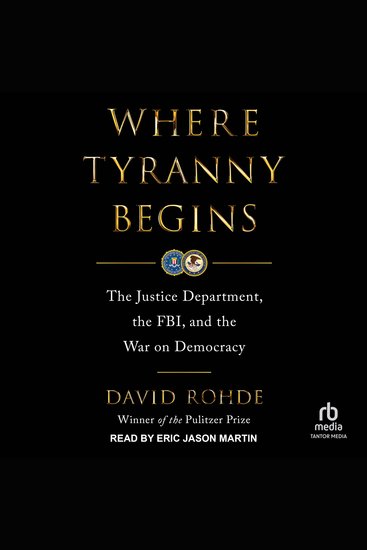
  • Where Tyranny Begins - The Justice Department the FBI and the War on Democracy - cover

    Where Tyranny Begins - The...

    David Rohde

    • 0
    • 0
    • 0
    Over the course of his presidency, Donald Trump intimidated, silenced, and bent to his will Justice Department and FBI officials. He sowed public doubt in both agencies so successfully that when he tried to overturn the results of the 2020 election, he paid little political cost and, despite an unprecedented array of criminal indictments, easily won the Republican nomination for the 2024 presidential election. 


    In Where Tyranny Begins, Pulitzer Prize–winning journalist David Rohde investigates the strategies Trump systematically used to turn the country's two most powerful law-enforcement agencies into his personal political weapons. Rohde also reveals how, during the Biden years, Justice Department non-partisan 1970s norms that Attorney General Merrick Garland reinforced inadvertently helped Trump, and could fail to deliver a trial and legal accountability by Election Day 2024. 


    Where Tyranny Begins exposes how ill-suited both the DOJ and FBI are to serve as checks on abuses of presidential power. A round of historic reforms equivalent to the post-Watergate reforms that stabilized American democracy in the 1970s are immediately needed. A five-word warning coined by the English philosopher John Locke in 1689 captures the stakes in 2024: "Where-ever law ends, tyranny begins."
    Show book
  • The Mythology of the Slavs - Folk Tales and Legends from Eastern Europe - cover

    The Mythology of the Slavs -...

    Odessa Nightshade

    • 0
    • 0
    • 0
    Slavic mythology is a rich and complex tradition that has been shaped by centuries of oral storytelling, cultural exchanges, and historical transformations. Rooted in the beliefs of ancient Slavic tribes, this mythology reflects a deep connection to nature, a reverence for powerful deities, and a world teeming with spirits, gods, and legendary heroes. Unlike the more widely documented mythologies of the Greeks and Romans, Slavic myths were primarily passed down through oral tradition, making them fluid and ever-evolving. As a result, variations exist across different Slavic nations, yet common themes and figures remain central to the mythology as a whole.  
    The natural world played a crucial role in shaping Slavic beliefs. The Slavs were deeply tied to the cycles of the seasons, the power of the sun, and the mysteries of the forests and rivers. Deities like Perun, the god of thunder, and Veles, the god of the underworld, represented the dual forces of order and chaos, life and death. Forest spirits like the Leshy guarded the woods, while the Rusalka, eerie water nymphs, were believed to lure unsuspecting travelers to a watery grave. These myths not only explained the forces of nature but also provided a spiritual framework for daily life.  
    Storytelling was the primary means of preserving these myths. Legends were shared around fires, during village gatherings, and at seasonal festivals. Oral tradition allowed for constant reinterpretation, with each storyteller adding new details to fit the cultural and historical context of their time. Folklore heroes, such as Ilya Muromets and Dobrynya Nikitich, emerged as symbols of courage and perseverance, their tales reinforcing the values of strength, loyalty, and wisdom. These stories also carried moral lessons, cautioning against greed, deceit, and disrespect for the natural and supernatural world. 
    Show book
  • Treating Adult Children of Emotionally Immature Parents - A Clinician's Guide - cover

    Treating Adult Children of...

    PsyD Lindsay C. Gibson

    • 0
    • 0
    • 0
    If you treat clients who grew up with an emotionally immature, unavailable, or self-involved parent, you know the lingering feelings of anger, loneliness, betrayal, or abandonment these clients experience. This comprehensive guide goes beyond mechanistic prescriptions to show you how to help clients not only recover but to also restart their own personal growth and self-actualization process. 


    In Treating Adult Children of Emotionally Immature Parents, psychologist and New York Times bestselling author Lindsay C. Gibson draws on more than thirty years of clinical experience as a psychotherapist and outlines a unique approach to treating a common syndrome that shapes the lives of so many people seeking therapy. Gibson shares her perspectives on the goals of therapy, and what therapists need to know in order to provide the most effective interventions. Using these insights, you can help your clients heal from feelings of loneliness and abandonment, improve confidence, decrease reactivity to emotionally immature behavior, find healthy ways to stop self-sacrificing and meet their own emotional needs, and rediscover their true selves. 


    By helping clients free themselves from the effects of emotionally immature people, you'll help them to create healthy, positive relationships that uplift them and improve their quality of life.
    Show book
  • Absolute Tao - Subtle is the way to love happiness and truth - cover

    Absolute Tao - Subtle is the way...

    Osho

    • 0
    • 0
    • 0
    Moving beyond the usual interpretations of this classic Chinese text - that of using it as an indicator of what to do next or attempting to predict the future - Osho is using the Tao Te Ching as Lao Tzu intended: to ignite the flame of individual awareness and insight. His commentaries on these seven verses burn through every idea we may hold about ourselves until we can see with the same crystal-clear light as Lao Tzu.
    Tao, like Osho, is the way of wholeness: not dividing or denying anything, simply remaining choiceless and aware. You will find yourself listening to this series as if it were a waterfall; as you listen, you will come to understand the emptiness that puts us in touch with the eternal and makes bliss and ecstasy possible.
    
    - On the Absolute Tao
    - Ordinariness
    - On the Character of Tao
    - Emptiness
    - On the Danger of Overweening Success
    - There Is No Meaning
    - On the Utility of Not-Being
    - Witnessing
    - On the Wise Ones of Old
    - Wisdom and Understanding
    
    © & ℗ 1975 OSHO International Foundation
    Show book
  • Training Oliver - a gay love story - cover

    Training Oliver - a gay love story

    Jason Fronde

    • 0
    • 0
    • 0
    In the sun-soaked Florida paradise of the Royal Palms beach resort, the cute young British Gabe Tinsdale is working as poolside waiter and bartender. Where he serves numerous cocktails to the handsome young Southern charmer Oliver Hunter, as he lounges showing his stunning body off by the pool. Gabe navigates the delicate line between the hotel guest and something more with Oliver. While Oliver is drawn to the very attractive but reserved Gabe, finding the way to his heart a puzzle he wants to solve. 
    After weeks of playful flirtation, Oliver dares Gabe to step out of his comfort zone and go on a date. Sharing a secluded beach and a romantic surprise picnic under the stars, the two young men find themselves explore their budding connection. Opening up with each other Gabe must to learn let his guard down, as he begins to train Oliver about new possibilities… Together, they embark on a journey of self-discovery, intimacy, and the promise of love, and a very big unexpected surprise from the shy British Gabriel.
    Show book