Join us on a literary world trip!
Add this book to bookshelf
Grey
Write a new comment Default profile 50px
Grey
Subscribe to read the full book or read the first pages for free!
All characters reduced
Eradicating Nationalism - A Comprehensive Assessment of the Causes and Solutions - cover

Eradicating Nationalism - A Comprehensive Assessment of the Causes and Solutions

Pasquale De Marco

Publisher: Publishdrive

  • 0
  • 0
  • 0

Summary

In an era marked by rising nationalism, this book offers a timely and thought-provoking examination of one of the most powerful and enduring forces in human history.

Nationalism, at its core, is a belief in the superiority of one's nation over all others. This belief can manifest in a variety of ways, from a sense of national pride to aggressive expansionism. Throughout history, nationalism has been a driving force behind both progress and conflict. It has inspired people to fight for freedom and independence, but it has also been used to justify imperialism, ethnic cleansing, and genocide.

In recent years, nationalism has experienced a resurgence around the world. This resurgence is often attributed to a combination of factors, including economic inequality, political instability, and the rise of social media. As people feel increasingly disconnected from their governments and communities, they are turning to nationalism as a source of identity and belonging.

This book delves into the multifaceted nature of nationalism, examining its historical roots, its psychological and sociological underpinnings, and its impact on the world we live in today. Through a comprehensive analysis of nationalism's various forms, drivers, and consequences, this book provides a deeper understanding of this complex phenomenon.

By gaining a deeper understanding of nationalism, we can better equip ourselves to navigate the challenges it poses and harness its potential for positive change. This book offers a nuanced perspective on nationalism, exploring both its positive and negative aspects, and providing insights into how we can mitigate its risks while fostering its potential for unity and progress.

With its rigorous analysis and accessible writing style, this book is an essential read for anyone seeking to understand the complexities of nationalism in the 21st century. It is a valuable resource for scholars, policymakers, and general readers alike, offering a deeper understanding of one of the most powerful forces shaping our world today.


If you like this book, write a review!
Available since: 06/02/2025.
Print length: 163 pages.
Other books that might interest you

  • The Art of War - cover

    The Art of War

    Niccolò Machiavelli

    • 0
    • 0
    • 0
    ""The Art of War" is a treatise by the Italian Renaissance political philosopher and historian Niccolò Machiavelli. Written between 1519 and 1520, it was published the following year and remains one of his most important works. Unlike the more widely read "The Prince" and "The Discourses", this book focuses specifically on military matters.    Here are the key features of "The Art of War":    Format: The book takes the form of a Socratic dialogue. Lord Fabrizio Colonna, perhaps Machiavelli's persona, declares the purpose at the outset: "To honor and reward virtù, not to have contempt for poverty, to esteem the modes and orders of military discipline, to constrain citizens to love one another, to live without factions, to esteem less the private than the public good." The military is likened to the roof of a palazzo protecting its contents.  Setting: The dialogues occur in the Orti Oricellari, classical-style gardens built by Bernardo Rucellai in the 1490s for Florentine aristocrats and humanists. The discussions take place between Cosimo Rucellai and "Lord Fabrizio Colonna," with other patrizi and captains of the recent Florentine republic.  Fabrizio's Wisdom: Fabrizio is enamored with the Roman Legions of the early to mid Roman Republic. He advocates adapting their strategies to the contemporary situation of Renaissance Florence. His knowledge dominates the discussions, often turning them into monologues where he details how an army should be raised, trained, organized, deployed, and employed.  Practical Insights: Machiavelli's theories are not merely theoretical; they are based on his observations during his fourteen years as secretary to the Chancery of Florence. He reported on the size, composition, weaponry, morale, and logistical capabilities of the most effective militaries of his day.  "The Art of War" serves as a guide to military leaders, including Frederick the Great and Napoleon, and remains an authoritative treatise on the fundamentals of warfare. Its clear and concise style stands in contrast to that of "The Prince"."
    Show book
  • Fading Footprints - In search of South Africa's first people - cover

    Fading Footprints - In search of...

    José Manuel de Prada-Samper

    • 0
    • 0
    • 0
    That summer afternoon, I had no way of knowing the book would radically alter my existence. Yet that proved to be the case. A wind that had begun to blow from a faraway place a long time ago had finally caught up with me.
    So writes folklorist José Manuel de Prada-Samper about a chance discovery more than thirty years ago of an obscure book called Specimens of Bushman Folklore in a second-hand bookshop in England.
    Part historical detective story, part memoir, Fading Footprints traces the author's journey into the magical folklore of the /xam hunter-gatherers of the Upper Karoo. Through archival research and on field trips in South Africa, de Prada-Samper reveals the tragic scope of the genocide of the /xam San by European colonisers. However, he is also able to humanise the /xam as he delves into the work and lives of researchers Wilhelm Bleek and Lucy Lloyd, who recorded the stories of San prisoners in Cape Town over more than a decade in the late 1800s.
    Determined to seek out the ancient folklore tales, the author travels to forgotten corners of the Northern Cape. There he learns that many stories are still told to this day by farm workers and that, contrary to common belief, the culture and traditions of South Africa's first people are still very much alive. Their footprints may have faded but they have not been erased.
    Show book
  • Worldmask - cover

    Worldmask

    Rabbi Akiva Tatz

    • 0
    • 0
    • 0
    Do you ever wonder what lies behind the mask of this physical world? Do you ever feel that there is more to reality than what meets the eye? Do you ever want to explore the spiritual dimension of existence and discover its secrets? 
    If so, then you will enjoy listening to Worldmask, a bestselling work by Rabbi Akiva Tatz, a renowned expert in Jewish thought and philosophy. In this book, Rabbi Tatz traces some of the Torah themes that express the duality of the world: the outer layer and the inner root. He deals with perplexing philosophical paradoxes, such as the relationship between God and nature, predestination and freewill, and suffering and joy. He shows how the Torah provides us with the keys to unlock the hidden world that exists behind the mask of the physical. 
    Worldmask is a book that will exhilarate and enlighten you, as you journey through the depths of Torah wisdom and uncover the mysteries of creation. It is a book that will challenge and inspire you, as you learn how to apply the Torah’s teachings to your own life and become closer to your Creator. 
    Don’t miss this opportunity to listen to Worldmask, a book that will transform your perspective on reality and reveal the true purpose of your existence.
    Show book
  • The Iraq Wars - A Very Short Introduction - cover

    The Iraq Wars - A Very Short...

    Samuel Helfont

    • 0
    • 0
    • 0
    American wars in Iraq were a defining feature of global politics for almost thirty years. The Gulf War of 1991, the American invasion of Iraq in 2003, and the campaign against the Islamic State beginning in 2014 each had their own logic. Each occurrence was a distinct conflict; however they must not only be considered in isolation. The United States spent the 1990s trying but failing to implement the Gulf War's cease fire agreement. After the terrorist attacks of September 11, 2001, American leaders decided to settle the open-ended aftermath of the Gulf War by launching the Iraq War of 2003. The Iraq War unleashed resistance, civil war, insurgency and eventually the Islamic State in Iraq and Syria. Thus, following the Gulf War, each war was fought to finish the previous conflict. The Iraq Wars, therefore, are perhaps best understood as a chain of events.Academics, journalists, statesmen, and soldiers have produced many library shelves of books on the Iraq Wars. Yet, no short, easily digestible volume exists to synthesize this vast literature of both English and Arabic sources. The Iraq Wars: A Very Short Introduction covers this series of important conflicts as a whole, in a highly succinct and uniquely listenable way.
    Show book
  • Bad Therapy: Unraveling Why Our Youth Struggle Today - "Transform your perspective on youth issues with 'Bad Therapy' an immersive audiobook experience designed for today’s listener!" - cover

    Bad Therapy: Unraveling Why Our...

    Ronan Ashcroft

    • 0
    • 0
    • 0
    Bad Therapy: Unraveling Why Our Youth Struggle Today 
    ⭐⭐ Simplified Guide & Explanations Included ⭐⭐ 
    Are you eager to advance your career and deepen your understanding to effectively address the struggles of today’s youth? 
    Searching for a thorough guide that encompasses everything necessary to empower future generations? 
    Your quest ends here! 
    This guide is your ultimate companion for enhancing your comprehension, implementing your skills, and engaging in practical exercises. With this resource, you're on the path to success. 
    Updated for new insights into understanding struggles to empower future generations effectively. 
    Key features of this enhanced guide include: 
    - In-depth insights into the challenges faced by youth today  
    - Detailed exploration of the factors influencing their struggles  
    - Effective strategies for addressing these issues and providing support  
    Our guide sets itself apart through extensive coverage, which is crucial for your success. Concepts are not merely touched upon; they’re examined with care and depth. 
    Crafted with a clear structure and accessible language, our guide ensures smooth transitions between topics. Say goodbye to convoluted terminology and embrace clear, precise, and accurately conveyed information. 
    So, why wait? Click the BUY NOW button to secure your guide and embark on your journey to effectively empower future generations! 
    Engage with this guide and be a part of the solution toward a brighter future for the next generation!
    Show book
  • Operation Balak: The History of the Weapons Smuggling Operation that Helped Israel Win the 1948 Arab-Israeli War - cover

    Operation Balak: The History of...

    Editors Charles River

    • 0
    • 0
    • 0
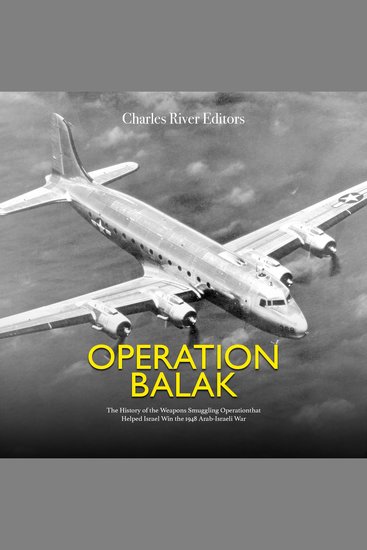
    Less than two weeks after the creation of Israel, the state’s leader, David Ben-Gurion, announced the creation of the Israel Defense Forces (IDF). This represented the combined military forces that would protect the new state, and while it might have sounded impressive on paper, the reality was very different. The new army was comprised mainly of ex-members of several paramilitary organizations that had fought for the establishment of the new state, but they lacked heavy weapons, armor and air defenses. The Israeli navy and air force did not exist other than as largely notional organizations, and at the beginning of 1948, the Israeli Air Force did not possess a single combat aircraft of any type.  
    	To many outsiders, the defeat of the nascent Jewish state seemed a certainty, yet in an unbelievably short space of time, and despite international embargoes on the export of arms to the region, Israel was able to procure sufficient arms to equip its armed forces and to successfully defend its territory in what became known as the War of Independence (also known as First Arab–Israeli War). 
    	This was not the last war that Israel would fight, nor the largest, but its very survival as a state depended on avoiding complete military defeat in 1948. The efforts to do so were tied to a series of secret operations that provided the aircraft and weapons that enabled Israel to survive the First Arab–Israeli War. The smuggling would center on procuring advanced European weaponry, which ironically meant that some of the weapons that reached Israel hailed from none other than Nazi Germany. 
    Show book