Join us on a literary world trip!
Add this book to bookshelf
Grey
Write a new comment Default profile 50px
Grey
Subscribe to read the full book or read the first pages for free!
All characters reduced
Enter the World of Wisdom - Unveiling Ancient Knowledge from the Presocratic Luminaries - cover

Enter the World of Wisdom - Unveiling Ancient Knowledge from the Presocratic Luminaries

Pasquale De Marco

Publisher: Publishdrive

  • 0
  • 0
  • 0

Summary

Embark on an intellectual odyssey through the world of Presocratic philosophy, where the seeds of Western thought were sown. Discover the profound wisdom of ancient luminaries like Parmenides, Heraclitus, Anaximander, and Empedocles, whose inquiries into the nature of reality, knowledge, and human existence continue to resonate today.

In this captivating book, you'll delve into the enigmatic teachings of Parmenides, whose exploration of being and non-being challenged the very foundations of thought. Encounter Heraclitus, the philosopher of flux, who saw the world as a river of constant change. Anaximander's boundless realm of the infinite will reveal the grandeur of the cosmos, while Empedocles' theory of the four roots will unveil the elements that make up all things.

Unravel the paradoxes and enigmas that lie at the heart of Presocratic philosophy. Grapple with fundamental questions that have puzzled humanity for centuries: What is the nature of change and permanence? How are mind and matter related? What is the essence of justice and virtue? Along the way, encounter some of the greatest minds in history, including Socrates, Plato, and Aristotle, who built upon the foundations laid by the Presocratics.

This book is not merely an intellectual exercise; it is an invitation to embark on a journey of self-discovery. The Presocratic philosophers' quest for knowledge and their profound insights into the human condition offer invaluable lessons for navigating the complexities of modern life. Their teachings can help us cultivate wisdom, resilience, and a deeper understanding of our place in the universe.

Join us on this enlightening odyssey as we explore the world of Presocratic philosophy, uncovering the profound wisdom and enduring legacy of these ancient luminaries. Discover how their ideas can illuminate our own lives and inspire us to seek truth, knowledge, and a deeper understanding of the world around us.


If you like this book, write a review!
Available since: 06/02/2025.
Print length: 166 pages.

Other books that might interest you

  • Hollywood’s Favorite Screwball Actresses: The Lives and Legacies of the Women Who Popularized the Comedy Genre - cover

    Hollywood’s Favorite Screwball...

    Editors Charles River

    • 0
    • 0
    • 0
    “If I couldn't laugh, I'd rather die.” – Claudette Colbert 
    The 1930s were the height of the classical Hollywood era, known for lavish studio productions by heavyweights like MGM, RKO, Warner Brothers, Paramount, and 20th Century Fox, which were operating at the height of their powers. Every major studio possessed a long roster of contract players, and films were released at such a rapid pace that it made for an especially competitive environment within the industry. Even while America remained in the throes of the Great Depression, the film industry continued to flourish, and movies easily supplanted the theater as the main attraction for American entertainment. Indeed, it would be no exaggeration to claim that the film industry reached its zenith during the decade precisely because it offered an affordable (if very temporary) escape from the anxieties of the economic woes of the era. 
    When the American Film Institute ranked its top 50 screen legends of the 20th century, many of the people named had careers spanning several decades, but one of them managed the feat despite living less than three decades. Ranked as the 22nd greatest actress of the 20th century, Jean Harlow was on the screen for less than 10 years, but in that time the “Blonde Bombshell” became the most popular actress of the 1930s, eclipsing superstars like Joan Crawford and Norma Shearer along the way. In fact, the platinum blonde accomplished that feat as a leading lady for just five years before her premature death of renal failure at the age of 26. 
    Carole Lombard has been memorialized in many fitting ways as an actress, and one of her biggest contributions to Hollywood was the blond archetype that the film industry used successfully for decades in screwball comedies, paving the way for the success of women like Marilyn Monroe. Perhaps the most remarkable aspect of that fact is that it was actually based on Carole’s gushing personality. 
    Show book
  • The Lion House - The Coming of a King - cover

    The Lion House - The Coming of a...

    Christopher de Bellaigue

    • 0
    • 0
    • 0
    "Christopher de Bellaigue has a magic talent for writing history. It is as if we are there as the era of Suleyman the Magnificent unfolds." —Orhan Pamuk, Winner of the Nobel Prize for Literature Narrated through the eyes of the intimates of Suleyman the Magnificent, the sixteenth-century sultan of the Ottoman Empire, The Lion House animates with stunning immediacy the fears and stratagems of those brought into orbit around him: the Greek slave who becomes his Grand Vizier, the Venetian jewel dealer who acts as his go-between, the Russian consort who becomes his most beloved wife.Within a decade and a half, Suleyman held dominion over twenty-five million souls, from Baghdad to the walls of Vienna, and with the help of his brilliant pirate commander Barbarossa placed more Christians than ever before or since under Muslim rule. And yet the real drama takes place in close-up: in small rooms and whispered conversations, behind the curtain of power, where the sultan sleeps head to toe with his best friend and eats from wooden spoons with his baby boy.In The Lion House, Christopher de Bellaigue tells not just the story of rival superpowers in an existential duel, nor of one of the most consequential lives in human history, but of what it means to live in a time when a few men get to decide the fate of the world.A Macmillan Audio production from Farrar, Straus and Giroux.
    Show book
  • How to Survive in Ancient Greece - cover

    How to Survive in Ancient Greece

    Robert Garland

    • 0
    • 0
    • 0
    What would it be like if you were transported back to Athens 420 BCE? This time-traveler's guide is a fascinating way to find out . . . 


    Imagine you were transported back in time to Ancient Greece and you had to start a new life there. What would you see? How would the people around you think and believe? How would you fit in? Where would you live? What would you eat? What work would be available, and what help could you get if you got sick? 


    All these questions, and many more, are answered in this engaging blend of self-help and survival guide that plunges you into this historical environment—and explains the many problems and strange new experiences you would face if you were there.
    Show book
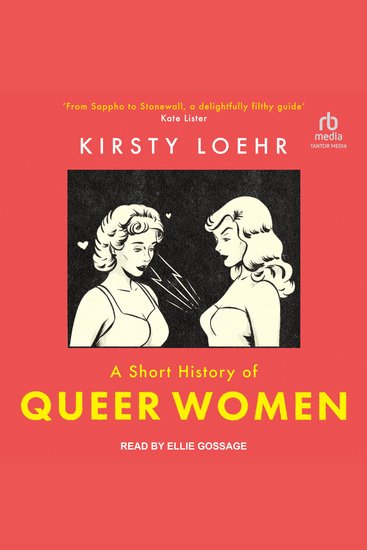
  • A Short History of Queer Women - cover

    A Short History of Queer Women

    Kirsty Loehr

    • 0
    • 0
    • 0
    Queer women have always existed—let's put them back in the history books 


    No, they weren't "just friends!" 


    Queer women have been written out of history since, well, forever. "But historians famously care about women!," said no one. From Anne Bonny and Mary Read who sailed the seas together disguised as pirates, to US football captain Megan Rapinoe declaring "You can't win a championship without gays on your team," via countless literary salons and tuxedos, A Short History of Queer Women sets the record straight on women who have loved other women through the ages. 


    Who says lesbians can't be funny?
    Show book
  • Tripped - Nazi Germany the CIA and the Dawn of the Psychedelic Age - cover

    Tripped - Nazi Germany the CIA...

    Norman Ohler

    • 0
    • 0
    • 0
    “A fleet-footed and propulsive account . . . Brilliantly sifting a massive history for its ideological through lines, this is a must-read."" — Publishers Weekly (starred review) 
    The author of the New York Times bestseller Blitzed returns with a provocative new history of drugs and postwar America, examining the untold story of how Nazi experiments into psychedelics covertly influenced CIA research and secretly shaped the War on Drugs.  
    Berlin 1945. Following the fall of the Third Reich, drug use—long kept under control by the Nazis’ strict anti-drug laws—is rampant throughout the city. Split into four sectors, Berlin's drug policies are being enforced under the individual jurisdictions of each allied power—the Soviet Union, Britain, France, and the US. In the American zone, Arthur J. Giuliani of the nascent Federal Bureau of Narcotics is tasked with learning about the Nazis’ anti-drug laws and bringing home anything that might prove “useful” to the United States. 
    Five years later, Harvard professor Dr. Henry Beecher began work with the US government to uncover the research behind the Nazis psychedelics program. Begun as an attempt to find a “truth serum” and experiment with mind control, the Nazi study initially involved mescaline, but quickly expanded to include LSD. Originally created for medical purposes by Swiss pharmaceutical Sandoz, the Nazis coopted the drug for their mind control military research—research that, following the war, the US was desperate to acquire. This research birthed MKUltra, the CIA's notorious brainwashing and psychological torture program during the 1950s and 1960s, and ultimately shaped US drug policy regarding psychedelics for over half a century. 
    Based on extensive archival research on both sides of the Atlantic, Tripped is a wild, unconventional postwar history, a spiritual sequel to Norman Ohler’s New York Times bestseller Blitzed. Revealing the close relationship and hidden connections between the Nazis and the early days of drugs in America, Ohler shares how this secret history held back therapeutic research of psychedelic drugs for decades and eventually became part of the foundation of America’s War on Drugs.
    Show book
  • Second Treatise of Government - cover

    Second Treatise of Government

    John Locke

    • 0
    • 0
    • 0
    The Second Treatise of Government is a political treatise written by English philosopher John Locke in 1689. It is considered one of the most important works on political philosophy, as it presents Locke's ideas on the natural rights of individuals and the proper role and limits of government in a society based on the consent of the governed. 
    In the Second Treatise, Locke argues that all individuals have natural rights to life, liberty, and property, which cannot be taken away by any authority, including the government. These rights are inherent and universal, and are not granted by any social contract or agreement. 
    Locke also argues that governments are formed by the consent of the governed, and are therefore obligated to protect the natural rights of their citizens. He asserts that the purpose of government is to promote the common good, and that governments that fail to do so may be overthrown by the people. 
    Moreover, Locke suggests that there are limits to the power of government, and that individuals have the right to resist or even overthrow a government that becomes tyrannical or violates their natural rights. 
    The Second Treatise of Government has had a significant impact on political theory and the development of democratic governance. It influenced the United States Declaration of Independence and the Constitution, as well as many other constitutions around the world.
    Show book