Join us on a literary world trip!
Add this book to bookshelf
Grey
Write a new comment Default profile 50px
Grey
Subscribe to read the full book or read the first pages for free!
All characters reduced
A Spatial Tapestry - Unveiling Patterns in Our World - cover

A Spatial Tapestry - Unveiling Patterns in Our World

Pasquale De Marco

Publisher: Publishdrive

  • 0
  • 0
  • 0

Summary

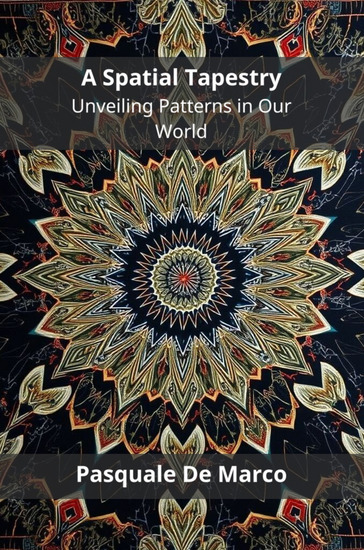
In a world awash with data, spatial data stands out as a unique and powerful resource, holding the key to understanding the patterns and processes that shape our world. Spatial data analysis is the art of transforming this raw data into actionable insights, revealing hidden connections and illuminating the unseen forces that drive human and environmental systems.

This comprehensive guide to spatial data analysis empowers you to unlock the transformative power of spatial data, providing a thorough grounding in the fundamentals and guiding you through the latest techniques and applications. Delve into the concepts of spatial relationships, patterns, and processes, and discover the statistical methods and geospatial technologies used to analyze spatial data.

With real-world examples drawn from a wide range of disciplines, this book brings spatial data analysis to life. Explore how spatial analysis is used to address pressing challenges in public health, crime prevention, resource management, and urban planning. Learn how to use spatial data to understand the spread of diseases, optimize emergency response, identify crime hotspots, allocate resources efficiently, and create sustainable communities.

More than just a technical manual, this book is an invitation to think spatially, to see the world through the lens of space and time. It is a call to action, urging you to use spatial data to make informed decisions and create a better future for all.

Whether you are a student, researcher, practitioner, or simply someone with a curious mind, this book is your gateway to the fascinating world of spatial data analysis. Embark on this journey of discovery and uncover the hidden stories hidden within the fabric of space.


If you like this book, write a review!
Available since: 06/02/2025.
Print length: 164 pages.

Other books that might interest you

  • Messalina - A Story of Empire Slander and Adultery - cover

    Messalina - A Story of Empire...

    Honor Cargill-Martin

    • 0
    • 0
    • 0
    This is the story of Messalina – third wife of Emperor Claudius and one of the most notorious women to have inhabited the Roman world. 
     
    The scandalous image of the Empress Messalina as a ruthless and sexually insatiable schemer, derived from the work of Roman historians such as Tacitus and Suetonius, has taken deep root in the Western imagination. The stories they told about her included nightly visits to a brothel and a twenty-four-hour sex competition with a prostitute. Tales like these have defined the empress's legacy, but her real story is much more complex. 
     
    In her new life of Messalina, the classicist Honor Cargill-Martin reappraises one of the most slandered and underestimated female figures of ancient history. Looking beyond the salacious anecdotes, she finds a woman battling to assert her position in the overwhelmingly male world of imperial Roman politics – and succeeding. Intelligent, passionate, and ruthless when she needed to be, Messalina's story encapsulates the cut-throat political manoeuvring and unimaginable luxury of the Julio-Claudian dynasty in its heyday. 
     
    Cargill-Martin sets out not to 'salvage' Messalina's reputation, but to look at her life in the context of her time. Above all, she seeks to reclaim the humanity of a life story previously circumscribed by currents of high politics and patriarchy.
    Show book
  • Delusion and Dream - cover

    Delusion and Dream

    Sigmund Freud

    • 0
    • 0
    • 0
    Freud examines the similarities and differences between the two mental states, and argues that delusions can be understood as a kind of waking dream. He also discusses the role of wish fulfillment in both dreams and delusions, and suggests that they both provide insight into the unconscious mind. Additionally, Freud analyzes specific cases of delusions, including religious delusions and paranoid delusions, and discusses their psychological significance. Overall, "Delusion and Dream" provides a thought-provoking examination of the workings of the human mind and the relationship between conscious and unconscious mental states. Read in English, unabridged.
    Show book
  • Ethics of Redistribution The: Book Summary & Analysis - cover

    Ethics of Redistribution The:...

    Briefly Summaries

    • 0
    • 0
    • 0
    This is a concise summary and analysis of The Ethics of Redistribution, by 
    Bertrand de Jouvenel.
     
    It is not the original book and is not affiliated with or endorsed by Bertrand de Jouvenel.
    Ideal those seeking a quick and insightful overview.
     
    In The Ethics of Redistribution, the author delves into the philosophical and economic implications of wealth redistribution, challenging commonly held assumptions about equality and social justice. The book explores the ethical boundaries of government intervention in economic systems, questioning whether redistributive policies truly benefit society or hinder individual freedoms and innovation. Through incisive arguments and historical examples, this work provides a thought-provoking critique of the role of the state in shaping economic fairness, making it an essential read for anyone interested in political philosophy, economics, or public policy.
    Show book
  • Following Caesar - From Rome to Constantinople the Pathways That Planted the Seeds of Empire - cover

    Following Caesar - From Rome to...

    John Keahey

    • 0
    • 0
    • 0
    In 66 BC, young, ambitious Julius Caesar, seeking recognition and authority, became the curator of the Via Appia. He borrowed significant sums to restore the ancient highway. It was a way to curry favor from Roman citizens in villages along the route, built from Rome to Brindisi between 312-191 BC. After achieving greatness in Rome and the far reaches of Gaul, he led armies along this road to battle enemies in Roman civil wars. And then, across the Adriatic Sea, he joined Via Appia's sister road, the Via Egnatia that began in today's Albania. Other armies followed these two roads that eventually connected Rome to Byzantium, today's Istanbul. In the early second century AD, the emperor Trajan charted a new coastal route between Benevento and Brindisi, later called the Via Traiana. 


    Today, short stretches of the original three roads can be seen in the ruins of ancient Roman cities, now preserved as archaeological wonders, and through the countryside near, and sometimes under, modern highways. Following those routes is the purpose of treading along the path that Caesar and so many others took over the early centuries. Modern eyes, seeing through the mists of more than two thousand years of history, lead the traveler along these three roads coursing through six countries between Rome and Istanbul.
    Show book
  • Mass Murderers - Biographies of Some of the Most Heartless Men in History - cover

    Mass Murderers - Biographies of...

    Kelly Mass

    • 0
    • 0
    • 0
    This is a special combo, including multiple titles, which are about the following subjects: 
    1 - Oliver Cromwell: The reason why people thought he was so evil, is because of his brutality against the Irish at that time. Several Irish and English scholars agree that Cromwell was too cruel in Ireland. Other academics blame him of 'ethnic cleansing,' or the systematic expulsion of a certain ethnic population from a territory. It typically entails the execution and deportation of Catholics, and that he is despised by Irish Catholics. 
    2 - Enver Pasha: It doesn’t seem like Enver Pasha was a good man. His war crimes have caused the deaths of millions of innocent citizens. Sure, during a war and a collapsing empire, you try to do what you can to stop losing, but I doubt anyone in the right mind can justify his actions, which included the slaughter of minorities in the Ottoman Empire during World War 1, and even the Armenian Genocide, which consisted of releasing prisoners upon the Armenian population to have their way and abuse, murder, rape, and pillage. Deportation of Armenians to remote areas, away from their homes, caused many to starve, drown, or become severely ill. And to this day, the Turkish government is still somewhat reluctant to acknowledge the severity of that historical atrocity. 
    3 - Benito Mussolini: Ironically, when we think of fascism, we often look at someone as brutal and influential as Adolf Hitler, but the word “fascism” originated from Italian. The ideology that was carried out in the vicious Spanish War right before World War 2, and was embraced by Nazi Germany, was actually pushed and more or less invented by the Italians during a critical time in history when many changes were made, and when fear and uncertainty were all in the air. Mussolini was efficient and influential. He was a fearless leader not to be trifled with. Let’s take a look at what he did and why.
    Show book
  • How To Make People Laugh: Learn To Develop Confidence and Improve Your Humor - cover

    How To Make People Laugh: Learn...

    Christopher Rothchester

    • 0
    • 0
    • 0
    Have you ever asked yourself how you can make people laugh? 
    The undoubted answer is by developing a sense of humor. There's no greater way to make people happy than by making them laugh, and improving your humor can be as easy as putting on a funny mask. 
    The time and effort you spend developing your sense of humor will pay off in countless little ways. You will be able to make people laugh at pretty much anything, whether it's yourself or other people, especially those who are more awkward than you are. It can help with crowd work and socializing too. 
    This audiobook will help you develop a funny mask, or at least some of the key elements that you might need to be able to make people laugh. 
    In this audiobook, you learn how to develop different joke styles and your own sense of humor, how to astutely perceive situations, how you can take risks and still come away with the laughs, and how you can use your sense of humor as a tool for learning from others. 
    This audiobook will cover:The science of charisma.How you can develop confidence and charisma.The role of body language in the equation.The role of personality in the types of jokes and delivery.Guidance for great improv.Examples of possible improv responses.And much more! 
    You will learn about the psychology of humor and how you can use it to your advantage. You'll also be able to develop a new way of doing crowd work, as well as perform better in social situations. As time goes on, you'll also be able to use that same way of thinking in other aspects of your life. This audiobook is going to help you become better at making people laugh, and it's something that you can use not only when you're on stage, but whenever you're around other people.
    Show book