Begleiten Sie uns auf eine literarische Weltreise!
Buch zum Bücherregal hinzufügen
Grey
Einen neuen Kommentar schreiben Default profile 50px
Grey
Jetzt das ganze Buch im Abo oder die ersten Seiten gratis lesen!
All characters reduced
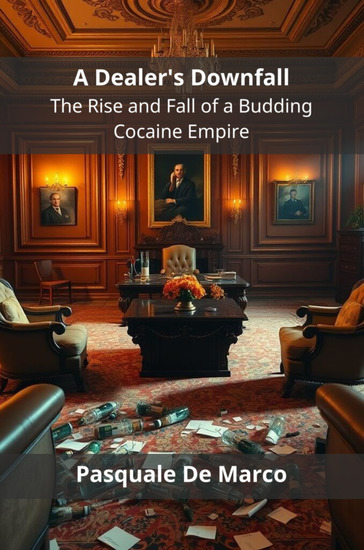
A Dealer's Downfall - The Rise and Fall of a Budding Cocaine Empire - cover

A Dealer's Downfall - The Rise and Fall of a Budding Cocaine Empire

Pasquale De Marco

Verlag: Publishdrive

  • 0
  • 0
  • 0

Beschreibung

In the heart of academia, where one would least expect to find vice, a group of Ivy League students succumb to the allure of easy money and embark on a perilous journey into the world of cocaine trafficking. Led by the ambitious and charismatic Larry Lavin, they establish a sophisticated drug empire that brings them immense wealth and power.

But as their operation expands, so does the danger. The FBI closes in, determined to bring down the young kingpins. Caught in a web of deceit and treachery, Larry and his cohorts must navigate a treacherous landscape of informants, undercover agents, and rival gangs, all while desperately trying to stay one step ahead of the law.

As the stakes rise and the walls close in, the true nature of their pursuit becomes clear. The pursuit of wealth and power corrupts their souls, turning them against each other and leading them down a path of self-destruction. Friendships are tested, loyalties are questioned, and the consequences of their actions reverberate through their lives and the lives of those around them.

In this gripping tale of ambition, greed, and the pursuit of the American Dream gone awry, the rise and fall of these Ivy League drug lords serves as a cautionary tale about the dangers of succumbing to temptation and the devastating impact it can have on individuals and society as a whole.


If you like this book, write a review!
Verfügbar seit: 02.06.2025.
Drucklänge: 157 Seiten.

Weitere Bücher, die Sie mögen werden

  • Urban Crime and Safety - Understanding and Addressing Issues - cover

    Urban Crime and Safety -...

    Lyric Vale

    • 0
    • 0
    • 0
    Urban crime is a complex and pervasive issue that affects millions of people across the globe. As cities continue to grow and evolve, the challenges of maintaining safety and reducing criminal activity become more pressing. Urban areas, often characterized by dense populations, diverse social dynamics, and limited resources, can create an environment where crime thrives. These cities face a unique set of circumstances that contribute to the rise of criminal activities, ranging from petty theft to violent crimes. The relationship between urban crime and safety is multifaceted and requires a comprehensive understanding of its causes, impact, and the strategies necessary for effective crime prevention. 
    The rise in urban crime can be attributed to several factors, including social inequality, economic disparity, inadequate law enforcement, and environmental design issues. High levels of poverty, unemployment, and lack of education in certain neighborhoods often serve as breeding grounds for criminal behavior. In many urban centers, individuals with limited opportunities turn to crime as a means of survival or social mobility. The breakdown of social networks and a lack of community cohesion further exacerbate these challenges, making it difficult to foster a sense of security and mutual trust among residents. 
    Urban crime also places a significant strain on local law enforcement and public resources. Police departments are often overwhelmed by the volume and diversity of crimes that occur in cities. Additionally, urban environments may present logistical challenges for law enforcement agencies, such as limited manpower, insufficient technology, and high crime concentrations in certain areas. This can lead to delayed responses, reduced effectiveness, and strained relations between law enforcement and the communities they serve.
    Zum Buch
  • The Monsters We Make - Murder Obsession and the Rise of Criminal Profiling - cover

    The Monsters We Make - Murder...

    Rachel Corbett

    • 0
    • 0
    • 0
    A riveting work of true crime that tells the strange story of criminal profiling from Victorian times to our own. 
      
    Criminal profiling—the delicate art of collecting and deciphering the psychological “fingerprints” of the monsters among us—holds an almost mythological status in pop culture. But what exactly is it, does it work, and why is the American public so entranced by it? What do we gain, and endanger, from studying why people commit murder? In The Monsters We Make, author Rachel Corbett explores how criminal profiling became one of society’s most seductive and quixotic undertakings through five significant moments in its history. 
      
    Corbett follows Arthur Conan Doyle through the London alleyways where Jack the Ripper butchered his victims, depicts the tailgate outside of Ted Bundy’s execution, and visits the remote Montana cabin where Ted Kaczynski assembled his antiestablishment bombs. Along the way emerge the people who studied and unraveled these cases. We meet self-taught psychologist Henry Murray, who profiled Adolf Hitler at the request of the U.S. government and later profiled his own students—including the future Unabomber—by subjecting them to cruel humiliation experiments. We also meet the prominent Yale psychiatrist Dorothy Lewis, who ended up testifying that Bundy was too sick to stand trial. Finally, Corbett takes the story into our own time, explaining the rise of modern “predictive policing” policies through a study of one Florida family that the analytics targeted—to devastating effects. 
      
    With narrative intrigue and deft research, Corbett delves deep into the mythology and reality of criminal profilers, revealing how thin the line can be separating those who do harm and those who claim to stop it. 
      
    “Corbett [is] a gifted storyteller … A highly readable, endlessly revealing primer on the homicidal mind.”—Kirkus Reviews (starred review)
    Zum Buch
  • Mexican Drug Cartels - Their Origins Their Background and Their Conflicts - cover

    Mexican Drug Cartels - Their...

    Kelly Mass

    • 0
    • 0
    • 0
    The Mexican drug war, also known as the Guerra contra el narcotráfico en México, is the Mexican theater of the global war on drugs, a campaign led by the United States federal government. This war has resulted in a protracted, asymmetric low-intensity conflict between the Mexican government and various drug trafficking organizations. The Mexican government’s main objective when it intervened militarily in 2006 was to curb drug-related violence, which had escalated in the preceding years. The government’s stated aim, in collaboration with U.S. officials, was to eliminate the cartels and reduce the demand for drugs trafficking. 
    Violence erupted after the 1989 arrest of Miguel Ángel Félix Gallardo, who was the leader and founder of Mexico’s first major drug cartel, the Guadalajara Cartel. His arrest led to the dissolution of the cartel as high-ranking members splintered off to create their own groups. This fragmentation gave rise to the Sinaloa, Juarez, Tijuana, and Sonora cartels, among others, which began to battle for control over lucrative trafficking routes and territories. This marked a new chapter in the drug war, with the cartels becoming increasingly violent in their efforts to secure dominance. 
    Mexican drug trafficking organizations have been a powerful force for decades, but their power surged significantly in the 1990s after the collapse of the Colombian Cali and Medellín cartels. By 2007, Mexican criminal groups controlled an overwhelming 90% of the cocaine entering the United States. Efforts to arrest cartel leaders, including those in the Tijuana and Gulf cartels, often resulted in even more violence, as smaller gangs competed for control over key drug trade routes into the U.S.
    Zum Buch
  • Pain Bleeds Crime - cover

    Pain Bleeds Crime

    Pamela Nathan

    • 0
    • 0
    • 0
    True stories from a forensic psychologist in prisons and out.  
     
     
    ‘The most dangerous people I met weren’t monsters. They were broken children wearing adult faces.’ 
     
    Pamela Nathan, clinical and forensic psychologist and psychoanalytic psychotherapist, uncovers the inner worlds of society’s most dangerous and broken—whether behind bars or hidden in plain sight. 
     
    In Pain Bleeds Crime, she shares twenty-three gripping true stories from her decades working in maximum-security prisons, courts, and forensic hospitals. The crimes are shocking—murder, rape, paedophilia, assault, fetishism, bestiality, and more—but what lies beneath is often even more confronting. 
     
    Each offender, whether male, female or transgender, reveals a hidden world shaped by trauma, pain, and silence. Pamela enters these inner worlds to feel and then to have revealed the internal crime scenes, to see what made them break—mentally, emotionally, morally. These aren’t excuses. They’re revelations. 
     
    You’ll come face-to-face with people whose crimes horrified the public—people who insist they’re not violent, or that “it just happened”—and come face-to-face with the dark truth: the past never really goes away. With unflinching honesty and rare insight, Pamela shows how the past never really stays buried—and how behind every act of violence, there’s a story waiting to be told. 
     
    Brutally honest, deeply unsettling, and impossible to forget, Pain Bleeds Crime is a journey into the darkest parts of humanity. 
     
     
    ‘Mad, bad, or sad—when we listen to the story, we see the person.’ 
     
     
    ‘A chilling exploration of the trauma and pain behind the most heinous crimes.’
    Zum Buch
  • In Search of the Romanovs - A Family’s Quest to Solve One of History’s Most Brutal Crimes - cover

    In Search of the Romanovs - A...

    Peter Sarandinaki

    • 0
    • 0
    • 0
    In 1918 a famed general of the Russian White Army battled through the Red Army to save Emperor Nicholas II—but he arrived too late. The Romanovs had already been murdered. 


    In this thrilling true-life detective story, we follow Anna, the general's courageous young daughter, who fled across the continent and boarded a ship with her husband to escape the bloodshed. Beneath her bunk was a box, and in this box lay grisly evidence of what had become of Russia's royal family, the Romanovs. Generations later, Anna's grandson Peter Sarandinaki set out to finish his great-grandfather's mission to find the Romanovs' remains, enlisting searchers and scientists to finally piece together the answers to some of history's most perplexing questions: What really happened to Tsar Nicholas, Empress Alexandra, and their children? And what about the tsar's brother, Mikhail, who simply disappeared? 


    A riveting and deeply personal story, In Search of the Romanovs reveals hidden truths in the legends about the murder and disappearance of Russia's most famous royal family.
    Zum Buch
  • Al Capone: The Greatest Mafia Boss in History - cover

    Al Capone: The Greatest Mafia...

    Waleed Saleh

    • 0
    • 0
    • 0
    This audiobook is narrated by an AI Voice.   
    Al Capone: The Greatest Mafia Boss in History presents the definitive account of America's most notorious criminal legend. This compelling biographical narrative traces the extraordinary journey of Alphonse "Al" Capone from his childhood in Brooklyn's impoverished Italian neighborhoods to his reign as the undisputed emperor of Chicago's criminal underworld. 
    During the tumultuous Prohibition era, Capone didn't just break laws—he rewrote them. With monthly revenues exceeding $100 million (equivalent to over $1.3 billion today), his organization operated like a corporate empire, complete with hierarchical management, strategic expansion, and systematic corruption of government officials. This book reveals how Capone managed to control approximately 60% of Chicago's police force and government officials, essentially running a shadow state within America's third-largest city. 
    The narrative explores the complex contradictions of Capone's character: the ruthless killer who was also a devoted family man, the terrorist who played Robin Hood to Chicago's poor, and the criminal mastermind who ultimately fell not to rivals' bullets but to tax evasion charges. Through detailed accounts of the infamous "Beer Wars," the St. Valentine's Day Massacre, and the political machinations that enabled his rise, readers witness both the seductive allure and devastating consequences of unchecked power. 
    More than just a crime story, this book serves as a profound study of American society during one of its most transformative periods. It examines how immigration, economic disparity, and flawed government policies created the perfect storm for organized crime to flourish. The tragic conclusion—Capone's mental deterioration from syphilis and his pathetic final years—offers sobering lessons about the ultimate futility of power built on violence and corruption.
    Zum Buch