Join us on a literary world trip!
Add this book to bookshelf
Grey
Write a new comment Default profile 50px
Grey
Subscribe to read the full book or read the first pages for free!
All characters reduced
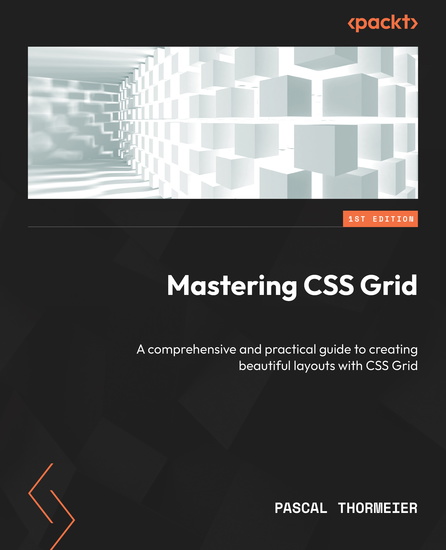
Mastering CSS Grid - A comprehensive and practical guide to creating beautiful layouts with CSS Grid - cover

Mastering CSS Grid - A comprehensive and practical guide to creating beautiful layouts with CSS Grid

Pascal Thormeier

Publisher: Packt Publishing

  • 0
  • 0
  • 0

Summary

CSS Grid has revolutionized web design by filling a long-existing gap in creating real, dynamic grids on the web. This book will help you grasp these CSS Grid concepts in a step-by-step way, empowering you with the knowledge and skills needed to design beautiful and responsive grid-based layouts for your web projects.
This book provides a comprehensive coverage of CSS Grid by taking you through both fundamental and advanced concepts with practical exercises. You'll learn how to create responsive layouts and discover best practices for incorporating grids into any design. As you advance, you'll explore the dynamic interplay between CSS Grid and flexbox, culminating in the development of a usable responsive web project as a reference for further improvement. You'll also see how frameworks utilize CSS Grid to construct reusable components and learn to rebuild and polyfill CSS Grid for browsers that don't fully support it yet. The concluding chapters include a quick reference and cheat sheet, making this book an indispensable resource for frontend developers of all skill levels.
By the end of this book, you'll have thoroughly explored all aspects of CSS Grid and gained expert-level proficiency, enabling you to craft beautiful and functional layouts for web projects of any size.
Available since: 06/09/2023.
Print length: 330 pages.
Other books that might interest you

  • The AI Execution System - How Leaders Turn AI from Hype into Real Business Results - cover

    The AI Execution System - How...

    Peter Mesarec

    • 0
    • 0
    • 0
    The AI Execution System is a practical leadership guide for companies that want to turn AI into measurable business results. 
    Based on real-world implementation experience across more than 150 organizations, Peter Mesarec introduces a structured framework for identifying AI opportunities, improving workflows, reducing manual work, and building an AI-first company. 
    This audiobook goes beyond AI theory and focuses on practical execution. You will learn how leaders can approach AI adoption responsibly, identify high-impact opportunities, avoid common implementation mistakes, and create momentum across teams. 
    Inside the book, you will discover: 
    - How to identify repetitive work suitable for AI 
    - How to prioritize AI projects using practical frameworks 
    - How to reduce manual work without losing control 
    - How to build internal AI adoption across departments 
    - How to approach AI responsibly and strategically 
    This is not a technical AI book for developers. It is a practical system for leaders, managers, and companies that want to move from AI experimentation to real execution. 
    About the Author 
    Peter Mesarec is the founder and director of SEOS AI, where he works with leadership teams on practical AI implementation, operational efficiency, and organizational transformation. 
    He has helped more than 150 companies identify where artificial intelligence can create measurable business impact across workflows, communication, decision-making, and internal operations. 
    Peter has delivered more than 500 executive workshops and strategic AI programs across more than 10 countries, working with organizations such as the Bank for International Settlements, Krka, Kolektor, AMZS, government institutions, and multinational companies. 
    His work focuses on helping organizations move from AI experimentation to structured execution in a practical, sustainable, and measurable way.
    Show book
  • Your Stone Age Brain in the Screen Age - Coping with Digital Distraction and Sensory Overload - cover

    Your Stone Age Brain in the...

    MD Richard E. Cytowic

    • 0
    • 0
    • 0
    An award-winning neurologist on the Stone-Age roots of our screen addictions, and what to do about them.The human brain hasn't changed much since the Stone Age, let alone in the mere thirty years of the Screen Age. That's why, according to neurologist Richard Cytowic—who, Oliver Sacks observed, "changed the way we think of the human brain"—our brains are so poorly equipped to resist the incursions of Big Tech: They are programmed for the wildly different needs of a prehistoric world. In Your Stone Age Brain in the Screen Age, Cytowic explains exactly how this programming works—from the brain's point of view. What he reveals in this book shows why we are easily addicted to screen devices; why young, developing brains are particularly vulnerable; why we need silence; and what we can do to push back.In the engaging storytelling style of his popular TED Talk, Cytowic draws an easily comprehensible picture of the Stone Age brain's workings—the function of neurotransmitters like dopamine in basic instincts for survival such as desire and reward; the role of comparison in emotion, and emotion in competition; and, most significantly, the orienting reflex, one of the unconscious circuits that automatically focus, shift, and sustain attention. Given this picture, the nature of our susceptibility to digital devices becomes clear, along with the possibility of how to break their spell.Full of practical actions that we can start taking right away, Your Stone Age Brain in the Screen Age offers compelling evidence that we can change the way we use technology, resist its addictive power over us, and take back the control we have lost.
    Show book
  • Bleeding Fabulous - the life of a haemosexual - cover

    Bleeding Fabulous - the life of...

    Mark Ward

    • 0
    • 0
    • 0
    The story of how a boy came to be infected with blood borne viruses, and in spite of multiple death sentences, lived to become the world's first ever LGBTQ+ Ambassador for Haemophilia.
    'Faced daily with my own mortality, I chose to live fabulously—each of my fifty-five years has been full of love, laughter, adventure… and feather boas.'
    Mark Ward is the founder of Haemosexual—an online support and information resource championing equality, education and better healthcare for everyone with a bleeding disorder, no matter what their sexual orientation. Mark's battle to secure a public enquiry into the Infected Blood Scandal—which is finally due to report in May—has led him to places he never expected, and to meet people he never dreamt of.
    'Mark is a survivor, literally, of the HIV visited upon him through contaminated blood, but rather than merely revelling in the simple fact of life, he has heroically dedicated himself to ensuring life remains possible for others.'—Sam Stein KC
    This forthright (and fabulous) memoir, recounts the journey of an unlikely lad from Letchworth who grows up to be a renowned and respected rights campaigner. With foreword by Sam Stein KC.
    'This is a remarkable book—brave, funny and honest. Ward is a gifted writer with a profound story to tell and he does it beautifully.' — Peter Moffat
    'This is a story of one of the worst cover ups of our time, and the author's part in the fight to expose it, but it is also the story of a human being who managed to live a life filled with joy despite the mistreatment he endured. An inspirational tale.' — Elkan Abrahamson, Director of Covid Enquiry Department, Jackson Lees Law Group
    'This is a profound and important book from a courageous individual who has lived through the darkest episode of medical history, and contributed to the resolution for the thousands impacted in the UK' — Brian O'Mahony, CEO of Irish Haemophilia Society
    Show book
  • Stories Dice and Rocks That Think - How Humans Learned to See the Future–and Shape It - cover

    Stories Dice and Rocks That...

    Byron Reese

    • 0
    • 0
    • 0
    What makes the human mind so unique? And how did we get this way? 


    This fascinating tale explores the three leaps in our history that made us what we are—and will change how you think about our future. 


    Look around. Clearly, we humans are radically different from the other creatures on this planet. But why? Where are the Bronze Age beavers? The Iron Age iguanas? In Stories, Dice, and Rocks That Think, Byron Reese argues that we owe our special status to our ability to imagine the future and recall the past, escaping the perpetual present that all other living creatures are trapped in. 


    Envisioning human history as the development of a societal superorganism he names Agora, Reese shows us how this escape enabled us to share knowledge on an unprecedented scale, and predict—and eventually master—the future. 


    Thoughtful and witty, this must-listen book unravels our history as an intelligent species in three acts. A fresh new look at the history and destiny of humanity, listeners will come away from Stories, Dice, and Rocks That Think with a new understanding of what they are—not just another animal, but a creature with a mastery of time itself.
    Show book
  • Healing Water Sounds: Babbling Brooks & Flowing Rivers for Deep Sleep Meditation & Stress Relief - Nature’s Serenity—Tranquil Waters to Soothe Your Mind Calm Your Soul & Guide You into Restful Sleep - cover

    Healing Water Sounds: Babbling...

    Mindful Moments - Nature Sounds...

    • 0
    • 0
    • 0
    Healing Water Sounds: Babbling Brooks & Flowing Rivers for Deep Sleep, Meditation & Stress Relief


    Close your eyes and let the world melt away. Imagine a gentle stream winding through a lush green valley, its crystal-clear waters whispering secrets only nature knows. The steady, soothing flow of a river carries away the weight of your thoughts, while the soft babbling of a brook wraps around you like a warm embrace.


    This is not just another background sound—this is a sanctuary, a return to something primal and pure. A place where your mind slows, your heart softens, and your breath deepens. Whether you’re seeking deep, uninterrupted sleep, a moment of peaceful meditation, or simply an escape from the noise of modern life, these flowing waters will guide you back to your natural rhythm.


    Why This  Audiobook?
     
    - Authentic, untouched nature – no artificial enhancements, just the pure voice of water.- Scientifically proven to calm the nervous system – let the steady flow ease stress and quiet the mind.
     
    - Perfect for sleep, meditation, focus, or simply unwinding – let these waters carry you to a place of stillness.


    Let go. Listen. Breathe. Be.
    Show book
  • The Universal Timekeepers - Reconstructing History Atom by Atom - cover

    The Universal Timekeepers -...

    David J. Helfand

    • 0
    • 0
    • 0
    Atoms are unfathomably tiny. It takes fifteen million trillion of them to make up a single poppy seed—give or take a few billion. And there's hardly anything to them: atoms are more than 99.9999999999 percent empty space. Yet scientists have learned to count these slivers of near nothingness with precision and to peer into their internal states. In looking so closely, we have learned that atoms, because of their inimitable signatures and imperturbable internal clocks, are little archives holding the secrets of the past. 


    David J. Helfand reconstructs the history of the universe—back to its first microsecond 13.8 billion years ago—with the help of atoms. He shows how, by using detectors and reactors, microscopes and telescopes, we can decode the tales these infinitesimal particles tell, answering questions such as: Is a medieval illustrated prayer book real or forged? How did maize cultivation spread from the highlands of central Mexico to New England? What was Earth's climate like before humans emerged? Where can we find clues to identify the culprit in the demise of the dinosaurs? When did our planet and solar system form? Can we trace the births of atoms in the cores of massive stars or even glimpse the origins of the universe itself?
    Show book