Join us on a literary world trip!
Add this book to bookshelf
Grey
Write a new comment Default profile 50px
Grey
Subscribe to read the full book or read the first pages for free!
All characters reduced
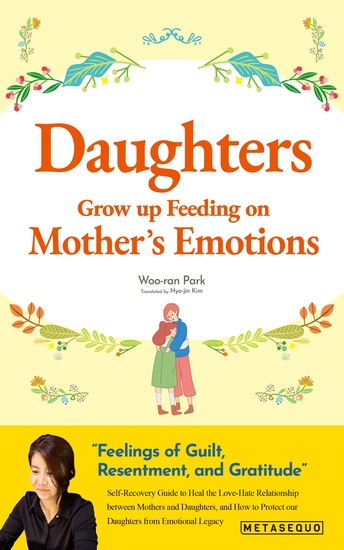
Daughters Grow up Feeding on Mother’s Emotions - Self-Recovery Guide to Heal the Love-Hate Relationship between Mothers and Daughters and How to Protect our Daughters from Emotional Legacy - cover

Daughters Grow up Feeding on Mother’s Emotions - Self-Recovery Guide to Heal the Love-Hate Relationship between Mothers and Daughters and How to Protect our Daughters from Emotional Legacy

Park Woo-ran

Translator Kim Hyo-jin

Publisher: METASEQUO

  • 0
  • 0
  • 0

Summary

“Mother is Mother, Daughter is Daughter”- A self-recovery guide for all mothers and daughters by a psychoanalytic expert- How mothers can reclaim their lives as an independent women and human beingsWhy do mothers turn more to their daughters than sons when feeling upset or distressed? Why do mothers look upon their happily married daughters with not just pride but a hint of jealousy? Why do daughters, when thinking about their mothers, feel gratitude as well as guilt and resentment?We need to lose our mothers to find ourselves. And we need to find ourselves for our daughters to live their own lives. Woo-ran Park, a psychoanalytic expert who for more than ten years has conducted over 10,000 psychotherapy and dream interpretation sessions, reaches deep into psychology research and case studies to unlock the secret behind the love-hate relationship between mothers and daughters and explain how we can protect our girls from this emotional wounding across generations.Many reasons lie behind the mother’s obsession with her daughter and the daughter’s inability to break free from this hold. But the author pays particular attention to the female tendency to attain self-realization by meeting the unmet needs of others. Mothers typically see the son or husband as the other and try to satisfy their needs, but when it comes to the daughter, who they see as their equivalent, they’re more likely to make demands. Likewise, daughters identify with the mother and see the mother’s emotions as her own. This is what makes the mother-daughter relationship so complicated: the daughter is angry at the mother who is full of demands but gives little love, and wants to hate her but can’t.This deep psychological bond between the mother and daughter starts to show cracks as they become older, introducing problems, both big and small, into their lives. Feelings of obsession, bitterness, resentment, longing, and gratitude get rolled into one and make the two oscillate between love and hate. In short, the mother and daughter have failed to create a healthy distance between themselves.Then what can we do? Park says we should question the social concept of unconditional motherly love and try to bring to surface the mom’s deeply-buried wants and desires as a woman. Only then can we forge a path different from our mother’s and our daughters live a different life from our young selves. The author walks us through the main conduits through which the mother’s unconscious is passed onto the daughter—emotions, gaze, unmet needs, maternal love, husband—and how we can reclaim ourselves as not just a woman but as a human being.This book will help you to learn the Psychology for Mothers, Daughters and all of women, and recover yourself:Feelings of Guilt, Resentment, and Gratitude - About Female EmotionsDaughters Grow up Feeding on Mother’s Emotions - About Mother’s EmotionsAm I Really My Child’s Mother? - About the Maternal GazeI Wanted to Be Mom’s Loving Daughter - About the Mother’s Unmet NeedsAll Mothers are Strong? - About Maternal LoveMoms Be Moms, Dads Be Dads - About Our HusbandsMoms are Human Too - About the Mother’s RecoveryNOW GET THE BOOK! And start growing your skills to strengthen your relationships between MOMs and DAUGHTERs!
Available since: 06/17/2022.
Print length: 312 pages.
Other books that might interest you

  • The Joy of Fish - cover

    The Joy of Fish

    Wang Dongyue, Translated by...

    • 0
    • 0
    • 0
    Do you know what truth or subsistence means to humanity? 
    What does wisdom or knowledge mean to humanity? 
    Do you really believe humanity has a choice for its future? 
    If you are unsure of the answers to these questions, the short essays in this book may give you a better idea. This book consists of thirty essays that talk about how civilized human beings think, believe, and behave toward truth, goodness, wisdom, and knowledge from different perspectives. These essays were written in a humorous style, allowing readers to easily get a glimpse of the author's philosophical ideas while avoiding difficult philosophical demonstrations.
    Show book
  • A Just Economy in Times of Global Crisis - cover

    A Just Economy in Times of...

    Timo Plutschinski

    • 0
    • 0
    • 0
    The world was and is in many areas in a turmoil: pandemic, war, energy scarcity, wheat price explosion, and many others. And everything is either impacted or has an impact on global economy. And on the top of it: Christians are in the midst of it. Therefore it matters how Christians think about the economy and act in the economy. It informs their choices as consumers and voters as well as entrepreneurs.The many crises also laid bare the injustices of our economic system and demonstrated that change is necessary. This publication presents reflections and ideas of Christians how to engage and bring change in our economy in light of these challenges. The many writers who contributed to this publication present their ideas from different angles. Nevertheless they clearly also converge when it comes to the direction we need to take.This book has been edited by Rev. Timo Plutschinski, Director of the World Evangelical Alliance´s Business Coalition.
    Show book
  • 10-Minute Summary of "EMOTIONAL INTELLIGENCE - Why It Can Matter More Than IQ” by Daniel Goleman - cover

    10-Minute Summary of "EMOTIONAL...

    Daniel Goleman

    • 0
    • 0
    • 0
    In his book “Emotional Intelligence: Why It Can Matter More Than IQ”, Daniel Goleman explores the importance of emotional skills in personal, professional, and social life. He argues that emotional intelligence (EI) is a crucial factor for success and well-being, often more influential than intelligence quotient (IQ). 
    Through examples, case studies, and scientific analysis, Goleman breaks down the components of EI and its impact on various aspects of life, challenging the traditional view that separates reason from emotion and emphasizing the need to integrate both in education and society.  
    Additionally, Goleman examines how emotional intelligence influences decision-making. According to him, emotions play a crucial role in the decision-making process, helping us quickly assess situations and make decisions based on past experiences. 
    For example, “emotional hijacking” is a phenomenon in which the amygdala, a part of the brain associated with emotions, takes control and triggers impulsive responses before the neocortex, the brain's rational part, can fully process the information. While useful in emergencies, this mechanism can lead to hasty decisions in modern contexts.  
    Goleman also discusses the importance of emotional intelligence in preventing antisocial and criminal behaviors. According to the author, many problematic behaviors, such as aggression and delinquency, are linked to low emotional intelligence. 
    People who lack emotional skills often struggle to manage their impulses and empathize with others, which can lead to destructive behaviors. Goleman cites studies showing that violent criminals often have a history of emotional neglect and lack of attention in childhood, emphasizing the importance of early emotional education.  
      
     
    Show book
  • The Japanese Way of Parenting - And What It Taught Me About Raising (Mostly) Calm Caring Capable Kids - cover

    The Japanese Way of Parenting -...

    Lisa Katayama

    • 0
    • 0
    • 0
    In this fascinating half-memoir, half-parenting guide, Lisa Katayama shares her quest to raise her American kids using Japanese parenting principles which combine unconditional love with unwavering rules While Bringing Up Bébé introduced readers to the French way of raising obedient children who are seen but not heard, and Battle Hymn of the Tiger Mother shared an in iron-will parental approach to creating high-achieving kids, Lisa Katayama’s Parenting the Japanese Way brings the principles of Japanese parenting to Americans, emphasizing unconditional love, community, and harmony with nature, to nurture children who are well-behaved, respectful, and creative.  Japan is well known for its culture of respect, technological innovations, delicious food, peaceful vibes, and deep connection to nature. The source code to all of it is the way the Japanese view childhood--as a time of rigorous training for societal participation, where they learn from the start that are just one part of a larger whole. Katayama takes readers along with her as she travels back and forth from her motherland of Tokyo to the East Bay of California to expose her two American, mixed-race kids to the Japanese way of parenting. Readers will be inspired to take some of her insights--the importance of routine and ritual or the benefits of simplified spaces or the power in making everyday things cute  -- and adopt them into their own parenting, no matter where they live.
    Show book
  • Burning Horizon - British Veteran Accounts of the Iraq War 2003 - cover

    Burning Horizon - British...

    Julian Whippy

    • 0
    • 0
    • 0
    “Burning Horizon reminds us how British and American servicemen and women train together, learn together, and, when called upon, fight together to defeat threats to our common values.” -General James N. Mattis, US Marine Corps (retired)Codenamed Operation Telic, the British component of the invasion of Iraq in 2003 was the largest gathering of British troops since the Second World War.  While the British public prepared for the worst as its soldiers were facing weapons of mass destruction, most servicemen and women were under no illusion that they were invading Iraq to rid the people of Saddam Hussein.  While much has been said about WMD and Tony Blair's government, not nearly enough has been heard from those men and women that took part in Operation Telic. Based upon dozens of veteran interviews, personal diaries and archival material, this book tells their stories, in their own words.  From controlling the vast Allied Air Forces at 34,000 feet in an AWACS plane down to submariners beneath the warm waves of the Persian Gulf firing Tomahawk Cruise missiles, from the steaming hot turret of a Challenger Tank as it is peppered with RPGs, to being on your belly in a sandstorm disarming unexploded bombs — these veteran accounts cover the whole spectrum of experiences.  Polarized public opinion and the post-war media portrayal of the war has detracted from what was achieved by these forces, when tasked to do so, often with insufficient or inadequate resources. These are their stories of courage, fortitude, pride, and brotherhood amidst the harsh realities of modern asymmetric warfare.
    Show book
  • Jnana Yoga - The Path of Knowledge - cover

    Jnana Yoga - The Path of Knowledge

    Clarice Bendleton

    • 0
    • 0
    • 0
    Jnana Yoga, often referred to as the "Path of Knowledge," is one of the four primary paths of yoga in the ancient tradition of Vedanta. The word “Jnana” comes from the Sanskrit root “jñā,” meaning knowledge, and Jnana Yoga is specifically concerned with the cultivation of wisdom and the realization of the ultimate truth of existence. Unlike the more physical paths like Hatha Yoga, Jnana Yoga focuses on intellectual discernment and meditation as tools to break through the illusion of the material world and achieve spiritual enlightenment. 
    At the heart of Jnana Yoga lies the pursuit of self-inquiry and the question, "Who am I?" This path asserts that ultimate knowledge, or liberation (moksha), can only be attained by understanding the true nature of oneself, and by discerning the difference between the transient, material world (Maya) and the eternal reality (Brahman). Jnana Yoga emphasizes the principle of non-duality, or Advaita, which teaches that the individual self (Atman) is ultimately one with the divine (Brahman). This realization dispels the illusion of separation between the self and the universe. 
    The path of Jnana Yoga is often described as a mental discipline that requires intense study, reflection, and meditation. It is traditionally taught by a guru, or spiritual teacher, who guides the seeker in their quest for self-knowledge. The guru's role is to help the student distinguish between the real and the unreal, encouraging them to look beyond their attachments, desires, and egos. Scriptures like the Upanishads, Bhagavad Gita, and other Vedantic texts are central to Jnana Yoga, providing the philosophical foundation for its practices.
    Show book