Join us on a literary world trip!
Add this book to bookshelf
Grey
Write a new comment Default profile 50px
Grey
Subscribe to read the full book or read the first pages for free!
All characters reduced
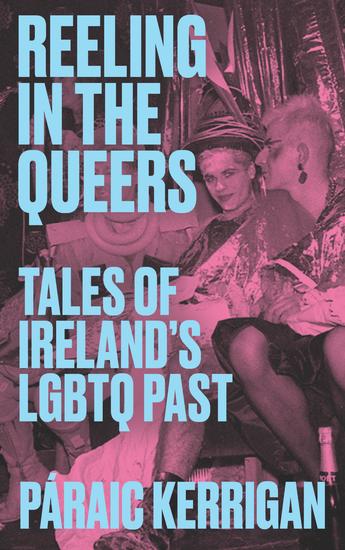
Reeling in the Queers - Tales of Ireland's LGBTQ Past - cover

Reeling in the Queers - Tales of Ireland's LGBTQ Past

Páraic Kerrigan

Publisher: New Island

  • 0
  • 0
  • 0

Summary

Marking fifty years of the founding of an LGBTQ rights movement in Ireland, Reeling in the Queers explores the lesser-known stories of the fight for LGBTQ rights since 1974, beyond decriminalisation and Marriage Equality. From 1990s boy bands to the AIDS priest, Fr Bernárd Lynch, from the Belfast Lesbian Line to proud parenting, from the earliest Pride events to the last days of Alternative Miss Ireland, fourteen distinct moments map the changing social and cultural landscape of Ireland.
These stories, from across the island of Ireland – and further afield – celebrate a strong community and its allies, and speak across the generations. Together, they tell a new story of the gains, losses, devastation and community rising from the ashes of defeat. It is a hugely enjoyable and insightful read for both those who lived through this movement and for those who enjoy its benefits today.
Drawing from oral history as well as archives, Reeling in the Queers brings even more to life the great big queer tapestry in Ireland. Queer history in Ireland is Irish history and acknowledging and celebrating the light and the dark of it protects all of our futures as much as our pasts.
 
Available since: 06/07/2024.
Print length: 256 pages.
Other books that might interest you

  • The Whale Hunters - cover

    The Whale Hunters

    Sebastian Junger

    • 0
    • 0
    • 0
    This piece, which appeared in Outside magazine in 1995 and was originally recorded for "Rough Water: Stories of Survival From The Sea," is about an old man, a Bequian harpooner, who uses a wooden sailboat to hunt humpback whales. The piece is an elegy of sorts--an unsentimental lament for something lost.
    Show book
  • Traveling Across America - cover

    Traveling Across America

    Thomas L Millhouse

    • 0
    • 0
    • 0
    The book "Traveling Across America" is designed to be an essential guide for young children, introducing them to the wonders of all 50 states in the United States. Through this book, children will embark on a journey of discovery, learning about the rich history and the unique paths each state took on its way to statehood. This adventure is not just about dates and facts, but about understanding the diverse cultures, significant events, and the iconic landmarks that define each state. By exploring these stories, children will gain a deep appreciation for the collective history that makes up the United States. 
    In addition to the historical journey, "Traveling Across America” highlights the remarkable contributions each state has made, from agricultural innovations to scientific discoveries, and from educational advancements to incredible inventions. The book also showcases famous people and places that have left a lasting impact on the nation. With carefully researched facts and captivating illustrations, this book invites young readers to explore the natural beauty, historical significance, and cultural richness of each state. It's an educational adventure that not only informs but inspires curiosity and a sense of pride in America's diverse heritage. 
    This Book is a must-have collector's item for every child in the United States of America. 
    Thomas Millhouse Arthur 
    Founder & Executive Director 
    Letter Destination & Safety Kids 
    In-School Program
    Show book
  • The Winter's Tale - cover

    The Winter's Tale

    William Shakespeare

    • 0
    • 0
    • 0
    The Winter's Tale is a play by William Shakespeare, originally published in the First Folio of 1623. Although it was grouped among the comedies, some modern editors have relabelled the play as one of Shakespeare's late romances. Some critics consider it to be one of Shakespeare's "problem plays", because the first three acts are filled with intense psychological drama, while the last two acts are comedic and supply a happy ending. The play has been intermittently popular, revived in productions in various forms and adaptations by some of the leading theatre practitioners in Shakespearean performance history, beginning after a long interval with David Garrick in his adaptation called Florizel and Perdita (first performed in 1754 and published in 1756).    The Winter's Tale was revived again in the 19th century, when the third "pastoral" act was widely popular. In the second half of the 20th century The Winter's Tale in its entirety, and drawn largely from the First Folio text, was often performed, with varying degrees of success. Short Summary of the Tale: John Fawcett as Autolycus in "The Winter's Tale" (1828) by Thomas Charles Wageman. Following a brief setup scene the play begins with the appearance of two childhood friends: Leontes, King of Sicilia, and Polixenes, the King of Bohemia. Polixenes is visiting the kingdom of Sicilia, and is enjoying catching up with his old friend. However, after nine months, Polixenes yearns to return to his own kingdom to tend to affairs and see his son. Leontes desperately attempts to get Polixenes to stay longer, but is unsuccessful. Leontes then decides to send his wife, Queen Hermione, to try to convince Polixenes. Hermione agrees and with three short speeches is successful. Leontes is puzzled as to how Hermione convinced Polixenes so easily, and Leontes suddenly goes insane and suspects that his pregnant wife has been having an affair with Polixenes and that the child is a bastard. Leontes orders Camillo, a Sicilian Lord, to poison Polixenes. Camillo instead warns Polixenes and they both flee to Bohemia.    Furious at their escape, Leontes now publicly accuses his wife of infidelity, and declares that the child she is bearing must be illegitimate. He throws her in prison, over the protests of his nobles, and sends two of his lords, Cleomenes and Dion, to the Oracle at Delphi for what he is sure will be confirmation of his suspicions. Meanwhile, the queen gives birth to a girl, and her loyal friend Paulina takes the baby to the king, in the hopes that the sight of the child will soften his heart. He grows angrier, however, and orders Paulina's husband, Lord Antigonus, to take the child and abandon it in a desolate place. Cleomenes and Dion return from Delphi with word from the Oracle and find Hermione publicly and humiliatingly put on trial before the king. She asserts her innocence, and asks for the word of the Oracle to be read before the court. The Oracle states categorically that Hermione and Polixenes are innocent, Camillo an honest man, and that Leontes will have no heir until his lost daughter is found. Leontes shuns the news, refusing to believe it as the truth. As this news is revealed, word comes that Leontes' son, Mamillius, has died of a wasting sickness brought on by the accusations against his mother. Hermione, meanwhile, falls in a swoon, and is carried away by Paulina, who subsequently reports the queen's death to her heartbroken and repentant husband. Leontes vows to spend the rest of his days atoning for the loss of his son and his queen.
    Show book
  • Teachers and translators - Enhancing their Reading and Writing Skills - cover

    Teachers and translators -...

    Graciela Bulleraich

    • 0
    • 2
    • 0
    Teachers and Translators: Enhancing their Reading and Writing Skills recommends that language teachers incorporate the reading and writing connection together with the influence of L1 culture as essential elements to achieve textual competence in the target language. The use of challenging magazine and newspaper articles with post-intermediate and advanced language learners has always been a priority in ESP (English for Specific Purposes). The purpose is to activate students' background knowledge, consolidate their critical thinking skills, raise their awareness in relation to varieties of English, figures of speech and coinages and, at the same time, encourage classroom research in such fields as journalese, legal and business English. Expository essay-writing is also incorporated in the course, following such patterns as the Comparison and Contrast essay and the Classification form
    Show book
  • Nineveh - History of the Ancient Assyrian City - cover

    Nineveh - History of the Ancient...

    Kelly Mass

    • 0
    • 0
    • 0
    Nineveh was an age-old Assyrian city in Upper Mesopotamia, near Mosul in modern-day northern Iraq. It was the capital and biggest city of the Neo-Assyrian Empire, and the world's biggest city for some decades, and is on the eastern bank of the Tigris River. It's now a prevalent name for the portion of Mosul that's on the Tigris' eastern bank, and it is also the name of the nation's Nineveh Governorate. 
    It was the world's largest city for about fifty years till it was sacked by a union of its previous subject tribes, including but not limited to the Babylonians, Medes, Persians, Scythians, and Cimmerians, in the year 612 BC, following a severe period of civil dispute in Assyria. The city was never ever a political or administrative center again, though it was the seat of a Christian bishop by Late Antiquity. Throughout the Middle Ages, it weakened in contrast to Mosul and was mainly deserted by the 13th century AD. 
    In the Bible, it has been mentioned several times, and it is the center of attention in the story of Jonah, who was swallowed up by a whale or fish and spat out on the beach, only to hear from God that he still needed to go to Nineveh and give the people a chance to repent. 
    There is much more to this mysterious city of the ancient. Learn more by reading or listening to this book!
    Show book
  • Ghana Empire - The Land of Gold and the Birth of West African Power - cover

    Ghana Empire - The Land of Gold...

    Rolf Hedger

    • 0
    • 0
    • 0
    The Ghana Empire, also known as Wagadou, emerged as one of the earliest and most influential states in West Africa. Situated in the Sahel region, between the Senegal and Niger rivers, it thrived in an environment that was both challenging and advantageous for settlement and expansion. The Soninke people, who founded the empire, played a crucial role in establishing a political and economic system that allowed Ghana to dominate the region for centuries. 
    The origins of the Ghana Empire can be traced to the migrations and settlements of the Soninke, a Mande-speaking group, who gradually organized themselves into small communities. These communities initially relied on agriculture, herding, and local trade but soon recognized the value of the trans-Saharan trade routes that passed through their territory. The strategic location of Ghana, near valuable gold deposits and trade routes, allowed it to grow into a powerful state. The Soninke clans, under the leadership of a ruling dynasty, established centralized control, which set the foundation for the empire’s expansion. 
    The political structure of early Ghana was based on a hierarchical system, with the king, known as the Ghana, at the top. The title "Ghana" was both a royal designation and a symbol of authority. The king served as the supreme leader, making key decisions related to governance, trade, and military strategy. His power was reinforced by a council of elders and advisors, often drawn from the nobility and influential families. This system enabled stability and continuity, which contributed to the long-term success of the empire.
    Show book