Join us on a literary world trip!
Add this book to bookshelf
Grey
Write a new comment Default profile 50px
Grey
Subscribe to read the full book or read the first pages for free!
All characters reduced
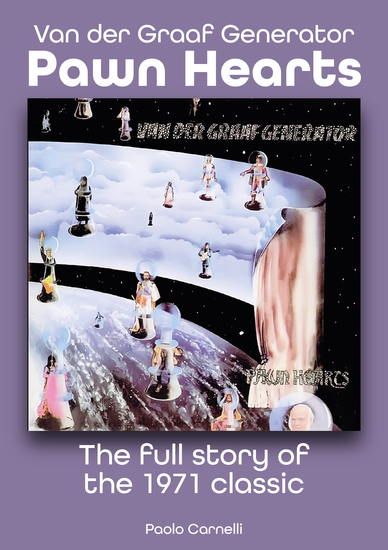
Van der Graaf Generator Pawn Hearts - The full story of the 1971 classic - cover

Van der Graaf Generator Pawn Hearts - The full story of the 1971 classic

Paolo Carnelli

Publisher: Sonicbond Publishing

  • 0
  • 0
  • 0

Summary

It has been more than 50 years since the extraordinary British rock band Van der Graaf Generator released their legendary fourth studio album, Pawn Hearts. It remains a mind-splitting masterpiece that fascinated an entire generation of music lovers. Written by well-known progressive rock author Paolo Carnelli, this is the most extensive treatise of its kind on this seminal 1971 record. Starting with the birth of the Pawn Hearts concept from live band experience, the song rehearsals and eventually the recording of the album material, what follows is a detailed track-by-track musical and lyrical analysis. Specific chapters are dedicated to the making and the meaning of the artwork and to the band's collaboration with King Crimson’s Robert Fripp. The last part of the book deals with the press reaction to the album and the unexpected release of the ‘Theme One' single in 1972. The final chapter contrasts an initial performance of ‘A Plague Of Lighthouse Keepers’ in March 1972 with the band’s 2013 tour, which presented this rarely performed epic once again, and ends with a detailed Pawn Hearts discography. The book is enhanced by a preface by Gary Lucas and some fresh comments from David Jackson, Hugh Banton, Guy Evans, Peter Hammill, Stephen W. Tayler and Paul Whitehead.
 
The authorOne of the most distinguished Italian prog rock journalists, Paolo Carnelli has been writing about music for over 30 years. A devoted researcher of Van der Graaf Generator and Peter Hammill efforts, he already published Van der Graaf Generator - La Biografia Italiana (2013), the first, highly acclaimed biography of the band in Italian, and Behind and Beyond - Le storie dietro le copertine (2022), revealing the stories behind every Van der Graaf Generator cover artwork. He is the Editorial Director of Prog magazine, Italian edition, and he also runs the online webzine Open Magazine.
Available since: 06/26/2025.
Print length: 88 pages.

Other books that might interest you

  • Greatest Detective Shows Volume 6 - Ten Classic Shows from the Golden Era of Radio - cover

    Greatest Detective Shows Volume...

    Various Various

    • 0
    • 0
    • 0
    OASIS AUDIO CLASSIC RADIO SHOWCASE SERIES   Oasis Audio has gone into the vaults and dusted off the very earliest form of audio book, old time radio shows, for our listeners. Introduced episode by episode by Jim Engel, old time radio authority and board member of the Museum of Broadcast Communications in Chicago, this series of classic radio shows is sure to have something for everyone. Celebrity casts and top-notch writers made the 1920s through the early 1950s, the golden era of radio. The series features seven exciting themes with 100 episodes in each. That is 700 classic radio programs in all.   Greatest Detective Shows   Thrill to the hardboiled adventures of Ellery Queen, Philip Marlow, Dragnet, The Man called X, Philo Vance, Rocky Fortune and so many more as heroes fight the bad guys. 100 great Detective classics in ten volumes. Volume 6 Jeff Regan Investigator 1948_12_04 The Lawyer and the LadyLet George Do It 1951_08_27 Murder on VacationLet George Do It 1951_01_08 The Man Behind the FrameThe Line Up 1951_09_05 The Pointless Pierson Polemic Polarity CaseThe Line Up 1951_09_12 The Senile Slugging CaseThe Line Up 1951_10_11 The Frivolous Forger FracasThe Line Up 1951_10_18 The Nicely Nixed Nixon CaseThe Lux Radio Theatre 1943_02_08 The Maltese FalconThe Man Called X 1951_05_11 Roulette SchemeThe Man Called X 1951_06_15 Rubber Sabotage
    Show book
  • Art Matters - Because Your Imagination Can Change the World - cover

    Art Matters - Because Your...

    Neil Gaiman

    • 0
    • 0
    • 0
    A stunning and timely creative call-to-arms combining four extraordinary written pieces by Neil Gaiman. 
     
    “The world always seems brighter when you’ve just made something that wasn’t there before.”—Neil Gaiman 
    Drawn from Gaiman’s trove of published speeches, poems, and creative manifestos, Art Matters is an embodiment of this remarkable multi-media artist’s vision—an exploration of how reading, imagining, and creating can transform the world and our lives. 
    Art Matters bring together four of Gaiman’s most beloved writings on creativity and artistry: “Credo,” his remarkably concise and relevant manifesto on free expression, first delivered in the wake of the Charlie Hebdo shootings“Make Good Art,” his famous 2012 commencement address delivered at the Philadelphia University of the Arts“Making a Chair,” a poem about the joys of creating something, even when words won’t come“On Libraries,” an impassioned argument for libraries that illuminates their importance to our future and celebrates how they foster readers and daydreamers. 
    Art Matters is a stirring testament to the freedom of ideas that inspires us to make art in the face of adversity, and dares us to choose to be bold.
    Show book
  • Fabric - The Hidden History of the Material World - cover

    Fabric - The Hidden History of...

    Victoria Finlay

    • 0
    • 0
    • 0
    A magnificent work of original research that unravels history through textiles and cloth—how we make it, use it, and what it means to us. 


    How is a handmade fabric helping save an ancient forest? Why is a famous fabric pattern from India best known by the name of a Scottish town? How is a Chinese dragon robe a diagram of the whole universe? What is the difference between how the Greek Fates and the Viking Norns used threads to tell our destiny? 


    In Fabric, bestselling author Victoria Finlay spins us round the globe, weaving stories of our relationship with cloth and asking how and why people through the ages have made it, worn it, invented it, and made symbols out of it. And sometimes why they have fought for it. 


    She beats the inner bark of trees into cloth in Papua New Guinea, fails to handspin cotton in Guatemala, visits tweed weavers at their homes in Harris, and has lessons in patchwork-making in Gee's Bend, Alabama. 


    She began her research just after the deaths of both her parents—and entwined in the threads she found her personal story too. Fabric is not just a material history of our world, but Finlay's own journey through grief and recovery.
    Show book
  • The Magic of Modern Art - How to Love Modern & Contemporary Art - cover

    The Magic of Modern Art - How to...

    Robyn Jamison

    • 0
    • 0
    • 0
    This book has one purpose—to offer everyone the opportunity to become as wild about modern and contemporary art as I am. I am committed that your visits to modern and contemporary art exhibits become joyful, enriching experiences that you eagerly anticipate, avidly soak in and never get over. 
    I say that the ability to appreciate art, including every type of art, is innate to all human beings. I have discovered that unlocking this natural love of art has much more to do with clearing out what's in the way than it does with accumulating information. 
    When I look at my own love affair with the art of our time, I see clearly that when I am focused entirely on the art in front of me—setting aside judgment and cognitive thinking—that's when I find myself profoundly moved and deeply satisfied. 
    I have come to the conclusion that the key to unlocking the magic of modern and contemporary art is in the ability to immerse oneself in the art and truly "experience" it. So, the obvious and most vital question becomes, "How does one learn to experience modern and contemporary art?" That is the work of this book. 
    ~Robyn Jamison
    Show book
  • The Hitler Bloodline - Uncovering the Fuhrer’s Secret Family - cover

    The Hitler Bloodline -...

    David Gardner

    • 0
    • 0
    • 0
    The astounding story of the quest to find the living descendants of the most monstrous tyrant in history - Adolf HitlerAdolf Hitler was one of six children born to his mother, and one of eight born to his father from two of his three marriages. Alois Hitler, né Schicklgruber, was an official of the Austrian customs service, and the combination of an imperial uniform and a severe drinking habit seems to have ensured that Hitler's father was a drunken bully given to beating his children if they were not instantly obedient.Alois had two children, Alois junior and Angela, by his second wife, and six by his third, Hitler's mother Clara, of whom four, all boys, died at birth or in infancy. Young Adolf was therefore left with a half-brother, Alois, and half-sister, Angela, and a full sister, Paula, who died in 1960. When Hitler killed himself in April 1945, all his siblings were still living and some had children of their own. So, what happened to them?The answer is that no one was really certain until David Gardner published this book in 2001, having patiently and steadfastly tracked down Hitler's living relations to the USA, and made contact with some of them. Now revised and updated, this is a fascinating study of a little-known side of Hitler's history, as well as a riveting account of how the author traced and contacted the survivors of a bloodline that most of the world probably hoped had become extinct.
    Show book
  • The Atomic Bombings of Hiroshima & Nagasaki - cover

    The Atomic Bombings of Hiroshima...

    Usac Engineers

    • 0
    • 0
    • 0
    On 6 and 9 August 1945, the United States detonated two atomic bombs over the Japanese cities of Hiroshima and Nagasaki respectively. The bombings killed between 129,000 and 226,000 people, most of whom were civilians, and remain the only use of nuclear weapons in an armed conflict. Japan surrendered to the Allies on 15 August, six days after the bombing of Nagasaki and the Soviet Union's declaration of war against Japan and invasion of Japanese-occupied Manchuria. The Japanese government signed the instrument of surrender on 2 September, effectively ending the war.
    Show book