Join us on a literary world trip!
Add this book to bookshelf
Grey
Write a new comment Default profile 50px
Grey
Subscribe to read the full book or read the first pages for free!
All characters reduced
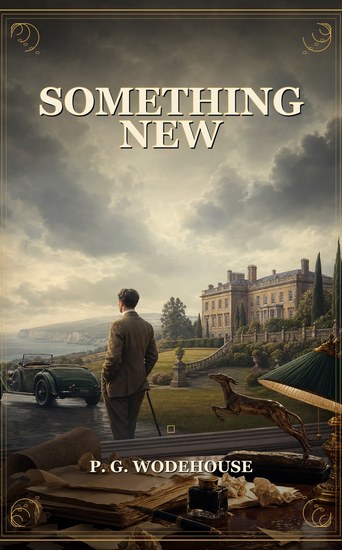
Something New - cover

Something New

P. G. Wodehouse

Publisher: Caelwick Press

  • 0
  • 0
  • 0

Summary

We rely on your support to help us keep producing beautiful, free, and unrestricted editions of literature for the digital age. Will you support our efforts with a donation ? Something New is the first novel of what became known as the "Blandings Castle Saga" by P. G. Wodehouse and was published in the United States in 1915. Two Americans, Ashe Marson and Joan Valentine, endeavor to retrieve a scarab pilfered from an American millionaire by the absent-minded Lord Emsworth. Marson and Valentine soon find themselves impersonating servants while evading the Efficient Baxter. The story was originally serialized in the Saturday Evening Post as Something Fresh in 1915. It introduced who would become the recurring characters of Blandings Castle: Lord Emsworth, Freddie Threepwood, Rupert Baxter, and Sebastian Beach. P. G. Wodehouse (died 1975) was a significant literary figure of the 20th century. Their work has endured across generations and continues to be read and studied worldwide. As a work of classic literary fiction, Something New exemplifies the narrative craft and social insight that defined great storytelling of its era. Literary fiction of this period was characterized by careful attention to character psychology, social milieu, and the moral questions that animated public discourse.
Available since: 05/19/2026.
Print length: 259 pages.
Other books that might interest you

  • The Adolescence of Number Eighty-Seven - cover

    The Adolescence of Number...

    Arthur Stringer

    • 0
    • 0
    • 0
    The Adolescence of Number Eighty-Seven by Arthur Stringer is offered here in a clean English digital edition prepared for fluent ebook reading. The work stands within classics and gives modern readers direct access to a public-domain classic with navigable structure and a restrained typographic presentation. The opening pages establish the book's atmosphere with this first movement: THE prairie drift-snow shrilled and whined under the slowly moving wheels, as the engine and tender for Number Three backed down the ice-hung water-tank. To Web Ross, up in the cab, it sounded loud and ludicrous, like the squealing of a train-load of hungry pigs. In the thermometer against the wall This edition is suited to readers who want a reliable, uncluttered version of the text for study, rediscovery, and sustained reading.
    Show book
  • Mark - cover

    Mark

    Saki Saki

    • 0
    • 0
    • 0
    A witty short story in which author Augustus "Mark" Mellowkent finds himself face to face with an overzealous book salesman.Mark first appeared in The Toys of Peace and Other Papers (1919), the first posthumous publication of Saki (H. H. Munro) following his death during active duty in World War I.
    Show book
  • The Man Who Died Twice - cover

    The Man Who Died Twice

    Edgar Wallace

    • 0
    • 0
    • 0
    The Man Who Died Twice by Edgar Wallace is offered here in a clean English digital edition prepared for fluent ebook reading. The work stands within classics and gives modern readers direct access to a public-domain classic with navigable structure and a restrained typographic presentation. The opening pages establish the book's atmosphere with this first movement: The interval between Acts II and III was an unusually long one, and the three men who sat in the stage box were in such harmony of mind that none of them felt the necessity for making conversation. The piece was a conventional crook play and each of the three had solved the "mystery" of the murder b This edition is suited to readers who want a reliable, uncluttered version of the text for study, rediscovery, and sustained reading.
    Show book
  • The Son of Monte Cristo Volume II of 2 - cover

    The Son of Monte Cristo Volume...

    Alexandre Dumas pere

    • 0
    • 0
    • 0
    It was about the middle of December, 1813, that a solitary horseman was pursuing the road which leads through the Black Forest from Breisach to Freiburg. The rider was a man in the prime of life. He wore a long brown overcoat, reaching to his knees, and shoes fastened with steel buckles. His powdered hair was combed back and tied with a black band, while his head was covered with a cap that had a projecting peak. The evening came, and darkness spread over the valley: the Black Forest had not received its name in vain. A few miles from Freiburg there stands a lonely hill, named the Emperor's Chair. Dark masses of basalt form the steps of this natural throne; tall evergreens stretch their branches protectingly over the hill. A fresh mountain air is cast about by the big trees, and the north wind is in eternal battle with this giant, which it bends but can never break...FROM THE BOOKS.
    Show book
  • Jess - A Novel of the First Boer War - cover

    Jess - A Novel of the First Boer...

    H. Rider Haggard

    • 0
    • 0
    • 0
    The Transvaal, 1880: two English sisters on a Transvaal farm, an English officer both love, and then the war — the siege of Pretoria, a ride through the enemy lines, and a choice made by the sister nobody expected. Haggard was in the Transvaal for the annexation and the war that followed; he wrote this in 1887, and the Boers in it are neither villains nor comedy, which was rare enough in England to be noticed. Fifty-six plates, from Balthasar-Paul Ommeganck to Harry Payne, carry the weather and the marching columns that press on the sisters' story.
    Show book
  • Secret Societies of the Middle Ages - cover

    Secret Societies of the Middle Ages

    Thomas Keightley

    • 0
    • 0
    • 0
    Secret Societies of the Middle Ages is a historical and antiquarian study by Thomas Keightley that examines reports, legends, and traditions about secret societies, mystery cults, and clandestine groups in medieval Europe. The book is not a modern academic analysis in the strict sense; instead, it reflects early 19th-century historical scholarship, combining documented history with folklore, legend, and speculative interpretation. Keightley attempts to trace the existence and influence of hidden or semi-secret organizations during the Middle Ages, including religious sects, mystical brotherhoods, and alleged conspiratorial groups.
    Show book