Join us on a literary world trip!
Add this book to bookshelf
Grey
Write a new comment Default profile 50px
Grey
Subscribe to read the full book or read the first pages for free!
All characters reduced
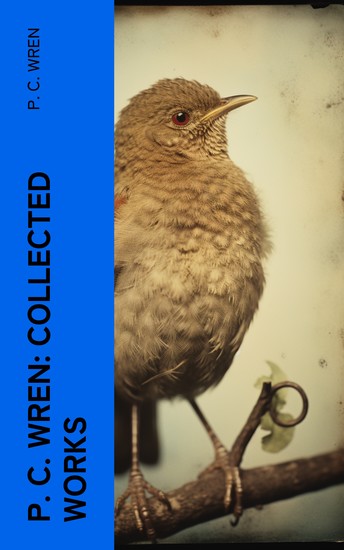
P C Wren: Collected Works - The Wages of Virtue Cupid in Africa Stepsons of France Snake and Sword Driftwood Spars & Biographical Stories of the French Foreign Legion - cover

P C Wren: Collected Works - The Wages of Virtue Cupid in Africa Stepsons of France Snake and Sword Driftwood Spars & Biographical Stories of the French Foreign Legion

P. C. Wren

Publisher: e-artnow

  • 0
  • 0
  • 0

Summary

This unique and meticulously edited collection of P. C. Wren's greatest works includes: The Novels_x000D_ SNAKE AND SWORD_x000D_ THE WAGES OF VIRTUE_x000D_ DRIFTWOOD SPARS_x000D_ CUPID IN AFRICA (The Baking of Bertram in Love and War)_x000D_ Short Stories_x000D_ STEPSONS OF FRANCE_x000D_ Ten little Legionaries_x000D_ À la Ninon de L'Enclos_x000D_ An Officer and—a Liar_x000D_ The Dead Hand_x000D_ The Gift_x000D_ The Deserter_x000D_ Five Minutes_x000D_ "Here are Ladies"_x000D_ The MacSnorrt_x000D_ "Belzébuth"_x000D_ The Quest_x000D_ "Vengeance is Mine..."_x000D_ Sermons in Stones_x000D_ Moonshine_x000D_ The Coward of the Legion_x000D_ Mahdev Rao_x000D_ The Merry Liars_x000D_ Percival Christopher Wren (1875-1941) was an English writer, mostly of adventure fiction. His novels and short stories mostly deal with colonial soldiering in Africa. While his fictional accounts of life in the pre-1914 Foreign Legion are highly romanticized, his details of Legion uniforms, training, equipment and barrack room layout are generally accurate, which has led to suggestions that Wren himself served with the legion.
Available since: 12/12/2023.
Print length: 930 pages.

Other books that might interest you

  • Archaeology of the Anunnaki Sumerians - Revealing Strange Artifacts and Mesopotamia Mysteries - cover

    Archaeology of the Anunnaki...

    Faruq Zamani

    • 0
    • 0
    • 0
    Leonard Woolley, an archaeologist from Britain, returned to Iraq in 1922, almost 4,000 years after the nuclear ancient catastrophe, to uncover ancient Mesopotamia.An imposing ziggurat standing out in the desert plain drew him to the nearby site of Tell el-Muqayyar, where he began excavating. As old walls, artifacts, and inscriptions were unearthed, he realized he was digging up ancient Ur-Ur of the Chaldees. 
    Twelve years of his work were conducted through a joint expedition between the British Museum in London and the University of Pennsylvania Museum in Philadelphia. For those institutions, Sir Leonard Woolley found some of the most dramatic objects and artifacts in Ur. However, what he discovered may well surpass anything ever exhibited before. 
    In the course of removing layers of soil deposited by desert sands, the elements, and time from the ruins, the ancient city began to take shape-here were the walls, there were the harbors and canals, the residential quarters, the palace, and the Tummal, the elevated sacred area. Woolley's discovery of a cemetery dated thousands of years ago included unique 'royal' tombs discovered by digging at its edge is the find of the century.
    Show book
  • Transformative Experience - cover

    Transformative Experience

    L.A. Paul

    • 0
    • 0
    • 0
    Transformative Experience by L.A. Paul challenges the foundations of how we make life's biggest decisions. From becoming a parent to changing careers—or even becoming a vampire in a thought experiment—some choices don’t just alter your circumstances; they change you. Paul introduces the concept of transformative experiences—decisions that are both epistemically transformative (you can’t know what they’re like until you live them) and personally transformative (they change your core values, preferences, or identity). 
     
    Traditional models of rational decision-making assume we can evaluate outcomes based on what we currently value. But what happens when the experience itself reshapes those values? If you can't imagine what the future will feel like, or if your future self values different things, how can you make a rational choice now? 
     
    Blending vivid examples, from parenthood to philosophical thought experiments, Paul explores the limits of foresight, the nature of self, and how we might embrace decision-making not as prediction—but as discovery. Transformative Experience is a groundbreaking work that forces us to rethink autonomy, authenticity, and the very meaning of rational choice.
    Show book
  • How we save the world - The Fight to Rewrite Our Future Begins Now - cover

    How we save the world - The...

    Jack Jay

    • 0
    • 0
    • 0
    How We Save The World by Jack Jay is a manifesto for those eager to reshape humanity’s future. Blending philosophy with actionable wisdom, Jay explores pressing global issues like inequality, environmental damage, and AI ethics. 
    Chapter 1: Introduces a new meta-narrative, emphasizing the need for a better global story. 
    Chapter 2: Explores the rapid evolution of technology. 
    Chapter 3: Discusses how information shapes reality through the butterfly effect. 
    Chapter 4: Outlines pragmatic philosophies for creating effective global movements. 
    Chapter 5: Introduces the concept of the “Prodemic” — viral methods anyone can use to upgrade humanity. 
    Chapter 6/7: Focus on hacking dopamine systems to avoid burnout and redefine laziness. 
    Chapter 8: Advocates for simplicity in self-improvement and avoiding over-optimization. 
    Chapter 9: Addresses the AI alignment problem, offering a solution for humanity to collectively manage the risks of AI. 
    Chapter 10: Redefines consumerism and philanthropy through designer goods purchased via tax-deductible donations. 
    Chapter 11: Introduces “storyhacking” to help individuals start global movements. 
    Chapter 12: Emphasizes long-term thinking in a future dominated by AI. 
    Chapter 13: Presents the concept of "spear ritual wisdom" as a catalyst for positive global change. 
    Chapter 14-16: Dive deeper into leading and sustaining such a movement. 
    Chapter 17: Discusses real-world operations for achieving tipping points in society. 
    Chapter 18: Focuses on the strategy behind global leadership and spear rituals. 
    Chapter 19: Recaps the book’s worldview, offering new solutions and missions for a brighter future. 
    The book combines deep reflections with practical approaches for individuals and movements to spark change, encouraging people to take action in reshaping the world.
    Show book
  • Enduring Art Active Faith - 3 Generations Create! - cover

    Enduring Art Active Faith - 3...

    Robert G. Proudfoot

    • 0
    • 0
    • 0
    The audiobook version of "Enduring Art, Active Faith - 3 Generations Create!" , recorded by Robert G. Proudfoot in April 2023 through Audivita, is an abridged version of the print book by the same name, which was previously published by Robert G. Proudfoot in February 2019 through FriesenPress Inc. The audiobook is comprised of two fictional short stories taken from the print book: "The Guard", and "Half and Half", written originally by Robert G. Proudfoot and Norma Proudfoot, respectively.  
         "The Guard" tells of an unlikely friendship that develops between an expatriate English schoolboy (James Greenburgh) and an African night watchman (Winter Banda), hired to guard the Greenburgh's home in Lusaka, Zambia while James' diplomat father is away in Great Britain, negotiating with Rhodesian and British Governments and black nationalist groups, towards transition to African majority rule for the break-away British colony during the turbulent early 1970s. In "Half and Half", an aging military veteran re-examines the satisfying life he has gained despite difficulties experienced - even with ongoing poverty,  want, and conflict in the world - after he encounters a little boy during the Christmas season in a busy Edmonton shopping mall, who despite so young is coping with disappointments and seeking answers for life's complexities.
    Show book
  • Pearl Harbor - The Attack That Brought America into the Global Conflict - cover

    Pearl Harbor - The Attack That...

    Sage Winters

    • 0
    • 0
    • 0
    The path to the attack on Pearl Harbor was paved by years of escalating tension between Japan, the United States, and other global powers. By the 1930s, Japan had increasingly pursued aggressive territorial expansion in Asia. The country sought to secure resources to fuel its growing industrial machine, leading to its invasion of China and the creation of the Greater East Asia Co-Prosperity Sphere. This expansionist ideology put Japan on a collision course with Western powers, particularly the United States, who had significant economic interests in the Pacific region. 
      
    As Japan moved to solidify its dominance in Asia, the United States responded with growing concern and diplomatic opposition. American policymakers viewed Japan’s actions as a direct threat to regional stability and their own economic interests, especially in China and the Philippines. By the late 1930s, the United States had placed significant economic sanctions on Japan, including an oil embargo that severely limited Japan’s access to vital resources. The embargo further strained relations between the two nations, as Japan’s need for oil and raw materials became critical to its war machine. 
      
    In response, Japan’s leadership became more determined to secure access to Southeast Asia’s oil reserves. The Japanese government began to focus on expanding its influence over the Dutch East Indies, British Malaya, and other territories rich in natural resources. Japan’s growing militarism and its desire for expansion were met with an increasingly isolationist stance from the United States. The U.S. saw Japan’s actions as imperialistic, but its leaders were hesitant to directly intervene, largely due to the isolationist sentiments that permeated American politics following World War I.
    Show book
  • Human All Too Human - cover

    Human All Too Human

    Friedrich Nietzsche

    • 0
    • 0
    • 0
    Step into the labyrinth of the human soul. 
    In Human, All Too Human, Friedrich Nietzsche dismantles illusions with surgical precision, guiding the reader through a world where morality, religion, and culture are re-examined under the piercing light of reason. This landmark work marks Nietzsche’s bold departure from romanticism and metaphysics, heralding his journey into free thought and psychological insight. 
    A cornerstone of modern philosophy, this collection of aphorisms and reflections challenges the very foundations of truth and belief. Explore Nietzsche’s analysis of moral prejudice, where he lays bare the constructed nature of our values. Enter the realm of the “free spirit,” a section devoted to those courageous enough to question inherited convictions. Witness his early critique of art and genius, where even beauty is not immune from inquiry. 
    Nietzsche’s influence on existentialism, psychoanalysis, and 20th-century thought is immeasurable. His words continue to stir minds and provoke debate, as relevant in our turbulent age as they were in his own. 
    Now, for the first time, immerse yourself in his unflinching vision through a pristine AI narration—delivered with crystal clarity, emotional nuance, and unwavering fidelity to the original text. Whether you’re a devoted reader of philosophy or a curious seeker, this audiobook offers a profound and accessible gateway into one of the most daring minds in history. 
    Let Nietzsche’s voice echo in your mind and begin your own philosophical awakening.
    Show book