Join us on a literary world trip!
Add this book to bookshelf
Grey
Write a new comment Default profile 50px
Grey
Subscribe to read the full book or read the first pages for free!
All characters reduced
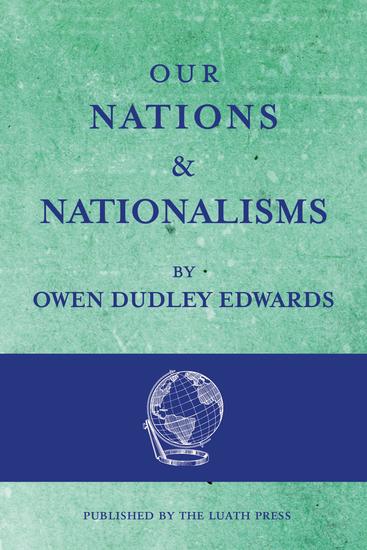
Our Nations and Nationalisms - cover

Our Nations and Nationalisms

Owen Dudley-Edwards

Publisher: Luath Press

  • 0
  • 0
  • 0

Summary

'Nationalism' is an increasingly unpopular word. Few would apply the label of 'nationalist' to themselves, and fewer still to any part of our history before the 1700s. But then, where does it come from? And what does it mean for us today?
With one eye on the present as he unpicks the past, Owen Dudley Edwards finds nationalism to be older than recorded history and broader than modern geography. Our Nations and Nationalisms traces the phenomena back as far as the Old Testament and the works of Homer and Virgil, through the attempts of Shakespeare and James VI & I to found the first British Union, and into the Celtic legends that helped form the identities held in the UK today. 
Taking wide-ranging examples from ancient to modern, from home and abroad, Dudley Edwards interrogates nationalism in action, asking what it really is and how it has impacted upon all of our lives, wherever we live or were born
This demonised word, he argues, is a fact of human nature. It may take a variety of forms, but we are all, in some sense, 'nationalists'; it is incumbent upon each of us to find ways to use this fact in the interests of humanity, and not a single nation. 
Available since: 06/30/2022.
Print length: 320 pages.

Other books that might interest you

  • On the Nature of Things - cover

    On the Nature of Things

    Lucretius

    • 0
    • 0
    • 0
    "On the Nature of Things" by Lucretius is a profound exploration of Epicurean philosophy, blending poetry and science to explain the universe. Lucretius argues that everything is composed of atoms, governed by natural laws rather than divine intervention. He explores themes of existence, free will, and the pursuit of happiness, advocating for a life free from fear of death and superstition. Through vivid imagery and logical reasoning, he dismantles myths, emphasizing the importance of reason and sensory experience. This seminal work critiques materialism and highlights the beauty of the natural world. A cornerstone of classical thought, it invites readers to embrace a rational, tranquil existence rooted in understanding the cosmos and humanity's place within it.
    Show book
  • The Permanent Problem - The Uncertain Transition from Mass Plenty to Mass Flourishing - cover

    The Permanent Problem - The...

    Brink Lindsey

    • 0
    • 0
    • 0
    The advanced capitalist democracies of the 21st century are the richest, freest, healthiest, best educated, and best governed societies in history. Why then does it seem like everything is falling apart? Economic stagnation is spreading, class divisions are deepening, birth rates are collapsing, mental health problems are on the rise, faith in democracy is in decline, and pessimism about the future abounds. 
    In The Permanent Problem, Brink Lindsey argues that these gathering difficulties reflect the stresses and strains of a great and uncompleted historical transition—from mass material prosperity to mass human flourishing. Capitalism's immense productive powers have raised our expectations of what life can be, but for most of us reality is coming up short. What's more, the arrival of mass prosperity has pushed both economic and cultural change in directions that make the transition to mass flourishing much harder to achieve. 
    A much brighter future is possible, and Lindsey charts an intriguing path to get there. There is no need to concoct a radical new social system. Instead, capitalism needs to be refocused on its core mission of extending the technological frontier, and rebalanced through the revitalization of face-to-face communities. Weaving together insights from history, economics, sociology, and philosophy, The Permanent Problem offers a synoptic overview of our fateful present moment and a provocative glimpse at what may lie ahead.
    Show book
  • Beyond the Mountains - An Immigrant's Inspiring Journey of Healing and Learning to Dance with the Universe - cover

    Beyond the Mountains - An...

    Deja Vu Prem

    • 0
    • 0
    • 0
    The powerful story of how an immigrant from the Philippines overcame childhood trauma and an emotionally abusive marriage to find her voice and thrive 


    As a child in a small barrio in the Philippines, Deja Vu Prem faced neglect and physical abuse. At age seventeen, desperate to escape her situation and claim a better life for herself beyond the mountains of her town, she became a mail-order bride and moved to San Francisco. But the challenges of her childhood didn't go away—they merely evolved into the form of her emotionally abusive husband. 


    Cut off from her family and any kind of emotional or financial support, Prem was a prisoner in her own home, unable even to use the phone or check the mail. But she wasn't helpless. Relying on her deep faith and the fire within that had always pushed her to achieve, Prem made the brave decision to escape her situation to provide a better life for herself and her two young children. 


    Recounting Prem's harrowing yet hopeful journey, Beyond the Mountains is a stirring and moving portrait of one immigrant's refusal to be defined as a victim and a testament on finding the strength to forgive in order to reclaim the power that lives within us all.
    Show book
  • World War I on the Ground: The History and Legacy of Life in the Trenches - cover

    World War I on the Ground: The...

    Editors Charles River

    • 0
    • 0
    • 0
    World War I, also known in its time as the “Great War” or the “War to End all Wars”, was an unprecedented holocaust in terms of its sheer scale. Fought by men who hailed from all corners of the globe, it saw millions of soldiers do battle in brutal assaults of attrition which dragged on for months with little to no respite. Tens of millions of artillery shells and untold hundreds of millions of rifle and machine gun bullets were fired in a conflict that demonstrated man’s capacity to kill each other on a heretofore unprecedented scale, and as always, such a war brought about technological innovation at a rate that made the boom of the Industrial Revolution seem stagnant. 
    The enduring image of World War I is of men stuck in muddy trenches, and of vast armies deadlocked in a fight neither could win. It was a war of barbed wire, poison gas, and horrific losses as officers led their troops on mass charges across No Man’s Land and into a hail of bullets. While these impressions are all too true, they hide the fact that trench warfare was dynamic and constantly evolving throughout the war as all armies struggled to find a way to break through the opposing lines. 
    There was another war going on beneath the trenches, a war of tunnels and mines fought by men who didn’t see sunlight for days at a time and who lived in constant fear of cave-ins and enemy detection. These men, who had mostly been miners in civilian life, lived a twilight existence, working long hours in silence and near darkness while great battles raged overhead. They suffered from fatigue, stress, and the knowledge that they could be killed at any time by an unseen enemy. Despite this, they persevered, and the mines they laid under enemy trench systems turned the tide of at least one major battle.
    Show book
  • Urban Economics - Understanding City Growth and Economic Development - cover

    Urban Economics - Understanding...

    Lyric Vale

    • 0
    • 0
    • 0
    Urban economics is the study of how economic forces shape the development, growth, and functioning of cities. In today’s rapidly urbanizing world, understanding the dynamics of urban areas is crucial for policymakers, businesses, and residents alike. Cities are the engines of economic activity, often driving national economies through industrialization, technological advancement, and labor market opportunities. The field of urban economics provides a framework for analyzing the complex interactions between land use, housing markets, transportation, and labor, all of which influence the growth and prosperity of cities. 
    One of the core ideas of urban economics is the concept of agglomeration, which refers to the concentration of people and businesses in a specific area to take advantage of economies of scale, reduced transportation costs, and access to a skilled workforce. This concentration leads to the formation of cities as hubs of economic activity, where services, manufacturing, and innovation thrive. However, agglomeration also brings challenges, such as congestion, pollution, and rising living costs. Urban economists seek to understand these trade-offs and develop policies that can foster economic growth while addressing the negative externalities associated with urbanization. 
    Another fundamental aspect of urban economics is the relationship between urban form and economic performance. Cities are not static entities; they evolve over time as they expand, change in function, and adapt to shifting economic realities. The spatial structure of a city—how land is used, where different activities are located, and the connectivity between various areas—can significantly impact its economic performance. Urban economics explores how factors like zoning laws, infrastructure, and transportation systems influence a city’s efficiency, livability, and overall success.
    Show book
  • Mystical and Magical Societies and Practitioners - cover

    Mystical and Magical Societies...

    Martin K. Ettington

    • 0
    • 0
    • 0
    This book a reference guide to mystical and magical orders around the world. Major religions are not the focus although I do in include some mystical organizations within some religions. These organizations include Jewish Kabbalah in Judaism, and the Sufis in Islam.There are many societies around the world which don’t fall into the standard religious categories. Some are spiritual in nature, and the ones listed here are those which follow some types of mystical and/or spiritual practices or beliefs.Many of these organizations subscribe to the beliefs that through our own efforts we can develop our spiritual abilities which can do amazing things.The groups listed are also current and have active members in our world. I’ve also included some metaphysical organizations which also have spiritual goals but may also include a focus on the mystical.There is also some history of the usage of psychedelic plants for spiritual and paranormal experiences. (Disclaimer: these can be very dangerous and should only be done with experienced practitioners.)Not included are organizations who worship or follow Satan or the Devil.
    Show book