¡Acompáñanos a viajar por el mundo de los libros!
Añadir este libro a la estantería
Grey
Escribe un nuevo comentario Default profile 50px
Grey
Suscríbete para leer el libro completo o lee las primeras páginas gratis.
All characters reduced
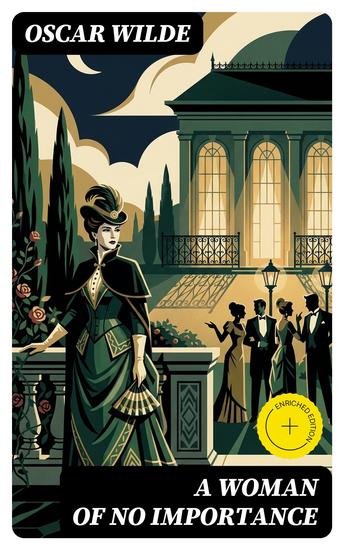
A Woman of No Importance - Enriched edition - cover

A Woman of No Importance - Enriched edition

Oscar Wilde

Editorial: DigiCat

  • 0
  • 0
  • 0

Sinopsis

In "A Woman of No Importance," Oscar Wilde masterfully explores the themes of gender, morality, and social hypocrisy through sharp wit and sparkling dialogue. Set in the vibrant Victorian society, the play unfolds at a lavish social gathering, where Wilde unveils the contrasting lives of men and women, their societal expectations, and the fragile dynamics of reputation and honor. The clever interplay of characters showcases Wilde's trademark epigrams, elevating the comedic elements while prompting audiences to reflect on deeper societal truths. Through his deft use of irony and satire, he critiques the moral standards of his time, presenting a compelling commentary on the roles of women in a patriarchal society. Oscar Wilde, an emblematic figure of the late 19th-century literary scene, was known for his flamboyant style and deep engagement with contemporary social issues. His experiences as a prominent writer and his complex relationship with society undoubtedly influenced his portrayals of women and their societal predicaments. Wilde's personal trials with public perception and morality resonate strongly in the characters and dialogues of the play, making it an intimate reflection of his beliefs. This play is essential for readers who wish to delve into the intricacies of Wilde's critique of societal norms through humor and pathos. It invites both laughter and reflection, making it a timeless piece that continues to provoke thought about gender and morality. "A Woman of No Importance" is not merely a comedy; it is an astute and unsettling examination of societal constructs that remains profoundly relevant today.

In this enriched edition, we have carefully created added value for your reading experience:
- A succinct Introduction situates the work's timeless appeal and themes.
- The Synopsis outlines the central plot, highlighting key developments without spoiling critical twists.
- A detailed Historical Context immerses you in the era's events and influences that shaped the writing.
- An Author Biography reveals milestones in the author's life, illuminating the personal insights behind the text.
- A thorough Analysis dissects symbols, motifs, and character arcs to unearth underlying meanings.
- Reflection questions prompt you to engage personally with the work's messages, connecting them to modern life.
- Hand‐picked Memorable Quotes shine a spotlight on moments of literary brilliance.
- Interactive footnotes clarify unusual references, historical allusions, and archaic phrases for an effortless, more informed read.
Disponible desde: 02/06/2022.
Longitud de impresión: 56 páginas.
Otros libros que te pueden interesar

  • Scary Short Stories - Shelley - Lovecraft - Lee - Howard - cover

    Scary Short Stories - Shelley -...

    Mary Wollstonecraft Shelley,...

    • 0
    • 0
    • 0
    With this collection, listeners will be taken on a journey through the darkest corners of the human imagination. From the supernatural to the psychological, these stories are sure to leave a lasting impression and keep listeners hooked until the very end. So sit back, relax, and prepare to be captivated by the masterful storytelling of these literary giants. 
     
    First up, we have "The Tomb" by H.P. Lovecraft, one of the most renowned horror writers of all time. This classic story takes the listener on a journey through the dark and shadowy depths of the human psyche, as the protagonist becomes increasingly obsessed with the idea of uncovering a mysterious tomb. 
     
    Next, we have "The Skulls in the Stars" by Robert E. Howard, the creator of Conan the Barbarian. In this story, the protagonist faces a terrifying supernatural force that threatens to consume him in its grasp. With vivid imagery and a chilling atmosphere, this tale will keep listeners on the edge of their seats. 
     
    Moving on to "A Wedding Chest" by Vernon Lee, a master of gothic fiction. This haunting tale follows a young bride as she uncovers the dark secrets of her husband's family and the sinister forces that lurk within their ancestral home. With a subtle touch of psychological horror, this story is sure to leave a lasting impression on the listener. 
     
    Lastly, we have "Transformation" by Mary Wollstonecraft Shelley, the author of the legendary "Frankenstein". This lesser-known gem tells the story of a young woman who experiences a bizarre and terrifying transformation after coming into contact with a mysterious substance. With its themes of identity and transformation, this story is a must-read for fans of Shelley's work.
    Ver libro
  • Some Great Little Things (Unabridged) - cover

    Some Great Little Things...

    Booker T. Washington

    • 0
    • 0
    • 0
    Booker Taliaferro Washington (April 5, 1856 - November 14, 1915) was an American educator, author, orator, and adviser to several presidents of the United States. Between 1890 and 1915, Washington was the dominant leader in the African American community and of the contemporary black elite. Washington was from the last generation of black American leaders born into slavery and became the leading voice of the former slaves and their descendants. They were newly oppressed in the South by disenfranchisement and the Jim Crow discriminatory laws enacted in the post-Reconstruction Southern states in the late 19th and early 20th centuries.
    SOME GREAT LITTLE THINGS: I am going to speak to you for a few minutes to-night upon what I shall term "Some Great Little Things." I speak of them as great, because of their supreme importance, and I speak of them as little, because they come in a class of things which are usually looked upon by many people as small and unimportant.
    Ver libro
  • The Case of Lady Sannox - cover

    The Case of Lady Sannox

    Arthur Conan Doyle

    • 0
    • 0
    • 0
    The Case of Lady Sannox (also published as "The Kiss of Blood") is a short story by Sir Arthur Conan Doyle published in The Idler in November 1893.The story features an arrogant surgeon, Douglas Stone, who is in love with the married Lady Sannox, one of the most beautiful women in London. On his way to a rendezvous with her, the surgeon is asked by a Turkish man to operate on the latter's wife, who has cut her lip with a poison envenomed scimitar. The doctor is informed the woman will die if the poison is not cut out.Because of his desire to meet his lover, his need for money, his professional arrogance, and the opinion of the Turk that any delay would kill his wife, the surgeon goes ahead with the operation on the heavily drugged wife, whose face is obscured by a veil. After he has performed the operation, Dr. Stone realizes his patient is Lady Sannox, and the Turk her husband, who believes the disfigurement will be morally good for his wife. The surgeon suffers a breakdown.
    Ver libro
  • Music of Erich Zann The (Unabridged) - cover

    Music of Erich Zann The...

    H. P. Lovecraft

    • 0
    • 0
    • 0
    Due to lack of funds, a student studying metaphysics abroad is forced to take up lodging in a cheap apartment building on a street named the "Rue d'Auseil". The street is not far from his university and is bordered by a river, dark warehouses and a large wall, giving the street an appearance of being on a cliff. The student cannot see what lies on the other side of the wall, as only a single window on the top floor of his building looks over it. Along with the building's disabled landlord, Blandot, one of the few other tenants is an old German man named Erich Zann. The old man is mute and plays the viol[a] with a local theater orchestra. He lives alone on the top floor and at night he plays strange melodies the student has never heard before. Despite Zann's reclusiveness, Blandot reveals his identity to the student, who approaches him in the hallway one evening and asks if he can listen to Zann's music. Zann relents and allows the student to enter his room. He plays for the student some of his unique melodies but not the same as the student had previously heard. The student asks him if he could play his music from the previous nights, awkwardly humming and whistling the notes he remembered. Zann is taken aback by the request and nervously glances at the window in his room, covered by curtains. The student recognizes the window as the only one that can oversee the wall at the end of the mysterious street. He approaches it to look outside but Zann angrily pulls him back. The student is fed up with Zann's eccentricities but Zann explains through writing that he is simply a lonely old man, and suffers from numerous phobias and nervous disorders. He is pleased that the student likes his music, but refuses to play the particular tunes that the student asked for. He persuades the student to move to a lower floor in the apartment as he would prefer the student not listen to them. The student sympathizes with Zann and agrees to move. Zann promises that he will invite the student to his room to hear his other music. After the student moves, however, Zann returns to his antisocial behavior and his health deteriorates, eventually not letting the student listen at all. The student's curiosity to hear the secret music and look out the window grows, and he begins eavesdropping on Zann while he plays at night. His melodies have an unearthly sound, and the student praises Zann as a musical genius. One night while secretly listening outside Zann's room, the student hears a commotion and the old man scream inside. When the student bangs at the door, Zann lets him in and asks him to wait while he writes, promising to explain everything. More than an hour into writing, Zann is startled by a distant sound in the form of a low note, interrupts his writing and starts furiously playing his viol with a crescent terror. The music is horrific and the student surmises that Zann is playing wildly to drown out or keep something out of the room. Zann seemingly enters a stupor, doing nothing but playing his music. Another sound from outside the room, which the student perceives to be mocking them, is heard and a gust shatters the window. The unnatural wind sweeps through the room, blowing Zann's unread papers out the window, despite the student's attempts at catching them. The student remembers his curiosity and finally looks out the window. Instead of seeing the city lights, he only sees a terrible black void, an infinite abyss of chaos. The howling winds and cacophony of elements snuff out the candles in the room, leaving the student and Zann in complete darkness. He blindly moves through the dark with desperation, beginning to feel "chilling things" brush up against him. Determined to save Zann, the student reaches the musician and screams at him to run, but Zann only continues to play his music. Upon attempting to physically carry him to safety, he discovers Zann is dead, although his body is still playing. With this re
    Ver libro
  • The Awakening and Other Stories - cover

    The Awakening and Other Stories

    Kate Chopin

    • 1
    • 0
    • 0
    What if embracing your true self meant challenging every expectation the world has placed upon you? 🌊
    
    In The Awakening and Other Stories, Kate Chopin delivers some of the most groundbreaking and emotionally resonant writing of the late 19th century. Through her fearless exploration of desire, independence, and the inner lives of women, Chopin reveals the struggles and beauty of self-discovery in a society that demands conformity.
    
    This compelling collection includes The Awakening, the powerful novella that follows Edna Pontellier's journey toward personal freedom, as well as a series of insightful, beautifully crafted short stories that expand on themes of:
    
    Individual identity vs. societal expectation
    
    Marriage, motherhood, and emotional longing
    
    Female autonomy, creativity, and self-expression
    
    The complexities of love, passion, and restraint
    
    Everyday moments that reveal deep psychological truths
    
    Chopin's elegant prose and bold subject matter challenged the norms of her time and paved the way for modern feminist literature. This beautifully formatted edition presents her work with clarity and sensitivity, creating an immersive reading experience for today's readers.
    
    Whether you're drawn to emotional fiction, feminist classics, or stories that speak to the hidden depths of human experience, this collection offers insight, beauty, and timeless relevance.
    
    Discover the powerful voice that helped redefine women's literature—add this essential classic to your library today and experience Chopin's unforgettable storytelling.
    Ver libro
  • Parade's End - The Complete Tetralogy - cover

    Parade's End - The Complete...

    Ford Madox

    • 0
    • 0
    • 0
    There is a hard brightness overlying the emotion and the human suffering and the human passions… Mr. Ford achieves not only what is probably his own best work but what is certainly one of the ablest of recent English novels. — The New York Times, 1924  
    There are not many English novels which deserve to be called great: Parade's End is one of them. — W. H. Auden  
    Ford Madox Ford's Parade's End tetralogy, written in the aftermath of World War I, was originally published in four parts in the 1920s: Some Do Not…; No More Parades; A Man Could Stand Up —; and Last Post. Highlighting the tension between traditional values and a rapidly changing social order in a world embroiled in war, the story details Tietjens' turmoils in both his personal life and on the warfront—and what follows when some of those struggles become one and the same.  
    Unique among other war fiction of the time, Parade's End privileges not the conflict of the Great War itself, but the impact the war had on its participants and upon society writ large. With it's publication, Ford hoped to contribute to the obviating of all future wars. 
    Parade's End is often referred to as one of the greatest 20th century novels, and one of the best depictions of war in literature. The 2012 television adaptation, written by Tom Stoppard (Shakespeare in Love), directed by Susanna White (Andor) and starring Benedict Cumberbatch and Rebecca Hall, was nominated for two Primetime Emmy Awards and seven BAFTA Television Awards.
    Ver libro