¡Acompáñanos a viajar por el mundo de los libros!
Añadir este libro a la estantería
Grey
Escribe un nuevo comentario Default profile 50px
Grey
Suscríbete para leer el libro completo o lee las primeras páginas gratis.
All characters reduced
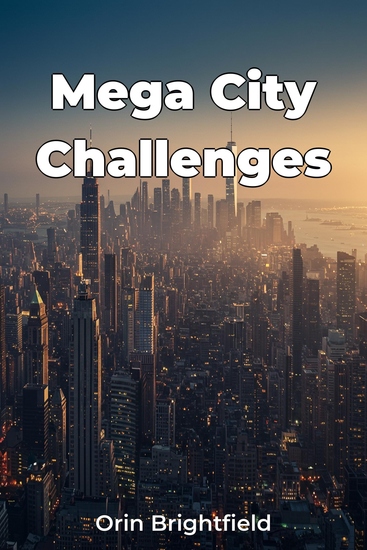
Mega City Challenges - cover

Mega City Challenges

Orin Brightfield

Traductor A AI

Editorial: Publifye

  • 0
  • 0
  • 0

Sinopsis

Mega City Challenges examines the pressing issues arising from the rapid growth of urban centers, focusing on how humanity can navigate the unprecedented challenges of concentrated populations. It addresses the strain on resources, the rise of socioeconomic disparities, and the urgent need for sustainable solutions. One key insight is how the density of mega-cities exacerbates existing problems, straining infrastructure and deepening inequality.

 
The book uniquely chronicles the historical arc of urbanization to provide context, contrasting traditional urban planning with proposed adaptive, inclusive, and ecological governance models.

 
The analysis progresses from defining mega-city characteristics to exploring specific issues like transportation, housing, clean water access, public health, and climate change, using global case studies and GIS maps to visually illustrate resource distribution. By investigating ongoing debates, the book emphasizes the need for integrated solutions that balance economic growth with environmental protection and tackle social inequalities.
Disponible desde: 21/02/2025.
Longitud de impresión: 83 páginas.
Otros libros que te pueden interesar

  • Propaganda: Book Summary & Analysis - cover

    Propaganda: Book Summary & Analysis

    Briefly Summaries

    • 0
    • 0
    • 0
    This is a concise summary and analysis of Propaganda, by Edward Bernays.
     
    It is not the original book and is not affiliated with or endorsed by Edward Bernays.
     
    Ideal those seeking a quick and insightful overview.
     
    Propaganda explores the powerful role of public relations and persuasion in shaping public opinion, politics, and consumer behavior. This groundbreaking work unveils the mechanics of influence in modern society, examining how ideas are spread and perceptions are crafted by media, governments, and corporations. Through insightful analysis, the book reveals the techniques used to sway public consciousness and highlights the ethical implications of such manipulation. A must-read for anyone seeking to understand the dynamics of communication and power in the 20th century and beyond.
    Ver libro
  • Sludge - What Stops Us from Getting Things Done and What to Do about It - cover

    Sludge - What Stops Us from...

    Cass R. Sunstein

    • 0
    • 0
    • 0
    How we became so burdened by red tape and unnecessary paperwork, and why we must do better. 


    We've all had to fight our way through administrative sludge—filling out complicated online forms, mailing in paperwork, standing in line at the motor vehicle registry. This kind of red tape is a nuisance, but, as Cass Sunstein shows in Sludge, it can also also impair health, reduce growth, entrench poverty, and exacerbate inequality. Confronted by sludge, people just give up—and lose a promised outcome: a visa, a job, a permit, an educational opportunity, necessary medical help. In this lively and entertaining look at the terribleness of sludge, Sunstein explains what we can do to reduce it. 


    Because of sludge, Sunstein, explains, too many people don't receive benefits to which they are entitled. Sludge even prevents many people from exercising their constitutional rights—when, for example, barriers to voting in an election are too high. Sunstein takes listeners on a tour of the not-so-wonderful world of sludge, describes justifications for certain kinds of sludge, and proposes "Sludge Audits" as a way to measure the effects of sludge. On balance, Sunstein argues, sludge infringes on human dignity, making people feel that their time and even their lives don't matter. We must do better.
    Ver libro
  • The Conspiracy to End America - Five Ways My Old Party Is Driving Our Democracy to Autocracy - cover

    The Conspiracy to End America -...

    Stuart Stevens

    • 0
    • 0
    • 0
    “This is the first must-read of the 2024 election cycle if you want to understand the stakes.” –Nicole Wallace A former chief Republican strategist and bestselling author of It Was All a Lie offers an ominous warning that the G.O.P. is dragging our country towards autocracy, and if we don’t wake up to the crisis in our system, 2024 may well be our last free and fair election. Today’s Republican party is not a “normal” political party in the American tradition. It has become an autocratic movement masquerading as a political party. As Stuart Stevens argues in The Conspiracy to End America, if we look away from that truth, we greatly increase the likelihood that the America we love will slip away, never to return.    Whenever a democracy slides into autocracy, there are five critical elements at work: financers, propagandists, party support, legal theories to legitimize, and shock troops. The Conspiracy to End America examines each of these driving forces on the Right and makes clear how they are working in concert to end our democracy as we know it.    In the tradition of It Can’t Happen Here and On Tyranny, The Conspiracy to End America is a blinking red distress call about the dark intentions lurking within Stevens’ old party and a rallying cry to beat back this perilous threat and save the Republic. 
    Ver libro
  • Living Disability - Building Accessible Futures for Everybody - cover

    Living Disability - Building...

    Emily Macrae

    • 0
    • 0
    • 0
    How can we build more accessible cities? Living Disability brings together vibrant perspectives on disability justice and urban systems. From sidewalks to the climate crisis, Living Disability brings together the vibrant perspectives of thirty-five disabled writers. They explore disability justice, analyze urban systems, and propose more equitable approaches to city building. Essays and interviews push the conversation about accessibility beyond policy papers and compliance checklists to show how disabled people are already creating more inclusive spaces in cities of all sizes.
      
      Living Disability is universal in scope but intimate and local in focus, grounded in personal struggles and celebrations. 
     Decisions about public transit, affordable housing, and park design all disproportionately impact disabled communities; by sharing stories and strategies, contributors consider the ways disabled thinkers and doers are embracing overlooked aspects of urban design and tackling the toughest problems facing cities. 
     
    "Living Disability is at once hopeful and infuriating, solemn and joyous. The stories shared within these pages point to both the past and future simultaneously – illuminating the struggles and joys and history of disabled life, while putting access barriers on blast in a way that is more necessary than ever. The deep, rich work of this collection lies in its embrace of complexity, community, grief, and also its belief in the capacity of our world (read: us) to change. May these stories touch your heart, kindle the flame of your anger, and move you forward into fighting for the better world we all deserve." – Amanda Leduc, author of Disfigured: On Fairy Tales, Disability, and Making Space
    Ver libro
  • The Great Global Transformation - The United States China and the Remaking of the World Economic Order - cover

    The Great Global Transformation...

    Branko Milanovic

    • 0
    • 0
    • 0
    From the essential chronicler of the world economy, a portrait of the Great Powers in transition. 
     
    The world’s two great economic powers are on opposite trajectories. In the United States, decades of neoliberal policies produced a small class of rich elites and gutted the middle class. In China, the same global forces have created a massive new upper class. The result is the greatest reshuffling of global incomes since the Industrial Revolution—a dramatic shakeup of each country’s political order. As the two powers retreat from one another, the implications for their futures, and for the world economy, are uncertain. 
     
    In The Great Global Transformation, acclaimed economist Branko Milanovic draws on original research to chart how these seismic shifts will shape the next century of the global economy. As both the US and China retreat into protectionism, Milanovic shows how a new and multipolar world order will follow—and how rising nationalism will have dramatically different effects on the two countries. And he shows us the fight ahead: as plutocracy returns, global war threatens, and a new system silently shapes our nations, driving populist discontent to the breaking point. 
     
    A worthy successor to Capitalism, Alone and his other landmark works, Milanovic’s new book announces the arrival of a new era he terms “national market liberalism,” in which liberalism survives in domestic economies, but not necessarily in the social arena. The Great Global Transformation is Milanovic’s indispensable account of the new twenty-first century now underway.
    Ver libro
  • Uncivil War An - Taking Back Our Democracy in An Age of Trumpian Disinformation and Thunderdome Politics - cover

    Uncivil War An - Taking Back Our...

    Anónimo

    • 0
    • 0
    • 0
    The author of the Washington Post’s hugely influential ""Plum Line"" sounds the alarm on the subversion of our democracy by self-interested politicians, greedy plutocrats, foreign government hacking, racial prejudice, media propaganda and our own lack of vigilance, and what must be done to save it before it’s too late. 
    The sophistication and ambition of those now eroding American democracy by gaming the rules in their favor is unprecedented, including computer-generated gerrymandering, unreasonable voter ID laws, limitations on voting hours, a lack of convenient polling places, and efforts to disenfranchise likely Democratic voters. This has been accompanied by foreign government intervention and an unprecedented level of political disinformation that threatens to undermine the very possibility of shared agreement on facts and poses profound new challenges to the media’s ability to inform the citizenry. 
    Yet it would be wrong to think that the problem is that Republicans alone have learned how to work the system—our electoral process is undermining itself from within: its dysfunctional rules incentivize vicious partisan efforts to tilt the playing field, combining in a toxic escalation of polarization and a frightening corrosion of basic norms that threaten to totally eradicate fair play in politics. 
    In An Uncivil War, Washington Post journalist Greg Sargent vividly lifts the curtain on the nightmare dynamic that is transforming American politics into little more than a naked power struggle. Yet An Uncivil War is not only a thorough dissection of an ultimately immoral system, but a handbook for turning that around by restoring authentic democracy. Given the incredibly high stakes in 2018 and 2020, Sargent’s book could not be more essential.
    Ver libro