Join us on a literary world trip!
Add this book to bookshelf
Grey
Write a new comment Default profile 50px
Grey
Subscribe to read the full book or read the first pages for free!
All characters reduced
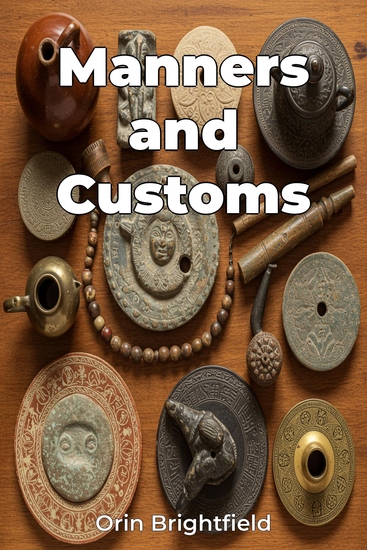
Manners and Customs - cover

Manners and Customs

Orin Brightfield

Translator A AI

Publisher: Publifye

  • 0
  • 0
  • 0

Summary

"Manners and Customs" explores the diverse tapestry of social norms and etiquette that govern human interactions worldwide. It examines how seemingly simple gestures, like bowing in Japan or shaking hands in America, reflect centuries of cultural evolution. The book delves into everyday etiquette, covering greetings, table manners, and gift-giving traditions, while also investigating formal social customs such as wedding ceremonies and religious observances. This exploration highlights the underlying values and belief systems that shape different cultures.

 
The book introduces key anthropological concepts, such as cultural relativism, to help readers understand behaviors within their specific cultural contexts. By tracing the historical development of etiquette from ancient civilizations to the modern era, the work illustrates how social norms evolve due to trade, conquest, and technological advancements.

 
Structured geographically, the book dedicates major sections to the Americas, Europe, Asia, and Africa, featuring illustrative case studies. Ultimately, "Manners and Customs" argues that etiquette is not a set of arbitrary rules but a reflection of a society's deepest values and historical trajectory. Understanding the logic behind different customs fosters global empathy and enhances cross-cultural communication, essential in our interconnected world. The book concludes with an analysis of cross-cultural communication challenges in the 21st century, offering practical strategies for navigating diverse social situations.
Available since: 02/20/2025.
Print length: 79 pages.


Other books that might interest you

  • Battle of Woody Point The: The History of the Confrontation that Led to the Deaths of the First American Settlers in the Pacific Northwest - cover

    Battle of Woody Point The: The...

    Editors Charles River

    • 0
    • 0
    • 0
    The fur trade had its tensions, but for many years, traders and natives worked out their own systems, times, and traditions, allowing many different groups to interact and even compete without issues that led to war. Though native groups sometimes found themselves in conflicts based on long-standing rivalries or relations with the Europeans, most of the fur traders, the trappers, the Indians, and Hudson’s Bay Company officials lived peaceably. The great amount of distance from one another in this land of millions of miles likely helped to alleviate tensions. When a new vision for the Hudson’s Bay Company came about, one where settlers, not itinerants, would be responsible for the colony, the rules changed. 
    In 1810, through the Pacific Fur Company, John Jacob Astor began to direct his energies at the still mostly unexploited regions accessible from the mouth of the Columbia River. This was, of course, in open defiance of British claims, but that was very much in keeping with Astor’s style. Astor put up the money, and a group of American and Canadian fur traders would manage affairs on the ground, traveling to the region to erect Fort Astoria and a string of trading posts in the region that could deal with the natives, trade with Asia and the East Coast, and amass untold riches. Or at least that was the plan. 
    Fort Astoria wouldn’t last a decade, and its turbulent history was so full of unfortunate twists and turns, a mixture of bad luck and incompetence, that the story still fascinates people today. And among all the chapters of that short history, none are as interesting as the fateful Battle of Woody Point, a misnomer for a confrontation that was brought about by misunderstandings, arrogance, and misplaced pride. The episode, despite its brevity and its occurrence in the furthest reaches of North America at the time, would color relations between whites and natives in the Pacific Northwest for decades.
    Show book
  • History Decoded - The Ten Greatest Conspiracies of All Time - cover

    History Decoded - The Ten...

    Keith Ferrell, Brad Meltzer

    • 0
    • 0
    • 0
    Adapted from Decoded, Meltzer’s hit show on the HISTORY network, History Decoded explores fascinating, unexplained questions. Is Fort Knox empty? Why was Hitler so intent on capturing the Roman ‘Spear of Destiny'? What’s the government hiding in Area 51? Where did the Confederacy’s $19 million in gold and silver go at the end of the Civil War? And did Lee Harvey Oswald really act alone? Meltzer sifts through the evidence; weighs competing theories; separates what we know to be true with what’s still—and perhaps forever—unproved or unprovable; and in the end, decodes the mystery, arriving at the most likely solution. Along the way we meet Freemasons, Rosicrucians, Nazi propagandists, and the real DB Cooper.
    Show book
  • Think Positive Before Sleeping - cover

    Think Positive Before Sleeping

    Gauri Janvekar

    • 0
    • 0
    • 0
    Storytel brings to you a range of Self Affirmation audiobooks for daily use. We hope these small doses of meditation helps you in your inner journey. Throughout our life we face moments of stress and tension in various different situations. These short and quick self affirmations helps us to stop and experience few moments of peace and tranquility of the mind
    Show book
  • Emancipation of the Mind An - Radical Philosophy the War Over Slavery and the Refounding of America - cover

    Emancipation of the Mind An -...

    Matthew Stewart

    • 0
    • 0
    • 0
    How a band of antislavery leaders recovered the radical philosophical inspirations of the first American Revolution to defeat the slaveholders' oligarchy in the Civil War. 


    In their struggle against the slaveholding oligarchy of their time, America's antislavery leaders found their way back to the rationalist, secularist, and essentially atheist inspiration for the first American Revolution. Frederick Douglass's unusual interest in radical German philosophers and Abraham Lincoln's buried allusions to the same thinkers are but a few of the clues that underlie this propulsive philosophical detective story. With fresh takes on forgotten thinkers like Theodore Parker, the excommunicated Unitarian minister who is the original source of some of Lincoln's most famous lines, Matthew Stewart tells the story of the battle between America's philosophical radicals and the conservative counterrevolution that swept the American republic in the first decades of its existence and persists in new forms up to the present day. In exposing the role of Christian nationalism and the collusion between northern economic elites and slaveholding oligarchs, An Emancipation of the Mind demands a significant revision in our understanding of the origins and meaning of the struggle over slavery in America—and offers a fresh perspective on struggles between democracy and elite power today.
    Show book
  • Russo-Turkish Wars The: The History and Legacy of the Conflicts Between the Russian Empire and Ottoman Empire - cover

    Russo-Turkish Wars The: The...

    Editors Charles River

    • 0
    • 0
    • 0
    In the wake of taking Constantinople, the Ottoman Empire would spend the next few centuries expanding its size, power, and influence, bumping up against Eastern Europe and becoming one of the world’s most important geopolitical players. It was a rise that would not truly start to wane until the 19th century, and in the centuries before the decline of the “sick man of Europe,” the Ottomans frequently tried to push further into Europe. 
    Some of those forays were memorably countered by Western Europeans and the Holy League, but the Ottomans’ most frequent foe was the Russian Empire, which opposed them for both geopolitical and religious reasons. From negotiations to battles, the two sides jockeyed for position over the course of hundreds of years, and the start of the fighting may have represented the Ottomans’ best chance to conquer Moscow and change the course of history. 
    By the 19th century, the tsar was notoriously referring to the Ottoman Empire as the “sick man of Europe,” and by the start of World War I, the Ottoman Empire was often described as a dwindling power, mired by administrative corruption, using inferior technology, and plagued by poor leadership. The general idea is that the Ottoman Empire was “lagging behind,” likely coming from the clear stagnation of the empire between 1683 and 1826. Yet it can be argued that this portrayal is often misleading and fails to give a fuller picture of the state of the Ottoman Empire. Looking at the reforms, technological advances and modernization efforts made by the Ottoman elite between 1826 and the beginning of World War I, one could really wonder why such a thirst for change failed to save the Ottomans when similar measures taken by other nations, such as Japan during the Meiji era, did in fact result in the rise of a global power in the 20th century.
    Show book
  • Common Sense - cover

    Common Sense

    Thomas Paine

    • 0
    • 0
    • 0
    Common Sense by Thomas Paine is a powerful and persuasive pamphlet that played a pivotal role in advocating for American independence from British rule. Written in 1776, Paine’s clear and compelling arguments challenged the authority of the British monarchy and promoted the idea of self-governance. His accessible language and logical reasoning inspired the colonists, making Common Sense a key text in the American Revolution. This influential work continues to be celebrated for its impact on political thought and its timeless call for freedom and justice.
    Show book