Join us on a literary world trip!
Add this book to bookshelf
Grey
Write a new comment Default profile 50px
Grey
Subscribe to read the full book or read the first pages for free!
All characters reduced
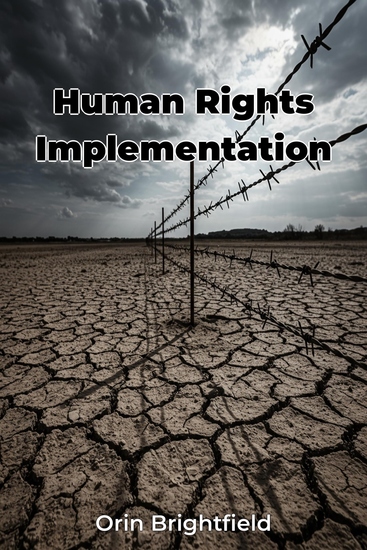
Human Rights Implementation - cover

Human Rights Implementation

Orin Brightfield

Translator A AI

Publisher: Publifye

  • 0
  • 0
  • 0

Summary

"Human Rights Implementation" grapples with why human rights violations persist despite extensive international laws. It explores the gap between legal frameworks and real-world improvements, emphasizing enforcement challenges and the vital role of civil society. The book uniquely highlights how effective implementation requires more than just legal or political solutions, stressing the need for active citizen participation and governmental accountability.

 
Did you know that political considerations often overshadow legal obligations in human rights enforcement? Or that assessing implementation effectiveness involves looking beyond simple compliance to see if protections genuinely improve lives? The book traces the evolution of international human rights law, like UN guidelines, and examines socio-political factors affecting state implementation. It argues for a multi-pronged approach combining robust legal frameworks, effective enforcement mechanisms, and civil society engagement.

 
It analyzes international organizations' roles, enforcement mechanism strengths and weaknesses, and civil society's contributions. Progressing through key sections, the book first introduces core concepts and theoretical frameworks. It then analyzes the UN's role, examines enforcement mechanisms, and focuses on civil society's crucial role. Case studies from diverse countries illustrate implementation challenges and successes, making this book a valuable resource for understanding and promoting human rights worldwide.
Available since: 02/18/2025.
Print length: 79 pages.
Other books that might interest you

  • Dark Psychology & Gaslighting Manipulation - How to Analyze People and Master Human Behaviour Using Body Language NLP Emotional Influence Mind Control Techniques and Subliminal Persuasion - cover

    Dark Psychology & Gaslighting...

    Leonard Farrell

    • 0
    • 0
    • 0
    Are you tired of being manipulated by others? 
    Do you struggle to understand why people behave the way they do? 
    Are you looking to strengthen your powers of communication and influence? 
    If you said YES to any of these questions, then “Dark Psychology & Gaslighting Manipulation” is for you! 
    Whether you want to defend yourself against narcissistic abuse or take your persuasion skills to the next level, this book will help you unlock the secrets of human behavior and master the art of manipulation!You’ll learn to:Defend yourself against manipulation: Use the power of body language, the art of persuasion, and the psychology of narcissism to analyze people with ease and defend yourself against all forms of manipulation.Discover the secrets of NLP and mind control techniques: Use NLP and mind control techniques to your advantage, giving you the power to influence others and achieve your personal and professional goals.Protect yourself against subliminal persuasion and dark triad personalities: Gain insight into the tactics of narcissists and psychopaths, so you can defend yourself against all their ill intentions.Analyze people: Gain the ability to read people's body language, emotions, and intentions with ease, allowing you to stay one step ahead of any manipulator. 
    And so much more! 
    Thanks to step-by-step instructions and practical tools that you can use day-to-day, you’re sure to keep manipulators at bay while ensuring you get one step closer toward a happier, freer, and more successful life!Get this audiobook and start taking control of your life today!
    Show book
  • A Country Called Prison - Mass Incarceration and the Making of a New Nation Second Edition - cover

    A Country Called Prison - Mass...

    John D. Carl, Mary D. Looman

    • 0
    • 0
    • 0
    In the first edition of A Country Called Prison, Mary Looman and John Carl presented persuasive data calling for downsizing of America's prisons. Their novel approach continues in their second edition, shifting the beliefs many people have about prisons and their role in the American society. Since the original edition was published, the landscape of incarceration has been changing. 


    In their second edition, Carl and Looman discuss the significant world events, such as the COVID epidemic, that impacted the American society in the past decade, which lead to an overall twenty percent reduction in prison populations across the board. The second edition includes a new chapter covering the history of prisons that clearly establishes the fact that prisons have always been about making money and less about rehabilitating offenders. They also introduce the new era of decarceration and desistance, encouraging courts to defer sentences and keep minor offenders at home with their families and in their communities while they work, attend education classes, and receive mental health treatment. Once again Carl and Looman end their book with a rational and daring proposal—Marshall Plan 2024—that envisions a way to bring the criminal justice system into the twenty-first century focusing on social equity and humane compassion for those who want to emigrate out.
    Show book
  • DW Griffith: The Life and Legacy of the Hollywood Director Who Made The Birth of a Nation - cover

    DW Griffith: The Life and Legacy...

    Charles River Editors

    • 0
    • 0
    • 0
    He was a pioneering film director who had 518 films to his credit. His work spanned the silent and sound eras. Most of his films were completed in a span of 15 years. But today he is known only for one of his films, one considered by historians to be a landmark in cinema as well as the most controversial ever made. He could not escape the controversy of this one film before he died in relative obscurity, his contributions to the motion picture industry forever marred. 
    The story of D.W. Griffith is one of triumph and tragedy, of a man who almost singlehandedly created the American motion picture industry, but whose prejudices and ego have permanently colored how he is perceived. In 1958, James Agee wrote of Griffith and his time, “This was the only time in movie history that a man of great ability worked freely, in an unspoiled medium, for an unspoiled audience, on a majestic theme which involved all that was, and brought to it, besides his abilities as an inventor and artist, absolute passion, pity, courage, and honesty. He achieved what no other known man has ever achieved. To watch his work is like being witness to the beginning of melody, or the first conscious use of the lever or the wheel, the emergence coordination, and first eloquence of language, the birth of an art, and to realize that this is all the work of one man.” 
    It would be an overstatement to say that D.W. Griffith created Hollywood; but Hollywood would have been quite different without his complicated genius. As historian Richard Griffith put it, “the origins of older arts are lost in prehistory, their creators unknown or barely guessed at,” but for the movies, “we have an almost complete record of the ‘birth of an art.’ The creator of film art was David Wark Griffith.”
    Show book
  • A Drama in Mexico - cover

    A Drama in Mexico

    Jules Verne

    • 0
    • 0
    • 0
    A Drama in Mexico is a vivid and engaging short work by Charles Dickens that combines travel writing with historical reflection. Based on Dickens's experiences and observations during his journey to North America, the piece offers a sharply written account of a real-life political execution he witnessed while in Mexico.
    
    Through powerful narrative detail, Dickens recounts the tense atmosphere surrounding the public execution of a political figure, capturing the emotional weight of the moment and the reactions of the crowd. Rather than focusing solely on the event itself, the story reflects Dickens's deep concern with justice, authority, and the human cost of political conflict.
    
    The work stands out for its immediacy and moral seriousness. Dickens uses the event as a lens through which to examine themes of power, violence, and public spectacle, questioning the effectiveness and humanity of capital punishment. His prose is direct and compelling, blending journalistic observation with emotional insight.
    
    A Drama in Mexico is a striking example of Dickens's ability to transform real-world experiences into meaningful commentary. Short yet impactful, the piece offers readers a rare glimpse into Dickens as an eyewitness to history and serves as a thought-provoking reflection on justice, punishment, and human dignity.
    Show book
  • Reflections on the Revolution in France: Book Summary & Analysis - cover

    Reflections on the Revolution in...

    Briefly Summaries

    • 0
    • 0
    • 0
    This is a concise summary and analysis of Reflections on the Revolution in France, by Edmund Burke.
     
    It is not the original book and is not affiliated with or endorsed by Edmund Burke.
     
    Ideal those seeking a quick and insightful overview.
     
    A seminal work of political philosophy, Reflections on the Revolution in France offers a profound critique of the French Revolution and its radical departure from tradition and order. Written as a series of letters, this book examines the consequences of upheaval, the dangers of unchecked progress, and the importance of preserving social institutions. Blending eloquence with sharp insight, it provides a timeless analysis of liberty, democracy, and the delicate balance between change and stability, making it essential reading for anyone interested in history, politics, or philosophy.
    Show book
  • Sir Thomas More - cover

    Sir Thomas More

    Anthony Munday

    • 0
    • 0
    • 0
    Sir Thomas More is a collaborative Elizabethan play by Anthony Munday and others depicting the life and death of Thomas More. It survives only in a single manuscript, now owned by the British Library. The manuscript is notable because three pages of it are considered to be in the hand of William Shakespeare and for the light it sheds on the collaborative nature of Elizabethan drama and the theatrical censorship of the era. The play dramatizes events in More's life, both real and legendary, in an episodic manner in 17 scenes, unified only by the rise and fall of More's fortunes.
    Show book