Join us on a literary world trip!
Add this book to bookshelf
Grey
Write a new comment Default profile 50px
Grey
Subscribe to read the full book or read the first pages for free!
All characters reduced
Diplomatic Alliances - cover

Diplomatic Alliances

Orin Brightfield

Translator A AI

Publisher: Publifye

  • 0
  • 0
  • 0

Summary

Diplomatic Alliances offers a comprehensive exploration of how and why nations form alliances, examining their lasting impact on global conflicts and international relations. The book reveals that alliances are not static agreements but dynamic entities that evolve with geopolitical shifts. Intriguingly, these alliances can sometimes limit a nation's autonomy and even draw them into unintended conflicts, highlighting the critical need to carefully consider the long-term implications of such commitments.

 
The book progresses through three major parts, initially introducing foundational concepts and historical development of alliances up to World War I. It then examines the alliance's role in the World Wars and the Cold War, detailing how these agreements influenced military strategies and economic policies. Finally, it explores the post-Cold War era, focusing on the emergence of new forms of cooperation and addressing challenges like the evolving role of NATO and the rise of China.

 
By drawing upon a wide range of historical sources and quantitative data, Diplomatic Alliances provides an interdisciplinary perspective, connecting international relations theory, political science, and economic history. This approach offers a nuanced understanding of factors that shape alliances, making it valuable for scholars, policymakers, and anyone interested in understanding global politics and the history of international relations.
Available since: 03/21/2025.
Print length: 68 pages.

Other books that might interest you

  • Stone Breaker - The Poet James Gates Percival and the Beginning of Geology in New England - cover

    Stone Breaker - The Poet James...

    Kathleen L. Housley

    • 0
    • 0
    • 0
    Stone Breaker is an in-depth, accessible biography of a true American polymath, James Gates Percival. A poet, linguist, and unstable savant Percival was also a brilliant geologist who walked thousands of miles crisscrossing first Connecticut and then Wisconsin to lay the foundation for the work of generations of Earth scientists. Exploring the confluences of literature, art, and geology, Kathleen L. Housley reveals how one of most famous poets of the 1820's became a renowned geologist with his groundbreaking 1843 work Report on the Geology of the State of Connecticut. The book includes historic photographs and paintings of the Connecticut landscape.Publication of this book is funded by the Beatrice Fox Auerbach Foundation Fund at the Hartford Foundation for Public Giving.
    Show book
  • Success and Ethics - Implementation and Measurements of Ethical Principles in Management - cover

    Success and Ethics -...

    Georg F. Sievers

    • 1
    • 0
    • 0
    In einer groß angelegten europaweit durchgeführten Studie – mit einem besonderen Schwerpunkt auf die den sog. Visegrád-Staaten – war es Zielsetzung, die Unternehmensethik als Wettbewerbsfaktor zu erforschen. Dies mit dem Ziel, die Voraussetzungen für den nachhaltigen Transfer ethischer Werte in die unternehmerische Praxis (das unternehmerische (Personal-)Management) zu untersuchen und daraus portable Modelle für die Implementierung und Validierung (Zertifizierung, Messung) ethischer Schlüsselwerte zu entwickeln. Leitfrage der Untersuchung war es dabei, wie sich der Bezug zwischen ökonomischem Interesse und ethischer Normenorientierung so vermitteln lässt, dass die Etablierung ethischer Werte im Unternehmensmanagement anstatt zu einer Einschränkung zu einer Erhöhung der Wettbewerbsstärke (Ethik als Erfolgsfaktor) führt.
    Show book
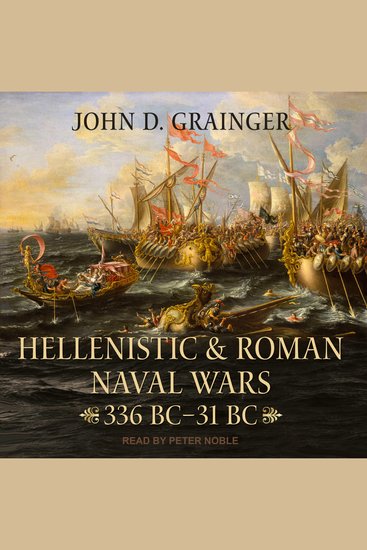
  • Hellenistic and Roman Naval Wars - 336 BC-31 BC - cover

    Hellenistic and Roman Naval Wars...

    John D. Grainger

    • 0
    • 0
    • 0
    A technological, strategic, and tactical history of ancient naval ships from Alexander to the battle of Actium. 


    The period covered in this book is well known for its epic battles and grand campaigns of territorial conquest, but Hellenistic monarchies, Carthaginians, and the rapacious Roman Republic were scarcely less active at sea. Huge resources were poured into maintaining fleets not only as symbols of prestige but as means of projecting real military power across the Mediterranean arena. 


    Taking the period between Alexander the Great's conquests and the Battle of Actium, John Grainger analyzes the developments in naval technology and tactics, the uses and limitations of sea power and the differing strategies of the various powers. He shows, for example, how the Rhodians and the Romans eschewed the ever-larger monster galleys favored by most Hellenistic monarchs in favor of smaller vessels. This is a fascinating study of a neglected aspect of ancient warfare.
    Show book
  • The Rivalry Peril - How Great-Power Competition Threatens Peace and Weakens Democracy - cover

    The Rivalry Peril - How...

    Van Jackson, Michael Brenes

    • 0
    • 0
    • 0
    How the US policy of competition with China is detrimental to democracy, peace, and prosperity—and how a saner approach is possible 


    For close to a decade, the US government has been preoccupied with the threat of China, fearing that the country will "eat our lunch," in the words of Joe Biden. The United States has crafted its foreign and domestic policy to help constrain China's military power and economic growth. Van Jackson and Michael Brenes argue that great-power competition with China is misguided and vastly underestimates the costs and risks that geopolitical rivalry poses to economic prosperity, the quality of democracy, and, ultimately, global stability. 


    This in-depth assessment of the trade-offs and pitfalls of protracted competition with China reveals how such a policy exacerbates inequality, leads to xenophobia, and increases the likelihood of violence around the world. In addition, it distracts from the priority of addressing such issues as climate change while at the same time undercutting democratic pluralism and sacrificing liberty in the name of prevailing against an enemy "other." Jackson and Brenes provide an informed and urgent critique of current US foreign policy and a road map toward a saner, more democratically accountable strategy of easing tension and achieving effective diplomacy.
    Show book
  • The Corpse That Won World War II - The Astonishing Story of Operation Mincemeat - cover

    The Corpse That Won World War II...

    John Harpoon

    • 0
    • 0
    • 0
    Deception has always played a crucial role in warfare. From ancient times to modern conflicts, misleading the enemy has proven to be as effective as brute force. World War II was no exception, as both the Allies and the Axis powers relied heavily on espionage, misinformation, and psychological tactics to outmaneuver one another. Among these deceptions, one of the most remarkable and audacious was Operation Mincemeat—a plan so bizarre and daring that it seemed like something out of a spy novel.  
      
    By 1943, the tides of the war were turning, but victory was far from certain. The Allies needed a way to gain the upper hand against Hitler’s forces, particularly in the Mediterranean. Their goal was to launch a massive invasion of Sicily, a strategic island controlled by the Axis. However, they knew the Germans would expect such an attack, and without an element of surprise, the operation could turn into a disastrous bloodbath. British intelligence had to find a way to convince Hitler that the invasion was happening elsewhere, leading the Germans to divert their troops and resources away from Sicily.  
      
    This was the challenge that led to the creation of Operation Mincemeat, a plan conceived by British intelligence officers Charles Cholmondeley and Ewen Montagu. Their idea was simple in theory but incredibly complex in execution: they would take a dead body, dress it up as a fictitious British officer, plant fake documents on it, and drop it off the coast of Spain, where German agents were known to operate. The goal was to make the Germans believe they had stumbled upon top-secret Allied plans revealing an invasion of Greece and Sardinia instead of Sicily. If the ruse worked, it could save countless lives and change the course of the war. 
    Show book
  • The Legacy Coach - cover

    The Legacy Coach

    Santiago Machain

    • 0
    • 0
    • 0
    The Legacy Coach is the final and most visionary volume in a transformative coaching trilogy designed for professionals who seek not only to grow, but to lead with meaning and leave a lasting impact. This book explores the high-level dimensions of coaching that support long-term success—personal and professional legacy, executive influence, sustainable business models, and public thought leadership. 
    Through insightful chapters, humanized strategies, and real-world reflections, this book guides coaches, leaders, and entrepreneurs as they step into their highest potential. It speaks to those ready to expand their influence, amplify their message, and design a career—or company—that endures beyond their direct presence. 
    Whether you're coaching C-suite leaders, scaling your coaching practice, or reflecting on your long-term legacy, this book invites you to align your daily actions with your deepest values. It's about moving from successful to significant—one coaching conversation at a time.
    Show book