Join us on a literary world trip!
Add this book to bookshelf
Grey
Write a new comment Default profile 50px
Grey
Subscribe to read the full book or read the first pages for free!
All characters reduced
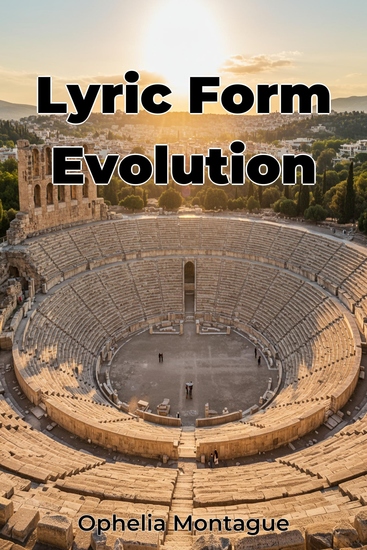
Lyric Form Evolution - cover

Lyric Form Evolution

Ophelia Montague

Translator A AI

Publisher: Publifye

  • 0
  • 0
  • 0

Summary

Lyric Form Evolution explores the captivating journey of lyric poetry in classical literature, transforming from personal sentiments to structured public performances. Initially, lyric poems offered intimate expressions, but their evolution involved formalization influenced by social, political, and cultural factors. The book examines the origins of lyric as personal expression, its formalization for choral performance, and the impact of patronage.

 
The book traces this evolution across chapters, beginning with early lyric examples expressing personal emotions. It then explores choral lyric, analyzing complex metrical schemes. The final section examines the Roman adaptation of Greek lyric models. Interestingly, lyric poems were initially sung with musical accompaniment, highlighting the connection to performance and public spectacle.

 
This study provides invaluable insights into classical societies' values and beliefs, uncovering how these poems reflect the changing relationship between individual expression and community. The book's unique approach integrates historical context with analyses of classical poets like Sappho, Archilochus, Catullus, Horace, and Ovid, offering a comprehensive exploration of lyric form evolution.
Available since: 05/05/2025.
Print length: 55 pages.

Other books that might interest you

  • Birthing Justice - Black Women Pregnancy and Childbirth Second Edition - cover

    Birthing Justice - Black Women...

    Julia Chinyere Oparah, Alicia D...

    • 0
    • 0
    • 0
    The second edition of this pathbreaking, widely taught book offers five new chapters, on breastfeeding and Black infant health; Black birthing during Covid; Black doulas rethinking birthing practices; the recent buildup of a US national movement; and expanding the global movement for sexual and reproductive wellbeing. Other chapters are updated throughout. Birthing Justice puts black women's voices at the center of the debate on what should be done to fix the broken maternal care system. It foregrounds Black women's agency in the birth justice movement. First published in 2016, Birthing Justice is a seminal text for those interested in maternal healthcare, reproductive justice, health equity, and intersectional racial justice, especially in courses on gender studies, Black studies, public health, and training programs for midwives and OB/GYNs.
    Show book
  • The Catastrophic Worrier - Why You Worry and How to Stop - cover

    The Catastrophic Worrier - Why...

    PhD Graham Davey

    • 0
    • 0
    • 0
    Do you turn all your molehills into insurmountable mountains? This accessible and engaging book will guide you along the path to stop catastrophizing so that you can reclaim control, achieve your goals, and live a happier life. 


    Is your worrying keeping you up all night, eroding your self-confidence, paralyzing your ability to make decisions, and harming your physical health? Excessive worrying is a problem that affects everyone at some point in their lives, but for some people it can become a lifelong affliction. Catastrophic worry can turn even imagined setbacks into a cascade of devastating events, impacting your sleep, self-confidence, decision making, problem solving, ability to cope, and overall health. 


    In this guide, leading worry expert Graham Davey explains the science of why we worry, and offers a clear path to stopping catastrophic worry so you can regain control and live a happier life. Focusing first on the psychological processes that contribute to catastrophizing, you'll gain a solid, research-based understanding of where your worry comes from, with insight into how it can snowball. You'll also learn how to assess your own level of catastrophic worrying, and find exercises that directly address those processes to help you establish healthy habits, manage your mood and anxiety, and make decisions with confidence.
    Show book
  • Who’s the Devil: the Other or the West? - cover

    Who’s the Devil: the Other or...

    Régis Le Sommier

    • 0
    • 0
    • 0
    “We’ve spent nine trillion dollars bombing the Middle East like mad. We’ve sown death there, including our own. And what has it gotten us? Nothing.” 
    Donald Trump, November 1, 2024. 
    
    The figure of the devil has haunted our collective consciousness since the dawn of time. He structures our societies, whether religious or secular. Sometimes, the devil has been a friend before being “demonized”. Sometimes, by force of circumstance, he has become an ally. And sometimes, the devil must be eliminated to mask or even justify the errors of our societies. 
    Thus, during the Second World War, we made a pact with Stalin to bring down a devil deemed more formidable: Hitler. In Northern Ireland, the British ended up talking with representatives of the IRA, just as the French did a few years earlier with the Algerian FLN. Recently, the Americans negotiated with the Taliban, another terrorist group, before handing over the keys to Afghanistan. Saddam Hussein, Muammar Gaddafi and Bashar al-Assad were friends of the West before the latter precipitated their downfall, even if it meant causing chaos in their countries.
    Régis Le Sommier has been a war reporter for 27 years, and has himself interviewed a number of infamous figures. His aim is to revisit the concept of the devil in the light of recent and current conflicts, in order to answer one question: shouldn’t the deleterious consequences of geopolitics conducted “in the name of good” lead us to doubt the validity of the actions taken by our governments, even today, against those they like to refer to as devils?
    Show book
  • Memory Improvement For Kids - The Greatest Collection Of Proven Techniques For Expanding Your Child's Mind And Boosting Their Brain Power - cover

    Memory Improvement For Kids -...

    Elisa Marshall

    • 0
    • 0
    • 0
    Discover a Perfect Toolbox Filled With Proven Methods to Boost Your Child's Memory and Intelligence! 
    If your little one struggles to remember things or seems uninterested and absent while learning new things, there is no reason for panic. 
    There are so many distractions around them in today's world, and naturally, their minds continuously drift towards the nearest distraction. 
    Would you like for your child to focus easily? Would you like to improve their memory? Would you like to boost their intelligence? 
    If so, then you are in the right place because this book has precisely what you need to transform your little one into a genius. 
    In Memory Improvement for Kids, a renowned parenting coach and Author expert in Parenting & Relationships, Lisa Marshall offers a collection of proven techniques for expanding your child's mind and boosting their brainpower. 
    Now, with her proven techniques and guidance, you will be able to do that too! 
    Here is what this memory improvement guide for kids can offer you:The connection between memory and the brain explainedFind your child's learning strengthsPattern identification activities for improving focusHome solutions to enhance IQGuide to embracing proven memory-enhancing lifestyle5 ways to improve your child's memoryEasy way to develop your child's mindsetBrain games & cognitive stimulation exercisesLink to download a gift, a free book – Discover Your Child's Learning Style by Lisa MarshallAnd much more! 
    If you want to boost your child's memory and intelligence with ease, all you need to do is follow step-by-step guides and expert exercises and advice found in this book - your child will become a highly focused genius in no time
    Show book
  • Pythagoras of Samos: The Life of Archaic Greece’s Most Influential Polyglot - cover

    Pythagoras of Samos: The Life of...

    Charles River Editors

    • 0
    • 0
    • 0
    Ionia was one of the most important Greek settlements in Anatolia, and it was the home of Thales (626–548 BCE), an enterprising Greek philosopher, mathematician, and astronomer who is best known for predicting the 585 BCE solar eclipse, which brought an immediate halt to the fighting between the Lydians and Medes in modern-day Turkey. Anaximander of Miletus (610–546 BCE), an Ionian philosopher and student of Thales, pioneered a rational, non-mythological approach to astronomy by proposing a mechanical model of the cosmos. He introduced the Apeiron (the Limitless) as the fundamental, eternal source of all matter, from which all worlds are created and to which they return.  
    Pythagoras studied cosmology, geometry, and astronomy under Thales and his successor Anaximander, and by building on the legacies of their brilliant minds, Pythagoras refined and expanded upon their foundational concepts. However, he also went in a different direction, focusing on mysticism and numbers more than material principles. Known for his profound influence on Plato, Pythagoras defined himself as a lover of wisdom and a seeker of knowledge. As a key figure in the evolution of Western intellectual thought, his ideas have endured for millennia, impacting fields ranging from mathematics to philosophy. Alongside other influential Greek thinkers, Pythagoras helped shift focus toward self-examination, deeply influencing how we understand purpose and the universe.  
    Pythagoras’s most lasting legacy was in the field of mathematics, but mathematics was not merely a tool for measurement to him - it was the underlying language of the universe. One of his most famous statements, “Panta arithmos” (“All is Number”), is indicative of his belief that numbers were the essence, structure, and governing principle of the universe. He thought ratios and proportions of integers could explain all reality, including musical harmony, physical objects, and abstract concepts like justice.
    Show book
  • Curious Not Furious - Empowering children to take charge of their brains and behaviour - a practical toolkit - cover

    Curious Not Furious - Empowering...

    Alison Rendle

    • 0
    • 0
    • 0
    ‘This book combines academic research with a clear, proven pathway to better outcomes for young people – in an entirely readable way.’Sarah Edwards, secondary school headteacher‘I’ve been a foster parent for thirteen years and I can honestly say that the approacheswithin this book are life changing for how you can support young people and yourself forbetter mental health outcomes.’Liz Saunders, foster parentMore than ever before, young people face tough challenges as they navigate their waythrough our fast-changing and often confusing world. It can be hard for them to know howto respond to the situations they face, especially if they don’t yet have the skills they need.In Curious Not Furious, Alison Rendle and Kit Messenger explain how you can supportyoung people to develop their skills to cope with these challenges now and in the future.Based on the latest research into neuroscience, psychology, attachment and trauma,this book is packed with examples, stories, models and tools that will help you respondeffectively and with kindness, no matter what happens.Whether you are a professional, a parent – or both – this book will help you to:• Understand what’s going on when young people are struggling• Respond well when challenges arise• Support young people to develop the skills they need now and for the futureCurious Not Furious is essential reading for any adult who wants to build their skills tosupport young people to be at their best. It can be read in its own right but it also sitsalongside the ground-breaking Empowerment Approach Training Programme, created anddelivered by Changing Chances CIC®.
    Show book