Join us on a literary world trip!
Add this book to bookshelf
Grey
Write a new comment Default profile 50px
Grey
Subscribe to read the full book or read the first pages for free!
All characters reduced
Gerrymandering Effects - cover

Gerrymandering Effects

Onyx Alderwood

Translator A AI

Publisher: Publifye

  • 0
  • 0
  • 0

Summary

Gerrymandering Effects explores how the strategic drawing of electoral district boundaries impacts political power and fair representation in the United States. The book reveals how gerrymandering can distort election results and entrench partisan advantages. It delves into the historical evolution of this practice, from its early forms to its modern, technologically advanced applications, highlighting how statistical analysis and case studies demonstrate its effects on political competition and polarization. A key insight is how advanced mapping technologies have exacerbated the problem, enabling more precise and effective gerrymandering strategies. The book examines real-world case studies to demonstrate the practical effects of gerrymandering on election outcomes and legislative representation. It also explores potential solutions and reforms, like independent redistricting commissions. It approaches the topic by introducing redistricting principles, analyzing case studies, and delving into legal challenges. The book progresses through chapters that cover the techniques used, the legal battles fought, and the reforms proposed.
Available since: 02/15/2025.
Print length: 67 pages.


Other books that might interest you

  • Every Weapon I Had - A Vietnam Vet's Long Road to the Medal of Honor - cover

    Every Weapon I Had - A Vietnam...

    Paris Davis

    • 0
    • 0
    • 0
    The story of a Green Beret commander's heroism during the Vietnam War, and the long fight to recognize his bravery.When Col. Paris Davis was selected to lead one of the Green Beret A-teams organizing resistance to Communist incursions into South Vietnam, his commanding officer warned him that some of his soldiers would resent his authority. This was no surprise; there were only a handful of Black officers in the Special Forces. Davis quickly won the respect of his soldiers, and would soon fight beside him as bullets snapped past and mortars exploded overhead.On June 18th, Davis led a group of inexperienced locals and Special Forces soldiers in an attack on a Viet Cong base in Bong Son. They were met by a superior enemy force, and Davis led the charge in a grueling firefight. He was seriously wounded, but he disobeyed a direct order to retreat until he dragged three injured Green Berets off the battlefield to safety.Every Weapon I Had is an inspiring tale of valor and sacrifice, set against the backdrop of major escalations in both the Vietnam War and the Civil Rights movement. It is also a story of deferred honor and delayed recognition; Davis earned the Silver Star and Purple Heart for his actions, but his nomination for the Congressional Medal of Honor was repeatedly “lost.” No official reason has ever been given for this oversight, but those who fought to correct it believe that it was motivated by racial prejudice. Davis was finally awarded the Medal in 2023, 58 years after the battle.A Macmillan Audio production from St. Martin’s Press.
    Show book
  • You Can't Get Much Closer Than This - Combat with the 80th "Blue Ridge" Division in World War II Europe - cover

    You Can't Get Much Closer Than...

    Andrew Z. Adkins III, A.Z. Adkins

    • 0
    • 0
    • 0
    After the Citadel and Officer Candidate School, Andrew Z. Adkins Jr. was sent to the 80th Infantry Division, then training in the California-Arizona desert. There, he was assigned as an 81mm mortar section leader in Company H, 2nd Battalion, 317th Infantry Regiment. 


    Lieutenant Adkins and his fellow soldiers took part in light hedgerow fighting that served to shake the division down and familiarize the troops and their officers with combat. While scouting for mortar positions in the woods, Adkins met a group of Germans and shot one of them dead with his carbine. This baptism in blood settled the question faced by every novice combatant: He was cool under fire, capable of killing when facing the enemy. 


    Adkins acted with skill and courage, placing himself at the forefront of the action whenever he could. His extremely aggressive delivery of critical supplies to a cut-off unit in an embattled French town earned him a Bronze Star, the first in his battalion. 


    Before his death, Andy Adkins was able to face his memory of war as bravely as he faced war itself. In 1944-45, he did his duty to his men and country—and here, he serves new generations of military and civilian listeners.
    Show book
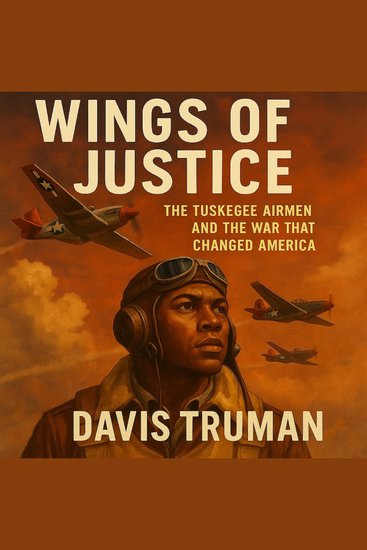
  • Wings of Justice - The Tuskegee Airmen and the War That Changed America - cover

    Wings of Justice - The Tuskegee...

    Davis Truman

    • 0
    • 0
    • 0
    Soar into the untold story of the heroes who defied gravity and racism. 
    In Wings of Justice, bestselling author Davis Truman delivers a gripping, emotionally charged tribute to the legendary Tuskegee Airmen, America’s first Black military pilots, who not only fought against the Axis powers during World War II but also challenged the deep-rooted injustice of segregation at home. 
    With vivid storytelling and powerful historical insight, this book follows the Airmen from the segregated airfields of Tuskegee, Alabama, to the skies over war-torn Europe. As they battled enemies abroad and prejudice within the ranks, these brave men rewrote the narrative of American heroism. 
    More than a story of war, this is a story of triumph, of courage, resilience, and the fight for equality. Wings of Justice will leave you inspired, enraged, and ultimately hopeful. It’s a must-read for anyone who believes in the power of history to shape a more just future. 
    History remembered. Justice reclaimed. Heroes are never forgotten.
    Show book
  • Moving Forwards Working Backwards: A strengths based approach to neurodivergence - cover

    Moving Forwards Working...

    Helen Sheehy

    • 0
    • 0
    • 0
    This book is about understanding how much neurodivergence and masking has unconsciously shaped so many people without them realising. For generations we have not recognised that many people who are highly adapted to a neurotypical world haven't been acknowledged or supported, especially women and girls. It explores the experience of attention divergent and highly sensitive people (often referred to as ADD or ADHD), Autistic people (often referred to as ASD) and people who are both (Dualies), in a non- pathologizing way. It challenges the current use of pathologizing language and explores the intersection of all the other shaping influences on how we make sense of this identity, including trauma, family of origin and overlaps between different types of neurodivergence. It explores the likely evolutionary components of how humans have developed different kinds of brains and attributes and makes suggestions for developing a more inclusive and validating picture of neurodiversity in schools, the workplace, families and friendship groups. Helen draws on her own and her partner's experiences of being neurodivergent, as well as drawing from stories of her friends, family and clients to develop a greater understanding of why it is important to embrace this identity if it applies to you. Helen is a psychologist who has worked with people for forty years. She describes how important it is to realise how masking neurodivergence stops people from realising their full potential, and where embracing it helps personal growth and a positive identity. 
    · 
    Show book
  • Liberty and Crisis: The History of the American Revolution during 1776 - cover

    Liberty and Crisis: The History...

    Editors Charles River

    • 0
    • 0
    • 0
    Although the Declaration of Independence is now considered one of the most important political documents in history, the men that drafted it did not initially favor such a move at the start of the American Revolution. Despite its assumption of governing duties, the Second Continental Congress never intended, at least initially, to become the governing body of a new nation. Instead, it merely hoped to transform the relationship between Britain and her colonies to allow for greater self-government on their side of the Atlantic. Separation between the two was rarely favored, and this initial sentiment coalesced into the Olive Branch Petition, which sought a reasonable motion of reconciliation between George III and the colonies. It was drafted by one of Virginia’s delegates, Thomas Jefferson.  
    	By April of 1776, talk had heated up concerning independence, and a consensus was quickly growing in Congress. However, one problem was in the way: did the Congress have the authority to declare independence for its 13 member colonies? The process was riddled with confusion across the colonies. independence. And of course, simply declaring independence did not mean the British were going to grant it, and during that time, things were looking quite dire for the cause. After the siege of Boston forced the British to evacuate that city in March 1776, Continental Army commander George Washington suspected that the British would move by sea to New York City, the next logical target in an attempt to end a colonial insurrection. He thus rushed his army south to defend the city. 
    In the summer of 1776, the British conducted the largest amphibious expedition in North America’s history at the time, landing over 20,000 troops on Long Island. They easily captured Staten Island, which Washington was incapable of defending without a proper navy. Washington’s army attempted to fight, but Washington was badly outmaneuvered, and his army was nearly cut off from escape. 
    Show book
  • Everything Left to Remember - My Mother Our Memories and a Journey Through the Rocky Mountains - cover

    Everything Left to Remember - My...

    Steph Jagger

    • 0
    • 0
    • 0
    "This audiobook is a touching testament to the power of stories, nature, and love to sustain and connect us." - AudioFile on Everything Left to Remember BETWEEN TWO KINGDOMS meets WILD. In this heart wrenching and inspirational memoir a woman and her mother, who is suffering from Alzheimer’s, embark on a road trip through national parks, revisiting the memories, and the mountains, that made them who they are.Steph Jagger lost her mother before she lost her. Her mother, stricken with an incurable disease that slowly erases all sense of self, struggles to remember her favorite drink, her favorite song, and—perhaps most heartbreaking of all—Steph herself. Steph watches as the woman who loved and raised her slips away before getting the chance to tell her story, and so Steph makes a promise: her mother will walk it and she will write it.Too aware of her mother’s waning memory, Steph proposes that the two take a camping trip out to Montana—which her mother, on the urging of Steph’s father, agrees to embark upon. An adventure full of horseback riding, hiking, and “tenting” out West quickly turns into one woman’s reflection on childhood, motherhood, personhood—and what it means to love someone who doesn’t quite remember the person she spent her lifetime becoming.A staggeringly beautiful examination of how stories are passed down through generations and from Mother Nature, Everything Left to Remember brings us the wisdom of who our memories make us under the constellations of the vast Montana sky.A Macmillan Audio production from Flatiron Books
    Show book