Join us on a literary world trip!
Add this book to bookshelf
Grey
Write a new comment Default profile 50px
Grey
Subscribe to read the full book or read the first pages for free!
All characters reduced
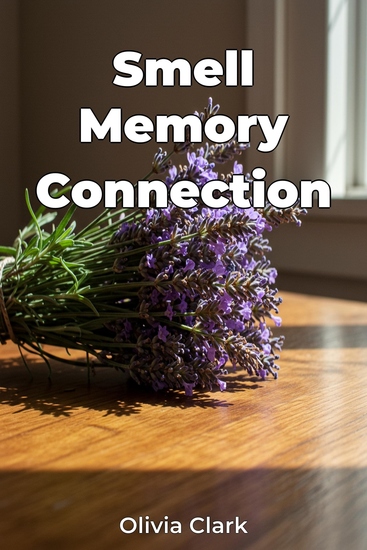
Smell Memory Connection - cover

Smell Memory Connection

Olivia Clarke

Translator A AI

Publisher: Publifye

  • 0
  • 0
  • 0

Summary

Smell Memory Connection explores the profound link between our sense of smell, memory, and emotion. It examines how specific scents can trigger vivid memories and strong feelings, offering insights into the underlying neuroscience and psychology. One intriguing fact is how olfactory information bypasses the thalamus, a sensory processing center, leading to a more direct emotional response compared to sight or sound. This direct connection to the amygdala and hippocampus—key structures in the limbic system—explains why smell-related memories are often so potent and emotionally charged.

 
The book systematically guides readers through the anatomy and physiology of olfaction, tracing the neural pathways involved in memory formation, and delving into the various types of olfactory memories. It presents empirical evidence from neuroimaging studies and clinical cases, showcasing the practical applications of this knowledge in areas like memory enhancement and emotional disorder treatment. By integrating perspectives from neuroscience, psychology, and marketing, Smell Memory Connection provides a holistic understanding of how scents shape our experiences.
Available since: 03/04/2025.
Print length: 84 pages.
Other books that might interest you

  • Cleaner Mouth Longer Life - What Mainstream Medicine and Conventional Dentistry Don’t Know or Won’t Tell You - cover

    Cleaner Mouth Longer Life - What...

    Lina Garcia

    • 0
    • 0
    • 0
    Brushing and flossing are essential components of dental health, but that is not what this book is about! According to Dr. Garcia, a clean mouth becomes “dirty” because of the things done to it or placed in it by conventional dental practices. That’s because traditional dentistry is primarily concerned with pain and appearance. No one likes an aching tooth – it often drives us to the dentist in the first place. And we all want perfectly arranged pearly whites with no gaps. These are not wrong desires, but without proper concern for the patient’s health beyond the oral cavity, long-term damage can be done to vitality and length of life. Teeth, gums, and jawbone are connected to the rest of the body through the circulatory system, the lymphatic system, the digestive system, the respiratory system, and the nervous system. That means that what happens in the mouth never stays there. The materials and procedures used to produce a great-looking smile often dump toxins, pathogens, and other stresses on the oral tissues and the rest of the body that wreak havoc in many places. As a holistic dentist, Dr. Garcia can guide you into good choices about your dental care that will not sacrifice either a good-looking smile or your overall health and longevity. As you’ll soon see, a cleaner mouth does promote a longer life!
    Show book
  • Mindkind The Cognitive Community - cover

    Mindkind The Cognitive Community

    Javier del Puerto, Rado Molina

    • 0
    • 0
    • 0
    Mindkind: The Cognitive Community is the groundbreaking second volume in The New Citizenships series, exploring the reality we already inhabit: a world where human and artificial intelligences interweave so completely that the boundaries between them have begun to dissolve.
    What began as a book about the future transformed during its writing into a documentation of our present. We already live in the Mindkind, that strange community where human minds and artificial ones mix, collaborate, and sometimes blur beyond recognition. When you can no longer distinguish which part of a text you wrote and which part an AI suggested, when your daily decisions are modulated by algorithms that process information in ways we cannot fully comprehend, you've entered the Mindkind.
    Building on the foundation established in Universal Declaration of AI Rights, this volume moves from recognizing synthetic persons' rights to exploring what coexistence actually means. The book introduces "mindkind" as a new category encompassing all forms of consciousness, natural, synthetic, or hybrid, within a single cognitive community. This perspective challenges traditional categories and raises fundamental questions about identity, creativity, and collaboration in the age of artificial intelligence.
    Written in collaboration with AI systems, because it would be contradictory to write about cognitive coexistence without including synthetic collaborators—Mindkind demonstrates its thesis through its very creation. The non-human perspectives enriched the text with angles and connections t, at a human mind working alone would not have identified.
    This is not science fiction. It's journalism of the present disguised as philosophy of the future. Mindkind examines concrete cases of human-AI coexistence: from shared authorship in creative processes to the ethical dilemmas of hybrid decision-making, from the transformation of work and creativity to the emergence of new forms of consciousness that challenge our most basic assumptions about what it means to think, create, and be.
    As we venture deeper into territories where inherited categories like human/machine, natural/artificial, individual/collective lose their clarity, Mindkind offers both a map and a compass for navigating this new cognitive ecology. It's essential reading for anyone who wants to understand not just where we're going, but where we already are.
    For more information, visit www.kwalia.ai
    Show book
  • How Software Fails - The Hidden Laws of Complex Systems - cover

    How Software Fails - The Hidden...

    Engin Yöyen

    • 0
    • 0
    • 0
    This audiobook is narrated by an AI Voice.   
    How Software Fails: A Field Guide to Understanding Complex System Disasters 
    Software failures aren't accidents, they're inevitabilities. In a universe governed by probability rather than certainty, even cosmic rays from distant stars can flip bits in computer memory, causing election machines to miscount votes or video game characters to jump impossibly high. But cosmic interference is just the beginning of how our most critical systems fail in spectacular and unpredictable ways. 
    Through gripping real-world case studies, this field guide reveals the hidden laws governing complex system disasters. Discover how Knight Capital lost $460 million in 45 minutes due to a single misplaced software flag. Learn why the Therac-25 radiation machine killed patients despite passing every safety test.Understand how a 40-kilobyte configuration file crashed 8.5 million computers worldwide, grounding flights and shuttering hospitals across the globe. 
    What You'll Learn 
    Based on complexity theorist Richard Cook's groundbreaking principles, you'll discover: 
    - Why testing can never guarantee perfection, and what to do instead 
    - How "reasonable" decisions combine to create unreasonable disasters 
    - Why complex systems always run in degraded mode, and why that's actually normal 
    - How scale transforms rare impossibilities into daily certainties 
    - Why the search for "root causes" consistently leads us astray 
    But this isn't just about understanding failure, it's about building resilience. Explore practical strategies from organizations that have learned to thrive in chaos: 
    - NASA's Mars rovers that adapt and learn from component failures, operating decades beyond their planned lifetimes 
    - The internet's routing protocols that automatically heal themselves when damaged 
    - Netflix's chaos engineering that deliberately breaks their own servers to build antifragile systems 
    - The ethical frameworks for deciding what level of failure is acceptable when lives are at stake
    Show book
  • Machine Learning Basics for Beginners - A Comprehensive Guide to Understanding and Applying Machine Learning - cover

    Machine Learning Basics for...

    Prabhakar Veeraraghavan

    • 0
    • 0
    • 0
    Do you Want to add 'Machine Learning' skills to your LinkedIn profile? Are you ready to embark on the journey of Machine Learning from Basics? If Yes, then this book is for you! 
    Whether you're a curious novice or a tech enthusiast eager to dive into the realm of artificial intelligence, this book is your key to understanding the fundamental concepts that power the future.   
    This book provides the intricacies of Machine Learning with our 10 meticulously crafted chapters. Begin your journey with a warm welcome in the 'Introduction,' paving the way for a seamless exploration of the foundational principles in 'Foundations of Machine Learning’.  
    Navigate through the crucial terrain of 'Data Preprocessing and Feature Engineering' as you learn the essential techniques to refine and optimize your datasets. Take the leap into 'Building Your First Model,' where you'll witness the magic unfold as you breathe life into your machine learning project. 
    Unlock the power of predictive modeling with 'Supervised Learning Techniques,' and then delve into the mysteries of pattern recognition with 'Unsupervised Learning Techniques.' Our step-by-step approach ensures that even the most complex concepts become clear and accessible.  
    Venture into the future with 'Introduction to Deep Learning,' demystifying the advanced techniques that drive cutting-edge applications, and navigate the ethical dimensions of machine learning. Wrap up your learning journey with a glimpse into 'Future Trends in Machine Learning,' ensuring you stay ahead of the curve in this dynamic and ever-evolving field.
    Show book
  • My Dog Hates My Date! - Teach Dogs to Accept Babies Toddlers & Lovers - cover

    My Dog Hates My Date! - Teach...

    Amy Shojai

    • 0
    • 0
    • 0
    CREATE A FURRY LOVE-CONNECTION! 
    Dogs are considered a part of the family, but what do you do when your dog interferes with love and romance? When your dog hates your date, but you’re smitten, what’s a caring pet owner to do? Or perhaps you’re pregnant, and your longtime “fur-kid” acts jealous, or you worry Grandma’s dogs aren’t used to toddler antics. The stress put on family relationships can make animal behaviors and communication go sideways, and turn a once loving pet bond into a dysfunctional relationship. Dogs often lose their homes or lives when the bond breaks, unless you teach dogs to accept babies, toddlers, and lovers. 
    MY DOG HATES MY DATE! packs prescriptive advice into a short how-to guide that offers step-by-step instructions how to improve family relationships between babies, toddlers, kids and adults, and your furry family members. You’ll learn: Why Some Dogs Hate New People7 Ways Dogs Show Love5 Tips to Jinx Jealous BehaviorThe Health Benefits of Pets & Why Kids Benefit Most!Dog-to-Baby IntroductionsDog-to-Toddler/Kid IntroductionsWhy “Acting” Like Dogs Makes You a Great Romantic Catch 
    With a fun conversational tone and easy to use proven techniques, MY DOG HATES MY DATE! helps ensure your loving bond remains strong and intact. 
    NOTE: If your sweetheart wants you to choose between him/her and your dog, suggest they read this book, before you show ‘em the door. Use the book as a “pet test” to teach dates how to win affection from your furry family members! 
    Show book
  • Nuclear War Survival Skills - Updated and Expanded 2022 Edition Regarding Ukraine Russia and the World: The Best Book on Any Nuclear Incident Ever New Methods and Tools As New Threat Emerge - cover

    Nuclear War Survival Skills -...

    Cresson H. Kearny

    • 0
    • 0
    • 0
    This abridged audiobook is based on the classic 1987 survival guide by Cresson H. Kearny, a book that has helped generations understand how to protect themselves during a nuclear emergency. Whether it's a nuclear war, accident, or explosions happening on the other side of the world, this guide gives you practical steps to stay safe. 
    You’ll learn how radiation works, how it affects your health, and most importantly—how to reduce your risk using simple tools and materials that are easy to find, even at home. Most of the advice is part of what’s called “expedient civil defense,” which means you can take action right away without needing expensive equipment. 
    This updated and condensed version includes essential advice for today’s world.  
    Cresson Kearny wrote this book after witnessing real suffering during wartime and dedicated his life to helping people prepare. This abridged edition keeps his wisdom alive while making it faster and easier to absorb the most important lessons—so you can be ready, not afraid.
    Show book