¡Acompáñanos a viajar por el mundo de los libros!
Añadir este libro a la estantería
Grey
Escribe un nuevo comentario Default profile 50px
Grey
Suscríbete para leer el libro completo o lee las primeras páginas gratis.
All characters reduced
Extreme Beetle Defenses - cover

Extreme Beetle Defenses

Olivia Clarke

Traductor A AI

Editorial: Publifye

  • 0
  • 0
  • 0

Sinopsis

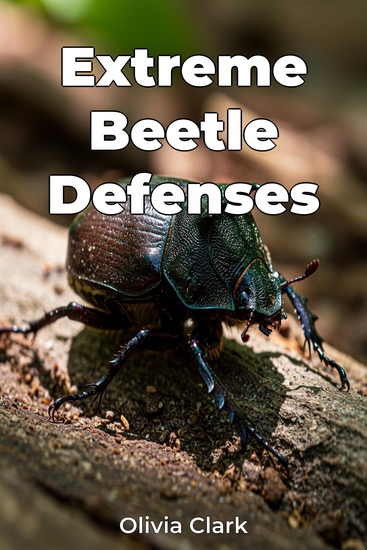
Extreme Beetle Defenses explores the extraordinary survival strategies of beetles, showcasing nature's ingenuity through physical and chemical adaptations. Beetles, having thrived for over 300 million years, present some of the most remarkable examples of evolutionary adaptation.

 
One intriguing insight is the ironclad beetle's exoskeleton, so tough it can withstand forces that would crush other insects. Another is the bombardier beetle's ability to deploy a precisely aimed, explosive chemical spray.

 
The book delves into these insect defenses, illustrating how natural selection drives the development of specialized survival mechanisms. It begins by introducing beetle diversity and the selective pressures they face, then progresses to detailed analyses of specific defenses like the ironclad beetle's exoskeleton and the bombardier beetle's chemical arsenal.

 
By integrating entomology, materials science, and chemistry, Extreme Beetle Defenses offers a unique perspective, revealing how these defenses can inspire advancements in biomimicry and engineering.
Disponible desde: 04/03/2025.
Longitud de impresión: 65 páginas.

Otros libros que te pueden interesar

  • Not with a Bug But With a Sticker - Attacks on Machine Learning Systems and What to Do About Them - cover

    Not with a Bug But With a...

    Hyrum Anderson, Ram Shankar Siva...

    • 0
    • 0
    • 0
    A robust and engaging account of the single greatest threat faced by AI and ML systems. 


    In Not with a Bug, But with a Sticker: Attacks on Machine Learning Systems and What to Do About Them, a team of distinguished adversarial machine learning researchers deliver a riveting account of the most significant risk to currently deployed artificial intelligence systems: cybersecurity threats. The authors take you on a sweeping tour—from inside secretive government organizations to academic workshops at ski chalets to Google's cafeteria—recounting how major AI systems remain vulnerable to the exploits of bad actors of all stripes. 


    Based on hundreds of interviews of academic researchers, policy makers, business leaders and national security experts, the authors compile the complex science of attacking AI systems with color and flourish and provide a front row seat to those who championed this change. Grounded in real world examples of previous attacks, you will learn how adversaries can upend the reliability of otherwise robust AI systems with straightforward exploits.
    Ver libro
  • The Psychology of Artificial Intelligence - cover

    The Psychology of Artificial...

    Tony Prescott

    • 0
    • 0
    • 0
    What is Artificial Intelligence? How will AI impact society? Is AI more powerful than human intelligence? 
     
    The Psychology of AI explores all aspects of the psychology—AI relationship, asking how closely AI can resemble humans, and whether this means they could have some form of self-awareness. It considers how AI systems have been modelled on human intelligence and the similarities between brains and computers, along with the current limitations of AI and how these could be overcome in the future. It also looks at how people interact with AI in their everyday lives, exploring some of the ethical and societal risks, such as bias in AI algorithms, and the consequences for our long-term future if AIs do surpass humans in important ways. 
     
    As AI continues to break new milestones, The Psychology of AI answers key questions about what it really means to be human, and how AI will impact our lives in every way, now and into the future.
    Ver libro
  • The Wise Hours - A Journey into the Wild and Secret World of Owls - cover

    The Wise Hours - A Journey into...

    Miriam Darlington

    • 0
    • 0
    • 0
    Owls have existed for over sixty million years, and in the relatively short time we have shared the planet with these majestic birds they have ignited the human imagination. But even as owls continue to captivate our collective consciousness, celebrated British nature writer Miriam Darlington finds herself struck by all she doesn't know about the true nature of these enigmatic creatures. 


    Darlington begins her fieldwork in the British Isles with her teenage son, Benji. As her avian fascination grows, she travels to France, Serbia, Spain, Finland, and the frosted Lapland borders of the Arctic for rare encounters with the barn owl, tawny owl, long-eared owl, pygmy owl, snowy owl, and more. But when her son develops a mysterious illness, her quest to understand the elusive nature of owls becomes entangled with her search for finding a cure. 


    In The Wise Hours, Darlington watches and listens to the natural world and to the rhythms of her home and family, inviting listeners to discover the wonders of owls alongside her while rewilding our imagination with the mystery, fragility, and magnificence of all creatures.
    Ver libro
  • Facing America's Greatest Enemy - cover

    Facing America's Greatest Enemy

    Rich Germaine

    • 0
    • 0
    • 0
    "Facing America's Greatest Enemy" by Rich Germaine delves into the pervasive issue of apathy within American society, exploring its historical roots, psychological underpinnings, and extensive impact on various facets of life. The book opens with a compelling introduction that frames apathy and indifference as a silent yet formidable adversary threatening the foundations of democracy and societal progress. Germaine traces the emergence of apathy from post-revolutionary disinterest to contemporary political indifference, emphasizing how crises and prosperity alike have fostered disengagement. 
    Germaine provides historical examples, such as the rise of Nazi Germany and the low voter participation in recent U.S. elections, to underscore the dire consequences of public disengagement. 
    In the digital age, the paradox of connectivity is examined, where social media's potential to mobilize is countered by the overwhelming influx of information, leading to 'slacktivism'—a superficial form of engagement. The manuscript also addresses the role of education in combating apathy, advocating for curricula that foster critical thinking, empathy, and active citizenship. 
    Parental apathy is explored as a significant factor in children's moral and educational development, highlighting the need for active parental involvement despite modern challenges. The author also incorporates a biblical worldview, urging Christians to act against apathy through faith-driven engagement and community building. 
    Concluding with actionable steps, calling for a collective commitment to rekindle civic engagement and counter the inertia threatening American self-government. This comprehensive exploration offers a roadmap for individuals and communities to overcome apathy and foster a more involved, empathic, and active society.
    Ver libro
  • Epidemics - cover

    Epidemics

    Hippocrates

    • 0
    • 0
    • 0
    The term "epidemic" is used to describe the spread of a disease or condition to a large number of people. The word "epidemic" is derived from the Greek word "epi", meaning "upon", and "demos", meaning "people". Hippocrates, a Greek physician who lived in the fourth century BC, was one of the first to use the term "epidemic". He used it to describe the spread of disease through a population. Read in English, unabridged.
    Ver libro
  • The Draw of the Sea - cover

    The Draw of the Sea

    Wyl Menmuir

    • 0
    • 0
    • 0
    Wyl Menmuir’s The Draw of the Sea is a beautifully written and deeply moving portrait of the Cornish Coast and the people who make their livings there, examining the ephemeral but universal pull the sea holds over the human imagination.‘A beautiful portrait of lives shaped by the swell of ocean and tide - a powerful salt-thread of connection’ -  Raynor Winn, author of The Salt Path Since the earliest stages of human development, the sea has fascinated and entranced us. It feeds us, sustaining communities and providing livelihoods, but it also holds immense destructive power which can take all those away in an instant.   It connects us to far away places, offering the promise of new lands and voyages of discovery, but also shapes our borders, carving divisions between landmasses and eroding the very ground beneath our feet. In this beautifully-written meditation on what it is that draws us to the waters' edge, author Wyl Menmuir tells the stories of the people whose lives revolve around the sea in the Cornish community where he lives. In twelve interlinked chapters, Menmuir explores the lives of local fishermen steeped in the rich traditions of a fishing community, the beachcombers who wander the shores in search of the varied objects which wash ashore and the stories they tell, and all number of others who have made their lives on the beautiful Cornwall coast.  In the specifics of these livelihoods and their rich histories and traditions, Wyl Menmuir captures the universal human connection to the sea. Into this seductive tapestry, Wyl weaves the story of how the sea has beckoned, consoled and restored him. This book is a meaningful and moving work into how we interact with the environment around us, and how it comes to shape the course of our lives. As unmissable as it is compelling, as profound as it is personal, this must-read book will delight anyone familiar with the intimate and powerful pull which the sea holds over us.
    Ver libro