Join us on a literary world trip!
Add this book to bookshelf
Grey
Write a new comment Default profile 50px
Grey
Subscribe to read the full book or read the first pages for free!
All characters reduced
Ancient Park Legends - cover

Ancient Park Legends

Oliver Scott

Translator A AI

Publisher: Publifye

  • 0
  • 0
  • 0

Summary

Ancient Park Legends unearths the captivating, often overlooked, histories hidden within America's national parks. More than just scenic landscapes, these parks are revealed as rich tapestries woven with Native American folklore, historical mysteries, and documented unexplained events. The book highlights how ancient myths are intrinsically linked to the land itself, shaping our understanding and experience of these cultural landscapes. For instance, the book examines the deep connection between Yosemite and the legends of the Ahwahneechee people, offering a poignant example of this interwoven history.

 
The book progresses methodically, beginning with the foundational role of indigenous stories and beliefs, then moving into documented park mysteries. By examining historical records, park ranger accounts, and visitor experiences, the book presents a balanced perspective on park legends.

 
What sets Ancient Park Legends apart is its commitment to factual evidence, distinguishing between verifiable events and speculation. This approach provides readers with a deeper, more informed appreciation for the historical and cultural significance of these treasured American parks.
Available since: 02/21/2025.
Print length: 68 pages.
Other books that might interest you

  • Our Contentious Universities - A Personal History - cover

    Our Contentious Universities - A...

    Neil L. Rudenstine

    • 0
    • 0
    • 0
    From his days at Princeton University as a member of the faculty, dean, and provost, and his time as a faculty member and president at Harvard University, Neil L. Rudenstine has been uniquely positioned to observe the changes that have occurred in higher education over the past few decades. In this book, he draws on his various roles to present an educator's inside account of the modern university. More than that, Our Contentious Universities is a personal history of how our current campus climate of antagonism evolved.Starting with his perceptions of the anti-Vietnam War events at Columbia, Princeton, and Berkeley, Rudenstine identifies a pattern that was characterized by students protesting against institutions because of purported university support for the Vietnam War. Not surprisingly, once the Vietnam War ended, the protests ceased. In contrast, Rudenstine reveals how contemporary campus conflicts essentially differ in nature from the '60s protests. Since the issues that spark these present protests―such as climate change, conservative judicial opinions, lack of gun control, the Hamas-Israeli war―are not readily soluble problems, there can be no easily defined end to the action. Rudenstine also depicts how universities themselves have changed substantially over the past few decades. The institutions have not only evolved into a collection of decentralized quasi-autonomous departments in competition with other centers and initiatives for resources but also nurtured a highly diverse population of faculty and students with a variety of backgrounds and perspectives already at odds before they even encounter each other on campus. Combining an analysis of how universities transformed with an examination of how protests changed, the book argues that it is actually the internal sources of division and conflict that are at the root of contentious campus environments.
    Show book
  • Benito Mussolini - The Doctrine Of Fascism & Mussolini Revealed in His Political Speeches - cover

    Benito Mussolini - The Doctrine...

    Benito Mussolini

    • 0
    • 0
    • 0
    “It’s better to live one day as a lion than 100 years as a sheep.” 
     
    "I am the most terrible animal that's ever existed." 
     
    "Democracy is beautiful in theory; in practice, it is a fallacy. You in America will see that someday." 
     
    "It's good to trust others but, not to do so is much better." 
     
    “I feel, when we have no friends upon whom to lean, or to look for moral guidance." (Mussolini) 
     
    Benito Amilcare Andrea Mussolini, born on July 29, 1883, who went by the nickname “Il Duce” (“the Leader”), was a deeply unbalanced tyrannical Italian dictator who created the dreaded Fascist Party in 1919. Eventually, he held all power in Italy as the country’s prime minister from 1922 to 1943. An ardent socialist as a youth, Mussolini followed in his father's political footsteps but was expelled by the party for his overt support of World War I. As an evil dictator during World War II (even murdering his own son by lethal injection) he greatly overextended his forces and was eventually killed by his own people in Mezzegra, Italy. Here, for the first time, are the words of the great dictator himself in his twisted manifesto on the political movement he started and is still so feared to this very day. 
     
    In this dynamic audiobook, the specter of Benito Mussolini comes alive. Wrought in painstaking detail as to the historical and controversial nature of this work here is the larger-than-life presence of Il Duce (The Boss) who lorded over Italy as a ruthless dictator from 1925 to 1945. Here is the ultimate look at the life of one of the 20th century's most compelling and troubling figures. An amazing audiobook adventure from start to finish.
    Show book
  • The Consolation of Philosophy - cover

    The Consolation of Philosophy

    Anicius Manlius Severinus Boethius

    • 0
    • 0
    • 0
    Consolation of Philosophy (Latin: Consolatio Philosophiae) is a philosophical work by Boethius written in about the year 524 AD. It has been described as the single most important and influential work in the West in medieval and early Renaissance Christianity, and is also the last great work that can be called Classical.  Consolation of Philosophy was written during Boethius' one year imprisonment while awaiting trial, and eventual horrific execution, for the crime of treason by Ostrogothic King Theodoric the Great. Boethius was at the very heights of power in Rome and was brought down by treachery. It was from this experience he was inspired to write a philosophical book from prison reflecting on how a lord's favor could change so quickly and why friends would turn against him. It has been described as “by far the most interesting example of prison literature the world has ever seen.”  The Consolation of Philosophy stands, by its note of fatalism and its affinities with the Christian doctrine of humility, midway between the heathen philosophy of Seneca the Younger and the later Christian philosophy of consolation represented by Thomas Aquinas. The book is heavily influenced by Plato and his dialogues (as was Boethius himself). (Summary from Wikipedia)
    Show book
  • Listening That Heals - Transforming Conflict Frustration and Distance Into Trust and Connection - cover

    Listening That Heals -...

    Mason Keller

    • 0
    • 0
    • 0
    Most conflicts, misunderstandings, and broken bonds are not caused by what is said—but by what is not truly heard. Listening That Heals reveals the transformative power of listening, hearing, and validating others in a way that goes far beyond simply hearing words. 
    In this practical and compassionate guide, you’ll discover how to:Move from passive hearing to active, empathetic listening that makes people feel truly seenBreak through invisible barriers in relationships with family, friends, partners, and colleaguesReflect and validate emotions without needing to agree or offer immediate solutionsNavigate conflicts, criticism, and emotionally charged conversations with calm presenceListen across cultural, generational, and personality differences to build bridges where agreement may never existDevelop small, consistent daily habits that strengthen trust, safety, and connection 
    Filled with simple, actionable techniques and insights, Listening That Heals teaches you that listening is not just a skill—it is a way of living. When practiced consistently, these principles can transform ordinary conversations into moments of genuine connection, turning frustration, distance, and misunderstanding into understanding, trust, and deeper relationships. 
    Whether you want to improve your personal relationships, enhance your professional interactions, or simply create a more empathetic world, this book offers the tools and mindset to make listening a powerful force for healing, connection, and lasting human connection.
    Show book
  • Plato of Athens - A Life in Philosophy - cover

    Plato of Athens - A Life in...

    Robin Waterfield

    • 0
    • 0
    • 0
    Considered by many to be the most important philosopher ever, Plato was born into a well-to-do family in wartime Athens at the end of the fifth century BCE. He finally decided to go into politics, but became disillusioned, especially after the Athenians condemned his teacher, Socrates, to death. He began teaching in his twenties and later founded the Academy, the world's first higher-educational research and teaching establishment. Eventually, he returned to practical politics and spent a considerable amount of time and energy trying to create a constitution for Syracuse in Sicily that would reflect and perpetuate some of his political ideals. The attempts failed, and Plato's disappointment can be traced in some of his later political works. 


    In his lifetime and after, Plato was considered almost divine. This led to the invention of many tall tales about him-both by those who adored him and his detractors. In this first ever full-length portrait of Plato, Robin Waterfield steers a judicious course among these stories, debunking some while accepting the kernels of truth in others. He explains why Plato chose to write dialogues rather than treatises and gives an overview of the subject matter of all of Plato's books. Clearly and engagingly written throughout, Plato of Athens is the perfect introduction to the man and his work.
    Show book
  • Awakening the Spirit of America - FDR's War of Words With Charles Lindbergh – and the Battle to Save Democracy - cover

    Awakening the Spirit of America...

    Paul M. Sparrow

    • 0
    • 0
    • 0
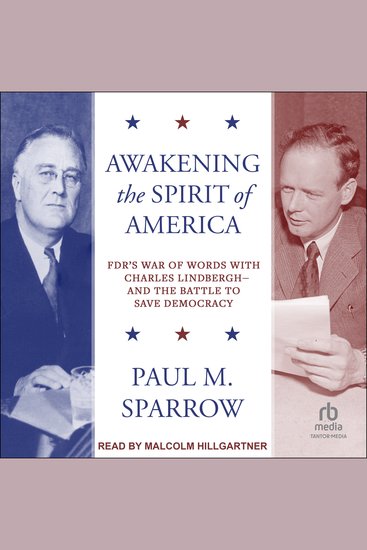
    Franklin Roosevelt awoke on September 1, 1939 to the news that Germany invaded Poland, signaling the start of World War II. The president warned for years that Hitler's fascist regime posed an existential threat to democracy, but the American public remained stubbornly isolationist as fascist sympathizing groups, egged on by right wing media stars promoting anti-Semitic conspiracy theories, plotted to overthrow the president. 


    The situation was dire, and Roosevelt found himself facing an unexpected adversary: Charles Lindbergh. Wildly popular, the famed aviator's youthful charm, plainspoken rhetoric, and media magnetism earned him a massive following as he led an attack on FDR's policies. The German government provided secret funds to Lindbergh's Nazi followers as he led the radical America First Committee in an effort to prevent Roosevelt from aiding England's survival—and the world's. 


    Awakening the Spirit of America shows how Roosevelt overcame the forces aligned against him in a war against fascism. Paul Sparrow, former director of the FDR Presidential Library, reveals how FDR's triumph of leadership was by no means a foregone conclusion. Awakening the Spirit of America provides a riveting account of FDR's ultimate victory over pro-Nazi isolationists and provides vital insight into American history and an iconic president.
    Show book