Junte-se a nós em uma viagem ao mundo dos livros!
Adicionar este livro à prateleira
Grey
Deixe um novo comentário Default profile 50px
Grey
Assine para ler o livro completo ou leia as primeiras páginas de graça!
All characters reduced
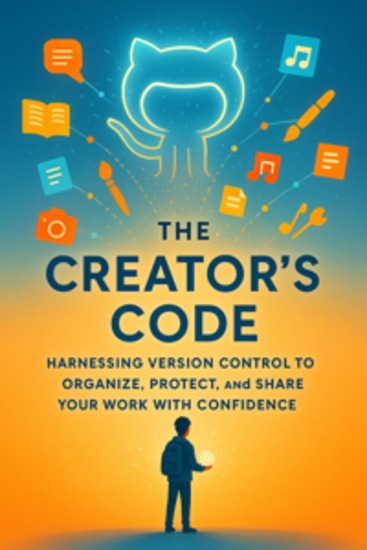
The Creator’s Code Harnessing Version Control to Organize Protect and Share Your Work with Confidence - cover
LER

The Creator’s Code Harnessing Version Control to Organize Protect and Share Your Work with Confidence

Oliver Kensington

Editora: BookRix

  • 0
  • 0
  • 0

Sinopse

GitHub isn’t just for programmers—it’s for anyone who creates. From writers and designers to students and researchers, the ability to track changes, manage versions, and collaborate seamlessly is now a core professional skill. The Creator’s Code brings the power of version control into the hands of non-coders, showing you how to use GitHub to transform the way you create, protect, and share your work.Through clear explanations and step-by-step guidance, this book breaks down intimidating tech concepts into practical skills you can apply immediately. You’ll learn how to save every draft, avoid accidental losses, collaborate effectively, and showcase your projects to the world—all without needing to write a single line of code.Perfect for students and creators of all backgrounds, this book unlocks the tools professionals use to stay organized, efficient, and future-ready. Don’t just make projects—manage them like a pro.
Disponível desde: 06/09/2025.

Outros livros que poderiam interessá-lo

  • Vagus Nerve and Polyvagal Theory The: Exploring the Neurophysiological Foundations of Healing Communication and Self-Regulation to Overcome Anxiety Trauma Inflammation Mental Stress & More - cover

    Vagus Nerve and Polyvagal Theory...

    Yumi Park

    • 0
    • 0
    • 0
    Harness the Power of the Vagus Nerve and Change Your Life! 
    The Vagus Nerve and Polyvagal Theory invites you on an enlightening journey deep into the intricate web of our neurophysiology, uncovering the remarkable power of the vagus nerve and the transformative potential of the Polyvagal Theory. 
    In this audiobook, delve into the hidden mechanisms that influence healing, communication, and self-regulation, offering a path to overcome anxiety, trauma, inflammation, mental stress, and a range of other challenges. 
    Unlock a treasure trove of practical knowledge, empowering techniques, and light-hearted explanations that anyone can appreciate. 
    Explore actionable steps to harness the innate healing potential of the vagus nerve and activate the Polyvagal Theory in your own life so you can finally live the peaceful, mentally stable life that you deserve. 
    You’ll also discover:How to cultivate a deeper connection with yourself: Get to know your own body, mind, and emotions, allowing for profound self-discovery and personal growth.Practical exercises to incorporate the theory in your daily life: Develop the tools needed to promote healing, improve communication, and establish a foundation of balance and resilience.Everything you need to know about the Vagus Nerve: These audiobooks explain everything in a friendly, and easy to follow way without skimping over important information.And more! 
    Whether you're a healthcare professional, therapist, researcher, or an individual seeking to enhance your overall well-being, this 2-in-1 offers invaluable insights and transformative guidance that you can’t get anywhere else.Scroll up, Get Your Copy, and Unlock the Healing Potential of the Vagus Nerve!
    Ver livro
  • Russian Cities - Saint Petersburg’s and Stalingrad’s History - cover

    Russian Cities - Saint...

    Kelly Mass

    • 0
    • 0
    • 0
    This bundle contains two different books about Russia: 
    Stalingrad - Stalingrad has changed names. It's now called Volgograd and is still one of the largest cities in Russia. But we can't ignore the fact that for a significant time in history, it was called Stalingrad, named after the tyrant and leader of the Soviet Union in the Second World War, Joseph Stalin. Let's explore the history of this city during the Second World War, and why the battles fought there were so horrendous and pivotal in history. 
    At the time of the Battle of Stalingrad In Southern Russia, Germany and its allies combated the Soviet Union for control of Stalingrad (now Volgograd). It is just one of the bloodiest engagements in the history of warfare, with an approximated 2 million general losses. It's marked by intense close-quarters battle and direct attacks on people in air campaign. The German High Command was pushed to eliminate substantial army forces from other theaters of war after their defeat at Stalingrad. 
    St. Petersburg - St Petersburg's structures lay over the skeletons of the press-ganged servant workers who worked to build it, making it the label "the city built on bones." Historians approximate that 100,000 18th-century serfs are buried underneath the city's stunning Italianate estates and large Parisian-style streets. 
    They passed away of cold, appetite, illness, or, if they were truly unfortunate, wolves. They were drawn from all around the Russian Empire at the time. They dedicated their lives for the magnificence of Imperial Russia, and the city they built, St Petersburg, stands as a testimony to the Russian state's single-mindedness. 
    Its extravagant palaces radiate European elegance and were actively built in a Western way to bring Russia closer to Europe.
    Ver livro
  • History of Iran - Events Turning Points Religion and Empirical Conquests - cover

    History of Iran - Events Turning...

    Kelly Mass

    • 0
    • 0
    • 0
    The history of Iran, once known as Persia in the Western world until the mid-twentieth century, is deeply intertwined with the history of a much broader region, referred to as Greater Iran. This expansive area stretches from Anatolia in the west to the borders of ancient India and the Syr Darya in the east, and from the Caucasus and Eurasian Steppe in the north to the Persian Gulf and the Gulf of Oman in the south. This vast territory has been home to a series of powerful civilizations and empires, each contributing to Iran's rich and complex history. 
    Iran's historical roots date back to around 7000 BC, with evidence of ancient settlements that make it one of the world's oldest continuous major civilizations. From the Early Bronze Age onward, the southwestern and western regions of the Iranian Plateau became integrated into the broader tapestry of the Ancient Near East. Early inhabitants such as the Elamites, followed by the Kassites, Mannaeans, and Gutians, played significant roles in shaping the region's cultural and political landscape. The Persians themselves are often regarded as the "first historical people" by the philosopher Georg Wilhelm Friedrich Hegel, reflecting their pivotal role in the development of world history. 
    In 625 BC, the Medes, a people native to the Iranian Plateau, succeeded in uniting Iran into a single nation and empire. This marked the beginning of the country's transformation into a major power. However, it was the Achaemenid Empire, founded by Cyrus the Great in 550 BC, that truly set Iran on the global stage. Under Cyrus, the Achaemenid Empire became the first true superpower in history, stretching across three continents—from the Balkans and North Africa to Central Asia.
    Ver livro
  • A History of Ancient Egypt’s Most Famous Sites - cover

    A History of Ancient Egypt’s...

    Editors Charles River

    • 0
    • 0
    • 0
    Africa may have given rise to the first humans, and Egypt probably gave rise to the first great civilizations, which continue to fascinate modern societies across the globe nearly 5,000 years later. From the Library and Lighthouse of Alexandria to the Great Pyramid at Giza, the Ancient Egyptians produced several wonders of the world, revolutionized architecture and construction, created some of the world’s first systems of mathematics and medicine, and established language and art that spread across the known world.  
    For almost four millennia, the Great Pyramids of Ancient Egypt have been widely hailed as the single greatest archeological feat man has ever accomplished. The Great Pyramid at Giza is the only one of the seven wonders of the ancient world to have survived into the modern age. Unlike so many pieces of the historical record which have been “re-discovered,” relatively recently (in the grand scheme of things,” in their four thousand years of existence, the Great Pyramids have never allowed themselves to be truly forgotten by the human civilization which has never ceased to regard them with wonder and awe. 
    Egypt also impressed its contemporaries. The 5th century B.C. Greek historian Herodotus wrote that Egypt was “the gift of the Nile” because the river made its soil so fertile and thus helped create one of the first great civilizations. Indeed, the land of Egypt so impressed the Greeks that when Alexander the Great conquered the Nile Valley in the 4th century B.C., he decided that he would build a new city on its soil and name it Alexandria. After Alexander, the city of Alexandria grew and became the most important city in the world for centuries as it watched and played a role in the rise and fall of numerous dynasties. The city also became home to one of the Seven Wonders of the Ancient World – the Lighthouse of Alexandria – and a center of culture and learning, which was exemplified by the Library of Alexandria.
    Ver livro
  • Tyrannosaurus Rex and Velociraptors: The History of the Cretaceous Period’s Most Famous Carnivores - cover

    Tyrannosaurus Rex and...

    Editors Charles River

    • 0
    • 0
    • 0
    The massively popular 1990 novel Jurassic Park by Michael Crichton and its subsequent movie adaptations led to a huge resurgence in interest in dinosaurs and the prehistoric world. That interest continues to the present day, even though most of the dinosaurs in Jurassic Park weren’t actually from the Jurassic period. Triceratops, Velociraptor, Tyrannosaurus Rex and the huge sauropods such as Brachiosaurus that feature in the book and movies all actually belong to the Late Cretaceous period, more than 40 million years after the end of the Jurassic. Regardless, certain kinds of dinosaurs remain instantly recognizable, and among them, the “king” is undoubtedly the Tyrannosaurus.  
    The first discovery of a Tyrannosaurus was made in 1902 and the largest carnivorous dinosaur ever found at the time quickly gripped the popular imagination. Even its name was dramatic - Tyrannosaurus Rex means “King of the Tyrant Lizards.” The T-Rex as it quickly became known didn’t appear until the last age of the Late Cretaceous period, the Maastrichtian, but when it did, it was the biggest and most terrifying of all the theropod predators.  
    	Thanks to the movie, there has been some unwitting confusion over the identity of the Velociraptor, and this confusion was due in large part to the fact the name sounds far more scary than the creature to which the name originally belonged. Moreover, the creature to which the label was applied in the novel and movie was actually a distant cousin named Deinonychus, but as the story goes, the author, Michael Crichton, thought “Velociraptor” sounded “more dramatic.” The actual Velociraptor lived not in the badlands of North America, but in the badlands of central-eastern Asia, and it was not nearly as intimidating as Deinonychus. In fact, the main species of genus Velociraptor - Velociraptor mongoliensis - was no bigger than a turkey.
    Ver livro
  • Stand Up! A Message to the Black Man - A Message of Hope and a Call to Action! - cover

    Stand Up! A Message to the Black...

    Alan D. Benson

    • 0
    • 0
    • 0
    Stand Up! A Message to the Black Man" is a powerful and inspiring book by Alan D. Benson that serves as "A Message of Hope and a Call to Action" for Black men. Benson, who holds an MBA and MPA, draws upon his own life experiences and extensive research to address the unique challenges and opportunities Black men face in America. 
    Key themes and insights in "Stand Up! A Message to the Black Man" include: 
    ●      Manifesting Purpose and Action Planning: Benson introduces his "PLOT" system (Purpose, Limitations, Opportunities, and Traps) as a self-reflection tool to help individuals align with their purpose and develop actionable strategies for success in various aspects of life, including education, career, finance, and health. 
    ●      Building Economic Foundation: A significant portion of the book is dedicated to the critical need for Black men to create their own economic foundation through investing in stocks, assets, and businesses, highlighting historical Black entrepreneurs and discussing wealth-creating strategies. 
    ●      Resilience and Forward Movement: The book consistently emphasizes faith, perseverance, and the importance of learning from setbacks, urging readers to "Keep Going Forward at All Costs". It highlights successful Black figures who have overcome significant adversity as an inspiration. 
    "Stand Up! A Message to the Black Man" is an urgent and empowering message for Black men to take control of their narratives, build strong foundations for themselves and their communities, and strive for their God-given potential in a constantly evolving society.
    Ver livro