Rejoignez-nous pour un voyage dans le monde des livres!
Ajouter ce livre à l'électronique
Grey
Ecrivez un nouveau commentaire Default profile 50px
Grey
Abonnez-vous pour lire le livre complet ou lisez les premières pages gratuitement!
All characters reduced
Social Rank Dynamics - cover

Social Rank Dynamics

Ocean Ecosoft

Traducteur A AI

Maison d'édition: Publifye

  • 0
  • 0
  • 0

Synopsis

"Social Rank Dynamics" explores the fascinating world of social hierarchies, examining how status, power, and influence shape our behavior in various settings. It argues that hierarchies aren't simply imposed but emerge from ongoing negotiations involving status cues, resource control, and group dynamics. Interestingly, individuals constantly vie for position, solidifying their rank or adapting to changes, highlighting the fluid nature of these systems. This book provides tools for navigating social environments and addressing inequality.

 
The book begins by defining key concepts like status, dominance, and prestige, then delves into the evolutionary roots of hierarchies. A significant portion focuses on status cues, analyzing how individuals signal their position through verbal and nonverbal communication and how these cues are interpreted by others. Furthermore, it investigates the influence of group behavior, such as conformity and coalition formation, on maintaining these hierarchies.

 
Imagine a flock of birds, each vying for the best spot, constantly adjusting to each other's movements – this illustrates the dynamic nature of social rank. Drawing from social psychology, evolutionary biology, and organizational behavior, this book emphasizes the dynamic nature of status negotiation, moving beyond static models to consider the subtle ways individuals influence and are influenced by their environment.

 
The book progresses across chapters to provide a balanced and rigorous analysis of the available evidence. Understanding these dynamics is crucial for promoting fairer and more equitable social structures.
Disponible depuis: 21/02/2025.
Longueur d'impression: 82 pages.


D'autres livres qui pourraient vous intéresser

  • Growth Modernity and the Nations of Wealth - A new theory explaining the mysterious rise of modern economic growth - cover

    Growth Modernity and the Nations...

    Dwight Semler

    • 0
    • 0
    • 0
    Eric Humphrey and Dwight Semler present a new theory explaining the mysterious historical emergence of modern economic growth and its even more baffling offspring, modernity. Noticeable changes in material life began less than three centuries ago, but previous theoretical accounts have failed to explain their arrival. Thinkers assumed modern wealth and morality were the universal standard driving human history. They assumed modern rights and riches were natural and normal. In this way they thought of such things as ends rooted in human nature, rather than deriving them as consequences from a historical, nonmodern baseline. Misdirected, they set out to liberate the imprisoned modern homunculus who "caused modernity" through moral education and economic institutions. Modernity became an "awareness problem." Yet this high-maintenance modern self and its ever-growing needs are a consequence of modern processes rather than their cause. Consequently, theorists of the modern world produced comically omnipotent notions of human agency. Marxists and developmental economists saw modernity as a moral or material self-realization project, requiring only a liberator or engineer. But when their God-of-Genesis model failed the facts, they overreacted and defaulted to its alter ego—humans were passive leaves in the wind of history. Modernity thus oscillates between a chosen destiny and a given fate. With modernity represented as a historical fate, all pretense of a grand theoretical view vanishes in thick description of one damn thing after another, and the historian's rote chronology replaces any theoretical causality, as a specific description of a particular falling rock replaces a general theory of gravity. Understanding the modern world and how it came to be, argue the authors, is less a matter of facts than of the foundational assumptions used to link facts together into robust and coherent theories. We must un-assume our modern selves and give poverty and illiberality their just historical due. With better and more scientifically consistent assumptions, they argue, the old facts of history can be seen in a new way. Then the solution to understanding the most puzzling and abnormal of human events, the modern world itself, turns out to be hiding in plain sight.
    Voir livre
  • The Tiger from Poznań - cover

    The Tiger from Poznań

    Richard Siegert

    • 0
    • 0
    • 0
    In the Second World War, Poznan was a key river crossing and railway junction on the Polish-German border. When the alarm was given indicating the Red Army's approach in January 1945, the city's 80-100,000 German civilians were speedily evacuated, leaving a garrison of some 15,000 men, mostly poorly-armed infantry, to face the rigors of a siege conducted by a massively superior and ruthless enemy anxious to acquire this transport center, which was vital for the advance on Berlin. 


    This is the account of Eastern Front veteran Richard Siegert, the gunner and later commander of the defenders' sole Tiger tank. Since the death of the driver in a futile attempt to escape from a PoW camp in Russia just after the end of the war, Siegert is the only survivor of that crew able to pass its record on to posterity. His account details how the crew fought gallantly against impossible odds, even when the Tiger was immobilized and could only act as a stationary antitank gun post or pillbox during the last heroic days' fighting for the citadel.
    Voir livre
  • Curious Connected & Calm - How leaders are better together - cover

    Curious Connected & Calm - How...

    Stephanie Bown

    • 0
    • 0
    • 0
    Together is better, but only if you turn up and lean in. 
    High performing teams are teams in synergy - where the whole is greater than the sum 
    of its parts. 
    This is especially important for directors and leadership teams who face unprecedented 
    market dynamics. Their individual and organisational success depends on their capacity 
    to form bonds of trust that allow them to show up, have courage, welcome open dissent, 
    and explore new solutions to adaptive challenges. 
    In this book, high performance leadership coach Stephanie Bown explores team synergy 
    as the intersection between independent thinking and collective capacity with the goal 
    of amplifying the potential for great people to come together to achieve amazing things.
    Voir livre
  • Vrnda Devi The Beautiful Yoga Of Devotion - The Mother Goddess - cover

    Vrnda Devi The Beautiful Yoga Of...

    Sripad Jagannatha Das

    • 0
    • 0
    • 0
    "Dear Tulsī, you are much beloved by Lord Kṛṣṇa because your leaves are always at His lotus feet. Dear mālatī flower, dear mallikā flower, dear jasmine flower, all of you must have been touched by Kṛṣṇa while He was passing this way after giving us transcendental enjoyment. Have you seen Mādhava passing this way? O mango trees, O trees of jackfruit, O pear trees and āsana trees! O blackberries and bael trees and trees of the kadamba flower—you are all very pious trees to be living on the bank of the Yamunā. Kṛṣṇa must have passed through this way. Will you kindly let us know which way He has gone?" The Srimad Bhagavatam 
     
    Tulsi Devi (Vrinda - Holy Basil) is a sacred plant in Hindu belief. She is regarded as an earthly manifestation of the goddess Srimati Tulsi Devi, and is as an avatar of Lakshmi, and thus the consort of Vishnu. The offering of her leaves is mandatory in the worship of Bhagavan Sri Krishna. Tulsi is regarded as the holiest of all plants and a bridge between heaven and earth. A traditional prayer teaches the creator Brahma and the Ganges resides in her branches, all holy pilgrimage centers in her roots, all deities are in her stem and leaves, and the Vedas are found in the upper part of her branches. The Tulsi herb is a center of household devotion, and is often referred to as the "women's deity" and "a symbol of wifehood and motherhood." Vaishnavites consider it as the manifestation of god in the plant kingdom. Tulsi Devi is one of Krishna’s most intimate servants coming to bless us all with extraordinary fortune. She has delicate purple and green leaves, flower tassels (like miniature temple spires), and an arresting, sweet fragrance famous for attracting the minds of yogis to Krishna’s service via Bhakti Yoga. Tulasi’s wood is carved into the Japa beads on which devotees chant Krishna’s holy name.
    Voir livre
  • When We Spoke to the Dead - How Ghosts Gave American Women Their Voice - cover

    When We Spoke to the Dead - How...

    Ilise S. Carter

    • 0
    • 0
    • 0
    Ghosts spoke. Women listened. Everything changed. 


    In the 1840s, the Fox Sisters—and the legions of mediums they inspired—ignited the Spiritualist movement that swept through Victorian parlors and presidential campaigns alike. Contacting the dead wasn't merely a parlor trick: It was a political statement, a declaration of self that still echoes. Séances attracted suffragists and scientists, skeptics and charlatans, giving women a voice in a society that often refused to hear them. But as Spiritualism surged, it also blurred the lines between faith, fraud, feminism, and financial opportunity, drawing figures as varied as Harry Houdini, Victoria Woodhull, and even modern self-help gurus into its ever-expanding orbit. 


    From wartime séances to the rise of televangelists, from Victorian ghosts to goop-approved wellness rituals, When We Spoke to the Dead unearths the forgotten roots of today's obsession with manifestation, mysticism, and the power of belief. Exploring America's deep-seated hunger for the unseen—whether through politics, personal empowerment, or grief—this book traces how the supernatural, once condemned as heresy, became the ultimate commodity.
    Voir livre
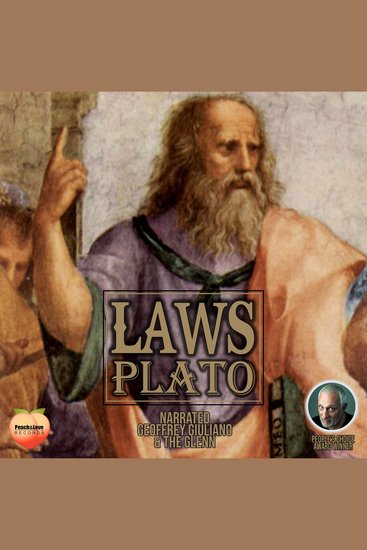
  • Laws - cover

    Laws

    Plato

    • 0
    • 0
    • 0
    Laws is Plato's last and longest dialogue. It is generally agreed that Plato wrote this dialogue as an older man, having failed in his effort in Syracuse on the island of Sicily to guide a tyrant's rule, instead having been thrown in prison 
     
    The Classical Greek philosopher Plato was instrumental in the development of Western philosophy and science. Plato was born to an aristocratic family and was well-educated. He founded the Academy, one of the first institutions of higher learning, around 385 BC. Plato was highly influenced by his teacher, Socrates. Socrates was condemned to death after being accused of corrupting his young followers. After Socrates' death, Plato recorded several dialogues detailing what he remembered from Socrates' teachings and interactions with others. Almost everything known about Socrates comes from Plato's dialogues. Plato's writings have been revised and interpreted by a variety of publishers.
    Voir livre