Join us on a literary world trip!
Add this book to bookshelf
Grey
Write a new comment Default profile 50px
Grey
Subscribe to read the full book or read the first pages for free!
All characters reduced
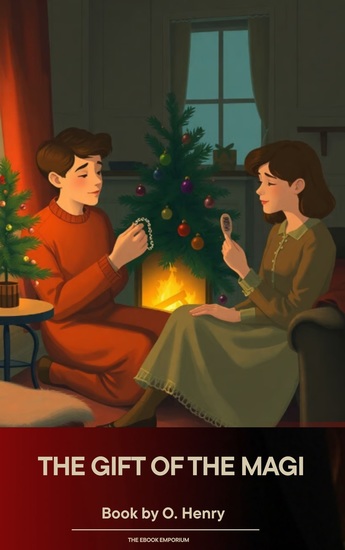
The Gift of the Magi - cover

The Gift of the Magi

O. Henry

Publisher: The Ebook Emporium

  • 0
  • 0
  • 0

Summary

"Two treasures, one dollar and eighty-seven cents, and a love that outweighed them both."

In a modest New York apartment, Della and Jim Young are "poor in purse but rich in spirit." With Christmas approaching and only pennies to their names, each decides to keep a secret from the other. To buy a worthy gift for her husband, Della makes a heartbreaking sacrifice of her most prized possession; meanwhile, Jim does the same to honor his wife. What follows is a masterclass in situational irony that culminates in a poignant realization: the most valuable gifts aren't the ones that come in boxes, but the ones that come from the heart.

The Master of the Twist Ending: O. Henry is world-renowned for his "smile-and-a-tear" endings. In this story, he uses irony not to mock his characters, but to elevate them. By showing how their "foolish" gifts were actually the wisest of all, he redefines the meaning of the biblical Magi for a modern audience.

A Snapshot of Old New York: Set against the backdrop of the early 20th-century city, the story captures the struggles of the working class with warmth and dignity. It's a relatable, human story about navigating financial hardship without losing one's sense of wonder or devotion.

Why It Is a Universal Classic: The Gift of the Magi is a story for every season. Its message—that the greatest treasure is the person standing beside you—resonates as strongly today as it did over a hundred years ago. It is a quick but profound read that will stay with you long after the final page is turned.

Rediscover the beauty of sacrifice. Purchase "The Gift of the Magi" today.
Available since: 01/16/2026.
Print length: 10 pages.
Other books that might interest you

  • What I Saw in America (Unabridged) - cover

    What I Saw in America (Unabridged)

    G. K. Chesterton

    • 0
    • 0
    • 0
    Journalist, novelist, poet, artist and art critic, essayist, theologian, propagandist, philosopher, and creator of the wily old Father Brown - G. K. Chesterton is one of the most beguiling authors of the early twentieth century. When asked to perform a lecture tour in 1921, Chesterton was in a slump of depression. He had recently lost his brother to the First World War and his wavering faith in the face of the horrors of the conflict only intensified his malaise. 'What I Saw in America' tells us as much about the author and his particular views as it does about his destination. Indeed, Chesterton's personalised observations - his aversion to imperialism, capitalism, Anglo-Americanism and his commitment to democracy and fraternity - are distinguished by the piercing wit for which he is famed.
    Show book
  • Dracula's Guest - cover

    Dracula's Guest

    Bram Stoker

    • 0
    • 0
    • 0
    Title: Dracula’s Guest 
    Author: Bram Stoker 
    Narrator: Jonathan Dunne 
    Original Publication: 1914 
    Public Domain: Yes 
    Series Placement: Number 8 in the Timeless Terrors series 
    Description: 
    Dracula’s Guest by Bram Stoker is a haunting Gothic tale that serves as a chilling prelude to the legendary novel Dracula. First published posthumously in 1914, this short story follows an unnamed Englishman—implied to be Jonathan Harker—who strays from his coach during a journey through the Bavarian countryside on Walpurgis Night. 
    What begins as a simple detour soon descends into an atmosphere of mounting dread, as he encounters desolate graveyards, supernatural portents, and an unseen force that foreshadows the terror awaiting him in Transylvania. 
    Stoker weaves an unsettling blend of folklore, suspense, and atmospheric horror, capturing the eerie allure of the Gothic tradition. This recording, narrated by Amazon bestselling horror author Jonathan Dunne, immerses listeners in the tale’s dark landscapes and spectral menace. While the text itself is in the public domain, this performance is an original work and copyright © 2025 Jonathan Dunne. 
    Prepare to step into a shadowed world of ancient superstition and nocturnal terror—a fitting overture to one of literature’s most enduring vampire myths.
    Show book
  • Blue & Green - From their pens to your ears genius in every story - cover

    Blue & Green - From their pens...

    Virginia Woolf

    • 0
    • 0
    • 0
    Adeline Virginia Woolf was born on the 25th January 1882 in South Kensington in London. 
    Although lauded as a founder of modernist writing with such classics as ‘Orlando’, ‘Mrs Dalloway’ and ‘To the Lighthouse’ and, of course, many classic short stories, her background is filled with elements of tragedy that she somehow overcame to become such a revered writer.   Her mother died when she was 13, her half-sister Stella two years later and with it her first of several nervous breakdowns.  Appallingly it was later found that three of her half-brothers had sexually abused her so darkness must have seemed ever present.   
    She began writing professionally at age 20 but her father’s death two years later brought a complete mental collapse and she was briefly institutionalised.  Somehow she found within herself a literary career and with it great innovations in writing; she was a pioneer of “stream of consciousness”.    
    Her tight circle of friends were the founders of the Bloomsbury Group, a movement whose legacy still influences across the arts and society in many way to this day.   
    Whilst the dark periods continued to interrupt her emotional state her rate of work never ceased.  Until, on 28th March 1941, Woolf put on her overcoat, filled up its pockets with stones, and walked into the River Ouse, in Lewes, East Sussex and drowned herself.  Her body was not recovered until the 18th April.  She was 59. 
    She left behind a note which read in part “Dearest, I feel certain that I am going mad again.  I feel we can't go through another of those terrible times.  And I shan't recover this time.  I begin to hear voices, and I can't concentrate.  So I am doing what seems the best thing to do”.
    Show book
  • General Custer - Folly At Little Bighorn - The Classic Tale - cover

    General Custer - Folly At Little...

    Elizabeth Bacon Custer

    • 0
    • 0
    • 0
    Since the Battle of Little Bighorn, George Armstrong Custer (1839-1876) possessed one of the most unique places in American history. Although he was a capable cavalry officer who served honorably during the Civil War, he remains one of the most instantly identifiable and famous military men in American history due to the fact he was killed during one of the country’s most well known and ignominious defeats, the Battle of Little Bighorn. And yet, this one relatively insignificant battle during America’s Indian Wars has become one of the country’s most mythologized events and continues to fascinate Americans nearly 140 years later. Though he’s now best remembered for “Custer’s Last Stand”, Custer mastered the art of public relations, dressing impeccably and having newspaper correspondents accompany him on the campaign, all in an effort to help cultivate and enhance his legacy.  
     
    For nearly 58 years, Elizabeth Bacon Custer was probably the most famous widow in the world. In this lively, fascinating, loving portrait of life on the plains with her already-famous husband, Libbie tells a civilized audience of the excitement, fun, and perils endured at a remote frontier post. Intelligent and beautiful, Libbie was a partner, confidant, and booster to the general, as well as an important figure in the social life of the posts he commanded. This book has been used as source material on the general's life as well as the frontier army for well over a century. Celebrated among the prominent people of her day, Libbie never remarried after Custer's death at the Little Bighorn in 1876. She spent the rest of her life writing and lecturing about him, burnishing his reputation and keeping his memory alive. Long a jewel of western Americana, this book continues to find and entertain new audiences in the 21st century.
    Show book
  • The Tempest - cover

    The Tempest

    William Shakespeare

    • 0
    • 0
    • 0
    The Tempest is a play by English playwright William Shakespeare, probably written in 1610-1611, and thought to be one of the last plays that Shakespeare wrote alone. After the first scene, which takes place on a ship at sea during a tempest, the rest of the story is set on a remote island, where the sorcerer Prospero, a complex and contradictory character, lives with his daughter Miranda, and his two servants: Caliban, a savage monster figure, and Ariel, an airy spirit. The play contains music and songs that evoke the spirit of enchantment on the island. It explores many themes, including magic, betrayal, revenge, and family. In Act IV, a wedding masque serves as a play-within-a-play, and contributes spectacle, allegory, and elevated language.
    Although The Tempest is listed in the First Folio as the first of Shakespeare's comedies, it deals with both tragic and comic themes, and modern criticism has created a category of romance for this and others of Shakespeare's late plays. The Tempest has been put to varied interpretations, from those that see it as a fable of art and creation, with Prospero representing Shakespeare, and Prospero's renunciation of magic signaling Shakespeare's farewell to the stage, to interpretations that consider it an allegory of Europeans colonizing foreign lands.
    Show book
  • Contemporary Novel The (Unabridged) - cover

    Contemporary Novel The (Unabridged)

    H. G. Wells

    • 0
    • 0
    • 0
    Herbert George Wells (21 September 1866 - 13 August 1946) was an English writer. Prolific in many genres, he wrote dozens of novels, short stories, and works of social commentary, history, satire, biography and autobiography. His work also included two books on recreational war games. Wells is now best remembered for his science fiction novels and is often called the "father of science fiction", along with Jules Verne and the publisher Hugo Gernsback.
    THE CONTEMPORARY NOVEL: Circumstances have made me think a good deal at different times about the business of writing novels, and what it means, and is, and may be; and I was a professional critic of novels long before I wrote them.
    Show book