Join us on a literary world trip!
Add this book to bookshelf
Grey
Write a new comment Default profile 50px
Grey
Subscribe to read the full book or read the first pages for free!
All characters reduced
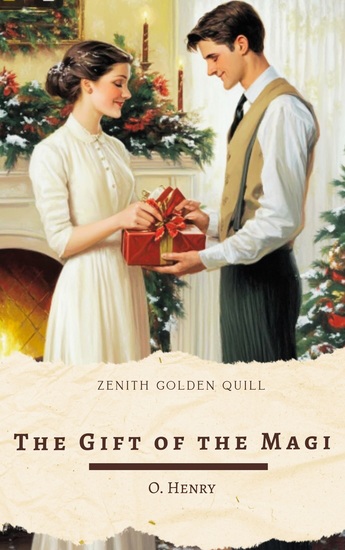
The Gift of the Magi - A Short Story That Defines the True Meaning of Giving - cover

The Gift of the Magi - A Short Story That Defines the True Meaning of Giving

O. Henry, Zenith Golden Quill

Publisher: Zenith Golden Quill

  • 0
  • 0
  • 0

Summary

Two gifts. One sacrifice. A love story remembered for generations.

The Gift of the Magi is O. Henry's most beloved short story—an enduring classic of holiday literature. Set on Christmas Eve, it follows a young couple, Jim and Della, who are deeply in love but financially poor. Each secretly sells their most prized possession to buy a gift for the other, leading to an ironic and heartwarming twist that speaks volumes about selfless love.

Praised for its simplicity, emotional depth, and masterful ending, this story continues to move readers of all ages with its message of true generosity and devotion.

This illustrated and annotated edition includes background on O. Henry, story commentary, and discussion prompts—perfect for holiday reading, classrooms, or gift-giving.

"The most perfect short story ever written in English." — The Atlantic
"A story that captures the spirit of Christmas better than any other." — The New York Times

Click Buy Now to rediscover the classic that proves love is the greatest gift of all.
Available since: 05/16/2025.
Print length: 72 pages.

Other books that might interest you

  • Les Misérables: Volume 2: Cosette - Book 3: Accomplishment of the Promise Made to the Dead Woman (Unabridged) - cover

    Les Misérables: Volume 2:...

    Victor Hugo

    • 0
    • 0
    • 0
    Victor-Marie Hugo (26 February 1802 - 22 May 1885) was a French poet, novelist, essayist, playwright, and dramatist of the Romantic movement. During a literary career that spanned more than sixty years, he wrote abundantly in an exceptional variety of genres: lyrics, satires, epics, philosophical poems, epigrams, novels, history, critical essays, political speeches, funeral orations, diaries, and letters public and private, as well as dramas in verse and prose.
    BOOK 3: ACCOMPLISHMENT OF THE PROMISE MADE TO THE DEAD WOMAN: Montfermeil is situated between Livry and Chelles, on the southern edge of that lofty table-land which separates the Ourcq from the Marne. At the present day it is a tolerably large town, ornamented all the year through with plaster villas, and on Sundays with beaming bourgeois.
    Show book
  • Emma - cover

    Emma

    Jane Austen

    • 0
    • 0
    • 0
    Emma, is a novel about youthful hubris and romantic misunderstandings. It is set in the fictional country village of Highbury and the surrounding estates of Hartfield, Randalls and Donwell Abbey, and involves the relationships among people from a small number of families. The novel was first published in December 1815, with its title page listing a publication date of 1816. As in her other novels, Austen explores the concerns and difficulties of genteel women living in Georgian–Regency England. Emma is a comedy of manners, and depicts issues of marriage, sex, age, and social status.Before she began the novel, Austen wrote, "I am going to take a heroine whom no one but myself will much like."  In the first sentence, she introduces the title character as "Emma Woodhouse, handsome, clever, and rich, with a comfortable home and a happy disposition... had lived nearly twenty-one years in the world with very little to distress or vex her." Emma is spoiled, headstrong, and self-satisfied; she greatly overestimates her own matchmaking abilities; she is blind to the dangers of meddling in other people's lives; and her imagination and perceptions often lead her astray.Emma, written after Austen's move to Chawton, was her last novel to be published during her lifetime, while Persuasion, the last complete novel Austen wrote, was published posthumously.The novel has been adapted for a number of films, television programmes and stage plays.Jane Austen was an English novelist known primarily for her six major novels, which interpret, critique, and comment upon the British landed gentry at the end of the 18th century. Austen's plots often explore the dependence of women on marriage in the pursuit of favorable social standing and economic security. Her works critique the novels of sensibility of the second half of the 18th century and are part of the transition to 19th-century literary realism.
    Show book
  • The Napoleon of Notting Hill - cover

    The Napoleon of Notting Hill

    G. K. Chesterson

    • 0
    • 0
    • 0
    When dystopian futures don’t feel so future at all…   Four decades before George Orwell wrote 1984, The Napoleon of Notting Hill defined the dystopian genre. One of the first dystopian comedies, instead of a dark vision of jackboots and surveillance states, G.K. Chesterton explores the question of what a society would look like if no one could take a joke.   In this future England, each new king is decided by lottery. When Auberon Quin, a man who cares only for a good joke, is chosen to be the next king, he resolves to spend his reign teaching his fellow governors how big a joke can really be.   While most district leaders are content to put up with Auberon’s schemes even when he insists upon elaborate costumes and heraldry, one provost takes his games much too seriously. When Adam Wayne, the Provost of Notting Hill, takes a military stand against his fellow leaders and seeks to defend his tiny fiefdom by any means necessary, Auberon’s joke has gone too far.   At a time when the dystopian genre is defined by hopelessness, Chesterton’s dry wit and tongue-in-cheek humor are a welcome respite. Follow Auberon and Wayne as they ponder the meaning of humor and virtue in a world where the swords are all too real and the defense of one’s pride may well result in blood in the streets.   Foreword by Dale Ahlquist, president of the Society of G.K. Chesterton.
    Show book
  • Comanche Conflict (Stonecroft Saga Book 14) - A Historical Western Novel - cover

    Comanche Conflict (Stonecroft...

    B.N. Rundell

    • 0
    • 0
    • 0
    BULLETS, BLOOD, DEATH AND VENGEANCE FILLED THE VALLEY AS BITTER ENEMIES CLASHED. 
    Gabe and company spent the winter with the Mouache Ute but the buffalo hunt was watched by a hunting party of Yaparuhka Comanche. That hunting party soon became a raiding party and the blood began to flow. 
    When the Northern Arapaho descend on the plains, the bitter enemies of the Comanche riled the warriors bent on vengeance to attack the Arapaho, and warriors died. But the cry for vengeance was directed at the white man and his people that were responsible for the deaths of Comanche warriors. 
    The quest for vengeance was misdirected and again the stench of death would fill the air.
    Show book
  • The Sorrows of Young Werther - cover

    The Sorrows of Young Werther

    Johann Wolfgang von Goethe

    • 0
    • 0
    • 0
    Enter the tormented heart of a young man overwhelmed by passion, beauty, and the crushing pain of unreturned love. In The Sorrows of Young Werther, Goethe presents the personal letters of Werther, a tender, idealistic artist who falls deeply for Charlotte—an alluring woman already engaged to someone else. 
    As Werther’s admiration turns into fixation, his thoughts on love, nature, art, and suffering become more intense and consuming. Framed by the scenic beauty of the German countryside, his emotional journey unfolds into a moving exploration of yearning, heartbreak, and the blurry boundary between romantic idealism and emotional collapse. 
    A defining work of the Sturm und Drang era and a seminal piece of Romantic literature, The Sorrows of Young Werther is far more than a love story—it’s a raw, lyrical outpouring from a soul in turmoil. It moved a generation and shocked Europe with its emotional candor and heartbreaking conclusion. 
    Whether you see it as a tragic love story or a reflection of your own quiet desires, Werther’s voice will linger long after you’ve turned the last page.
    Show book
  • Twilight Alley - An early 20th century of a man exploring the underworld of a French port city - cover

    Twilight Alley - An early 20th...

    Stefan Zweig

    • 0
    • 0
    • 0
    Stefan Zweig was born on the 28th November 1881 in Vienna, then part of the Austro-Hungarian Empire, and into a wealthy Jewish family with interests in banking and textiles. 
     
    He studied philosophy at the University of Vienna and achieved his degree in 1904. 
     
    Zweig first published in 1900 and two decades later was a popular and highly regarded author in many parts of the world, although not in England.    
     
    During the Great War he served in the Archives of the Ministry of War and supported Austria's war effort through his writings in the ‘Neue Freie Presse’.  Whilst his work praised his Country’s progress and, on occasions, its excesses and massacres, he later claimed, in his memoir, that he was a pacifist. 
     
    In 1912 he began an affair with the married, and mother or two, Friderike Maria von Winternitz, but it was only in 1920 that circumstances allowed them to marry.  She took care of much of his business interests and supported him artistically.  In this decade too many of his most famous works including the short stories; ‘Amok’, and ‘Letter from an Unknown Woman’ (filmed in 1948 by Max Ophüls), novels; ‘Confusion of Feelings’ and biographies including that on Marie Antoinette (filmed by MGM in 1938) were published. 
     
    He was also the librettist with Richard Strauss of two operas and a keen collector of autographed musical manuscripts.  His collection of over two hundred pieces was later donated to the British Library.  
     
    In 1934, Zweig, as a Jew, and finding life very difficult under his anti-Semitic government and the neighbouring Nazi’s persuaded him to leave Austria for England.   
     
    In 1940 Zweig, now divorced and married to his second wife, and former secretary, Lotte Altmann, left London and via New York moved to Petrópolis, a German-colonized town 50 miles north of Rio de Janeiro in Brazil.  Although he continued to write he became, along with his wife, increasingly depressed about the situation in Europe and the future for humanity,  
     
    His memoir ‘The World of Yesterday’ was completed on the 22nd February 1942. 
     
    The following day the Zweig’s were found in their house dead of a barbiturate overdose, holding each other’s hand.  He was 60.
    Show book