Join us on a literary world trip!
Add this book to bookshelf
Grey
Write a new comment Default profile 50px
Grey
Subscribe to read the full book or read the first pages for free!
All characters reduced
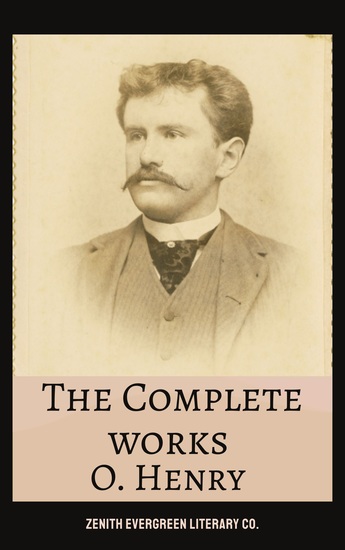
The Complete Works of O Henry - Masterpieces of Wit Irony and Unexpected Endings in One Timeless Collection - cover

The Complete Works of O Henry - Masterpieces of Wit Irony and Unexpected Endings in One Timeless Collection

O. Henry, Zenith Evergreen Literary Co.

Publisher: Zenith Evergreen Literary Co.

  • 0
  • 0
  • 0

Summary

Enter the clever, compassionate, and delightfully twisted world of O. Henry—America's unrivaled master of the short story.

O. Henry's stories are beloved for their brilliant use of irony, unforgettable characters, and astonishing twist endings. This complete collection brings together every one of his enduring tales—hundreds of them—all in one carefully formatted digital volume.

From the heartwarming charm of The Gift of the Magi to the humorous con-men of The Ransom of Red Chief, O. Henry's fiction captures the soul of early 20th-century America with warmth, wit, and wisdom.

📚 Includes:
✔ The Gift of the Magi
✔ The Ransom of Red Chief
✔ The Last Leaf
✔ A Retrieved Reformation
✔ All short story collections and standalone works

💬 Readers Say:
"Every story is a surprise—some joyful, some heartbreaking."
"Twist endings that still hold up over 100 years later."
"This collection is a goldmine for anyone who loves storytelling."

Perfect for fans of Edgar Allan Poe, Flannery O'Connor, Anton Chekhov, and classic short fiction, this digital treasury is essential for literature lovers and Kindle collectors.

📥 Download today and rediscover the magic of storytelling through the eyes of O. Henry.
Available since: 04/30/2025.
Print length: 2435 pages.


Other books that might interest you

  • A Fragment of Stained Glass - cover

    A Fragment of Stained Glass

    D H Lawrence

    • 0
    • 0
    • 0
    'A Fragment of Stained Glass' was written by D H Lawrence in 1911. Lawrence relates a story, supposedly from the Middle Ages, which tells of the possible triumph of love and the human spirit over the forces of religion, superstition and social injustice.
    Show book
  • Cain - From their pens to your ears genius in every story - cover

    Cain - From their pens to your...

    Alexander Kuprin

    • 0
    • 0
    • 0
    Alexander Kuprin was born in Narovchat, Penza in Russia on 7th September 1870. 
    At 3 his Father died and he and mother moved to Moscow. By 10 he was enrolled at the Second Moscow Military High School and there his interest in literature began. The Alexander Military Academy followed and two years later he was a sub-lieutenant and posted to an Infantry Regiment for a further four years. 
    Despite his duties he was a now a keen writer and published his first short story at this time. His military duties also garnered him experiences for his breakthrough work ‘The Duel’.  Leaving the military he left for Kiev to work for local newspapers.  He continued to publish both stories and novels and by 1901 he was in St Petersburg becoming part of a group that included Chekhov, Ivan Bunin, Maxim Gorky and Leonid Andreyev.  
    In the years that followed further controversial works and acclaim followed.  His comments on the regime meant he was also put under secret police surveillance.   
    As World War I erupted, Kuprin opened a military hospital but was then given command of an infantry company in Finland. He was soon discharged on grounds of ill health.  
    The October Revolution saw him praise Lenin, but he warned that the Bolsheviks threatened Russian culture and might cause further widespread suffering to the peasants.  As Civil War raged he took his family to Helsinki and then on to Paris. 
    Exile saw his talents decline further and his succumbing to alcoholism. He became lonely and withdrawn. The family's poverty increased his malaise.   
    In May 1937, the Kuprin’s returned to Moscow.  He now saw his work published but wrote almost nothing new.  In 1938 his health rapidly deteriorated.  Already suffering from a kidney problems and sclerosis, he had now developed cancer of the oesophagus.  
    Alexander Kuprin died on 25th August 1938.
    Show book
  • 3 Sad Stories - About Orphans - A trio of classic tales perfect for a commute walk or quiet night in - cover

    3 Sad Stories - About Orphans -...

    Anton Chekhov, Mary E Mann, Hans...

    • 0
    • 0
    • 0
    There is something about the number 3.    
     
    The Ancient Greeks believed 3 was the perfect number, and in China 3 has always been a lucky number, and they know a thing or two.   
     
    Most religions also have 3 this and 3 that and, of course, in these more modern times, three’s a crowd may be too many, except when it’s a ménage à trois.  It seems good things usually come in threes. 
     
    Whatever history and culture says WE think 3, a hat-trick of stories, is a great number to explore themes and literary avenues that classic authors were so adept at creating. 
     
    From their pens to your your ears.
    Show book
  • The Naming of Moths - cover

    The Naming of Moths

    Tracy Fells

    • 0
    • 4
    • 0
    THE NAMING OF MOTHS features stories of magical realism, myths and legends re-imagined, where all the characters are undergoing transformation or facing a pivotal moment of change in their lives. People and animals interchange their shapes. Story landscapes flit from fairy-tale woods to urban homes. Here love, hope and kindness weave between the realities of man's endless talent for cruelty.
    Show book
  • Horror Short Stories: Volume 1 - cover

    Horror Short Stories: Volume 1

    Willow Rose

    • 0
    • 0
    • 0
    Two frightening psychological thrillers. Better Watch Out: He sees you when you’re sleeping; he knows when you’re awake. Some kids are scared of the dark, others of monsters living under their beds. Some are even afraid of clowns. None of those things scare Sara. But she is terrified of one man who comes to her house every year in the middle of the night. Santa... Curl up with some frightening Christmas horror from the Queen of Scream, Willow Rose. Warning: You might not feel like putting out cookies for Santa ever again after listening to this short story. The Bird: Everyone's nightmare. When five-year-old Winnie finds a little bird that is hurt, she wants to take it in and take care of it. Her mother is reluctant. She is terrified of birds. As she rightfully should be... Two quick and scary listens, as only Willow Rose can deliver it. Get the audiobook today.
    Show book
  • Scenes of Clerical Life - cover

    Scenes of Clerical Life

    George Eliot

    • 0
    • 0
    • 0
    Three novellas that brilliantly portray English country and clergy life at the turn of the nineteenth century from the author of Middlemarch.   Initially appearing in Blackwood’s Magazine, this trio of linked stories comprises George Eliot’s first published work. Together they form a portrait of small-town life in Midlands, England, where changes are affecting both society at large and religious beliefs and institutions.   In “The Sad Fortunes of Reverend Amos Barton,” the clergyman struggles to raise funds for church repairs and perform his parochial duties, while a target of gossip—both good and bad. Meanwhile, few in Shepperton can find fault with his shy and hardworking wife, who cares for their six children, stretching Barton’s meager salary—and herself—to the limit.   Set before the arrival of Amos Barton, “Mr. Gilfil’s Love Story” features well-liked parish priest Maynard Gifil, who is known for smoking long pipes and preaching short sermons. Shockingly tumultuous events lead up to his marriage—including a love triangle, deception, and a murder plot.   An argument over religious doctrine splits the market town of Milby into two factions in “Janet’s Repentance.” With the arrival of Reverend Tryan, a rumor spreads that Evangelicalism has invaded the parish, angering local lawyer Robert Dempster. But his long-suffering wife finds in Tryan a kindred spirit, leading her to embark on a new life.  “The exquisite truth and delicacy, both of the humour and the pathos of those stories, I have never seen the like of.” —Charles Dickens “A first-rate novel, and its author takes rank at once among the masters of the art.” —The Times
    Show book