Join us on a literary world trip!
Add this book to bookshelf
Grey
Write a new comment Default profile 50px
Grey
Subscribe to read the full book or read the first pages for free!
All characters reduced
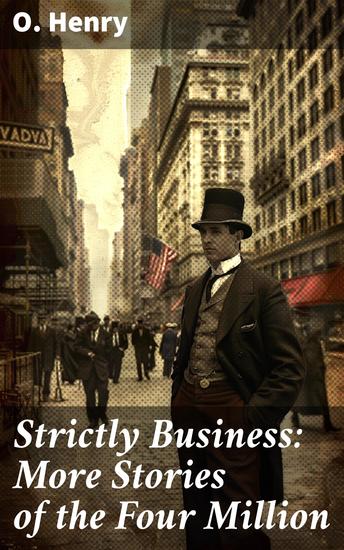
Strictly Business: More Stories of the Four Million - Vivid Portrayals of Urban Life in Turn-of-the-Century New York - cover

Strictly Business: More Stories of the Four Million - Vivid Portrayals of Urban Life in Turn-of-the-Century New York

O. Henry

Publisher: Good Press

  • 0
  • 0
  • 0

Summary

"Strictly Business: More Stories of the Four Million" showcases O. Henry's masterful storytelling and wit, encapsulating the essence of early 20th-century urban life in America. The collection consists of short stories that capture the complexities of human nature, often unfolding with a twist that reveals the deeper truths of society. O. Henry's distinctive narrative style, characterized by clever wordplay and intricate plots, immerses the reader in a vibrant milieu where business meets personal intrigue, exemplifying the bustling energy of New York City and its diverse inhabitants. O. Henry, born William Sydney Porter, is renowned for his contributions to American literature, notably his unique ability to portray the everyday lives of ordinary people with warmth and humor. His experiences working in various occupations, including as a draftsman and a bank teller, greatly influenced his understanding of the human condition and the societal challenges of his time. His encounters with urban life and the moral dilemmas faced by individuals provided a rich backdrop for the stories within this collection, making them not just entertainment but also insightful commentaries on society. I highly recommend "Strictly Business" for anyone interested in the nuanced interplay of humanity and commerce in early 20th-century America. O. Henry's stories not only entertain but also provoke thought and reflection on the intricacies of life. This collection is a testament to the enduring power of short fiction and a delightful exploration of the stories that emerge from daily encounters.
Available since: 10/04/2023.
Print length: 174 pages.


Other books that might interest you

  • Better Angel - cover

    Better Angel

    Richard Meeker

    • 0
    • 0
    • 0
    ""Better Angel" is a novel by Forman Brown, initially published in 1933 under the pseudonym Richard Meeker. Later, it was republished as "Torment" in 1951. This early novel offers a portrayal of a gay lifestyle without condemnation. In fact, Christopher Carey hailed it as the ""first homosexual novel with a truly happy ending"".    The title of the novel alludes to Shakespeare's Sonnet 144, which includes the line: "the better angel is a man right fair". This poem has been interpreted as having a homosexual subtext12.    The plot follows the journey of Kurt Gray, whose experiences mirror those of the author, Forman Brown. Kurt's life unfolds from his adolescent years in central Michigan to adulthood as a musician and composer. His story encompasses solitude, religious awakening, same-sex relationships, and intellectual exploration. The love affair between Kurt and another man, Derry, forms a central theme, along with their relationship with a third man named Tony. Notably, Brown based these characters on real individuals, including himself and his long-time lover, Harry Burnett.    Despite its initial lack of critical attention, "Better Angel" remains a significant work. It resurfaced in 1987 under its original title, with an introduction by Hubert Kennedy. Brown, who had used a pseudonym to protect his writing career and family, provided an epilogue for the 1990 reprint, explaining his reasons for anonymity.    This novel stands as a testament to the courage of early LGBTQ+ literature and offers a glimpse into the complexities of identity, love, and acceptance during a time when such themes were often silenced"
    Show book
  • White Fang - cover

    White Fang

    Jason Smith

    • 0
    • 0
    • 0
    "White Fang" is a novel by Jack London, first published in 1906. It's the story of a wild wolfdog's journey to domestication in the Yukon Territory during the 1890s Klondike Gold Rush. The narrative is structured as a reverse tale to London's other famous work, "The Call of the Wild." While "The Call of the Wild" depicts a domestic dog embracing his wild nature, "White Fang" chronicles the opposite trajectory, where the titular character evolves from ferality to domesticity. Throughout the novel, London examines themes of nature vs. nurture, the inherent violence of the wild, and the potential for redemption through love and kindness.
    Show book
  • Les Misérables: Volume 1: Fantine - Book 7: The Champmathieu Affair (Unabridged) - cover

    Les Misérables: Volume 1:...

    Victor Hugo

    • 0
    • 0
    • 0
    Victor-Marie Hugo (26 February 1802 - 22 May 1885) was a French poet, novelist, essayist, playwright, and dramatist of the Romantic movement. During a literary career that spanned more than sixty years, he wrote abundantly in an exceptional variety of genres: lyrics, satires, epics, philosophical poems, epigrams, novels, history, critical essays, political speeches, funeral orations, diaries, and letters public and private, as well as dramas in verse and prose.
    BOOK 7: THE CHAMPMATHIEU AFFAIR: The incidents the reader is about to peruse were not all known at M. sur M. But the small portion of them which became known left such a memory in that town that a serious gap would exist in this book if we did not narrate them in their most minute details. Among these details the reader will encounter two or three improbable circumstances, which we preserve out of respect for the truth.
    Show book
  • The Sea Fogs - cover

    The Sea Fogs

    Robert Louis Stevenson

    • 0
    • 0
    • 0
    A change in the colour of the light usually called me in the morning. By a certain hour, the long, vertical chinks in our western gable, where the boards had shrunk and separated, flashed suddenly into my eyes as stripes of dazzling blue, at once so dark and splendid that I used to marvel how the qualities could be combined. At an earlier hour, the heavens in that quarter were still quietly coloured, but the shoulder of the mountain which shuts in the canyon already glowed with sunlight in a wonderful compound of gold and rose and green; and this too would kindle, although more mildly and with rainbow tints, the fissures of our crazy gable. If I were sleeping heavily, it was the bold blue that struck me awake; if more lightly, then I would come to myself in that earlier and fairer light.
    Show book
  • The Wrecker - cover

    The Wrecker

    Robert Louis Stevenson

    • 0
    • 0
    • 0
    First published in 1892 and co-written with Lloyd Osbourne, The Wrecker is a gripping tale of mystery, adventure, and moral ambiguity set against the vast, unpredictable expanse of the Pacific.
    
    When Loudon Dodd, a struggling artist living in Paris, unexpectedly inherits a modest fortune, he uses it to invest in what seems like a promising opportunity: the purchase of a wrecked ship stranded on a remote Pacific island. What begins as a speculative business venture quickly spirals into a dangerous quest to uncover the truth behind the ship's destruction and the sinister events surrounding it.
    
    As Dodd journeys from Europe to the islands of the South Seas, he is drawn into a web of deception, greed, and hidden crimes. Along the way, he encounters a vivid cast of characters—adventurers, con men, traders, and outcasts—each with their own secrets and motives. The deeper Dodd investigates, the clearer it becomes that the wreck is no accident, and that powerful forces will go to great lengths to keep the truth buried.
    
    Blending elements of detective fiction, maritime adventure, and psychological drama, The Wrecker explores the darker side of human ambition and the ethical compromises people make in the pursuit of wealth and power. Stevenson's masterful storytelling brings to life exotic locales, tense confrontations, and a steadily unfolding mystery that challenges the protagonist's ideals and courage.
    
    Rich in atmosphere and suspense, The Wrecker stands as a compelling example of Stevenson's ability to move beyond straightforward adventure into complex moral terrain. It is a novel that examines not only the perils of the sea, but also the treacherous depths of the human soul—making it an enduring and thought-provoking read for lovers of classic literature and mystery alike.
    Show book
  • Dracula – Chapter 10: Letter Dr Seward to Hon Arthur Holmwood - A Chapter-by-Chapter Reading of Bram Stoker’s Classic - cover

    Dracula – Chapter 10: Letter Dr...

    Bram Stoker

    • 0
    • 0
    • 0
    In this chapter, the story shifts to Dr. John Seward’s perspective as he grows alarmed over Lucy Westenra’s rapidly worsening condition. Despite care and rest, Lucy grows paler and weaker by the day, her vitality draining as if from some unseen nightly visitor. Seward’s medical expertise cannot explain the strange marks on her throat, nor her unsettling habit of wandering in her sleep. 
    Desperate to help her, Seward writes to his friend — Lucy’s fiancé, Arthur Holmwood — urging him to return to Whitby at once. But Arthur is tied up with his gravely ill father, leaving Seward to act alone. Recognizing that Lucy’s illness lies beyond conventional medicine, he sends for his old mentor, the brilliant and enigmatic Professor Abraham Van Helsing. 
    A sense of dread deepens as nightfall continues to bring danger. Something sinister is feeding on Lucy’s life, and the arrival of Van Helsing marks the beginning of a new battle — one waged not only with science, but with ancient forces that defy reason. 
    This is Chapter 10 of Bram Stoker’s Dracula, narrated by Amazon bestselling horror author Jonathan Dunne — part of a complete chapter-by-chapter audiobook experience capturing the Gothic suspense, emotional stakes, and creeping supernatural terror of this classic novel. 
    📖 Public domain text. Original publication: 1897.
    Show book