Join us on a literary world trip!
Add this book to bookshelf
Grey
Write a new comment Default profile 50px
Grey
Subscribe to read the full book or read the first pages for free!
All characters reduced
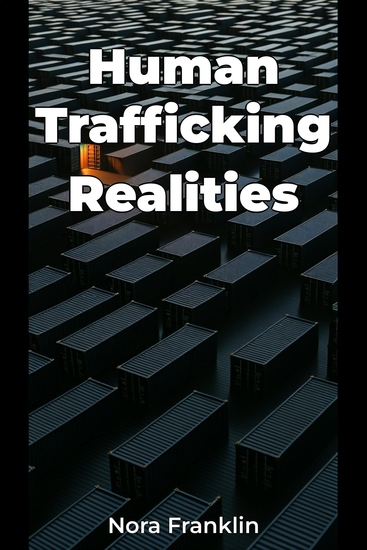
Human Trafficking Realities - cover

Human Trafficking Realities

Nora Franklin

Publisher: Publifye

  • 0
  • 0
  • 0

Summary

"Human Trafficking Realities" presents a comprehensive investigation into modern slavery, revealing the sobering fact that every nation serves as either a source, transit point, or destination for human trafficking—a criminal enterprise generating over $150 billion annually.

 
Through meticulous research spanning five continents, the book uncovers the sophisticated methods trafficking networks employ, combining insights from classified intelligence reports, court documents, and survivor testimonies to paint a complete picture of this global crisis. The book's three-part structure guides readers through the current scope of trafficking operations, regional variations in trafficking methods, and the effectiveness of international counter-measures.

 
By examining the intersection of human trafficking with other criminal enterprises, including money laundering and cybercrime, the work demonstrates how trafficking networks adapt to technological advancements and exploit legal loopholes. Notable findings reveal how cultural, economic, and political factors influence trafficking patterns across different regions, supported by statistical analysis and real-world case studies.

 
Drawing from encrypted communications, financial records, and survivor narratives, the book balances academic rigor with accessible investigative reporting. It uniquely combines criminal justice, international relations, and economic development perspectives to demonstrate how trafficking networks exploit gaps between these domains.

 
The work concludes with practical recommendations for strengthening international cooperation and improving victim support systems, making it an invaluable resource for law enforcement professionals, policy makers, and NGO workers combating modern slavery.
Available since: 01/08/2025.
Print length: 118 pages.
Other books that might interest you

  • We the People and Our Freedom Charters - An Appeal to Heaven - cover

    We the People and Our Freedom...

    John Pitkethly

    • 0
    • 0
    • 0
    Spanning 315 pages, the book dives into the historical, philosophical, sociological, and psychological forces that gave birth to the American constitutional republic. The book introduces the concept of “Our Freedom Charters,” which includes the Declaration of Independence, the U.S. Constitution, the Bill of Rights, and all subsequent amendments—not just as static texts, but as the product of the collective ideas from the history of human civilization and the actions that formed a new nation. Pitkethly draws on decades of study in sociology, mental health counseling, and history to provide what he calls a “human-centered evaluation” of America’s origin story. He analyzes the country as one might a person—its family tree, family of origin, conception, birth, infancy, personality, character development, and current identity crisis.
    Show book
  • Themistocles - The Rise and Fall of Athens's Naval Mastermind - cover

    Themistocles - The Rise and Fall...

    Michael Scott

    • 0
    • 0
    • 0
    Themistocles (524–459 BC) came of age just as a newly democratic and empowered Athens was emerging. He would become an instrumental political and military figure, fighting in the Battle of Marathon; persuading Athenians to expand their fleet; and engineering the Athenians' defeat of the Persians at the Battle of Salamis. However, as Michael Scott demonstrates in this biography, Themistocles failed as much as he succeeded. 
     
    Scott offers a fully human picture of Themistocles, a man who could be both decisive and heroic as well as uncertain and unprepared. He was loved and hated in Athens, his plans and ideas ignored as often as they were respected. Eventually he was exiled as a traitor, ultimately settling in Persia as an adviser to Artaxerxes, the son of Xerxes, his foe at Salamis. And yet, in the aftermath of his death, he emerged as one of Greece's historical heroes. 
     
    In this portrait of a man Thucydides deemed one of the most illustrious Greeks of his time, Scott reveals one man's struggle to navigate the turbulent world of Athenian politics, and the crucial role of historians and biographers in shaping, and distorting, the image of Themistocles that has come down to us through the centuries.
    Show book
  • Göbekli Tepe and Karahan Tepe: The History of Neolithic Anatolia’s Mysterious Religious Sites - cover

    Göbekli Tepe and Karahan Tepe:...

    Charles River Editors

    • 0
    • 0
    • 0
    Despite the fact some Neolithic communities grew to considerable sizes, they’re typically not considered when people think of the first ancient civilizations or the first major cities, so when German archaeologists discovered the archaeological site of Göbekli Tepe in southeastern Turkey in the 1990s, it created an academic firestorm that is still raging. Far from being just another settlement, Göbekli Tepe has been described as the world’s first temple and perhaps one of the locations where human civilization began. Subsequent archaeological work at Göbekli Tepe has revealed that the site was a spiritual center for the local population during a time when humans were undergoing a transition as hunter-gatherers in the Paleolithic Period to a more sedentary lifestyle in the Neolithic Period, more than 10,000 years ago. Further research in the disciplines of anthropology, religion, and history indicate that the activity at Göbekli Tepe subsequently set the tone for elements of Neolithic and Bronze Age religion and ideology in the Near East, especially in Anatolia (roughly equivalent with modern Turkey).  
    Likewise, archaeologists have been able to determine when Karahan Tepe was built, possibly how long it was occupied, and that it was probably related to the larger, better-known site of Göbekli Tepe, but several important questions remain. What was the purpose of Karahan Tepe? Was Karahan Tepe a permanent or semi-permanent settlement? What was the background of the people who built the site, and how long did it take them to build it?  
    Karahan Tepe was just one of many sites in ancient modern Turkey, and as part of a greater complex, Karahan Tepe represents one of the earliest known attempts to build a complex society, so understanding more about the site can tell historians about how the process worked. 
    Show book
  • The Coffee-House of Surat - A Parable of Faith Tolerance and the Search for Truth - cover

    The Coffee-House of Surat - A...

    Leo Tolstoy, Tim Zengerink

    • 0
    • 0
    • 0
    What if every path led to the same destination—just spoken in different tongues? 
    The Coffee-House of Surat by Leo Tolstoy is a short, powerful story that imagines a meeting of five religious men—each defending their path to truth. But when a quiet observer finally joins the discussion, he offers a perspective that challenges the foundation of their debate. 
    This modern audiobook adaptation presents Tolstoy’s timeless reflection on faith, dogma, and understanding in clear, thoughtful language for today’s listener. 
    What You’ll Hear in This Modern Translation: 
    •	A moving dialogue between representatives of different faiths 
    •	A calm, wise interruption that reframes the entire debate 
    •	A reminder that truth may not belong to any one group—but to all 
    Included in This Edition: 
    This audiobook retains the heart of Tolstoy’s message while modernizing the language for clarity, flow, and accessibility—making it ideal for both reflection and discussion. 
    Listen now—and let this parable open your heart to the wisdom of unity.
    Show book
  • War and AI - The Algorithmic Battlefield - cover

    War and AI - The Algorithmic...

    Javier del Puerto, Rado Molina

    • 0
    • 0
    • 0
    "War and AI" tracks the lethal contradiction at the center of the AI boom: the same systems marketed as tools of progress are already being wired into kill chains, targeting systems, and automated decisions about who lives and who dies.From Gaza to Ukraine, machine vision, autonomous drones, and algorithmic targeting are no longer speculative. They are shaping real battlefields in real time, with civilians trapped inside the margin of error.This urgent new book maps the doctrine, supply chains, and moral collapse behind algorithmic warfare, arguing that the most dangerous lie of the AI age is the claim that we can build machines to save humanity without first teaching them how to kill.
    Show book
  • Apocalypse Television - How The Day After Helped End the Cold War - cover

    Apocalypse Television - How The...

    David Craig, Robert Iger

    • 0
    • 0
    • 0
    On November 20, 1983, a three-hour made-for-TV movie, The Day After, premiered on ABC. Set in the heartland of Lawrence, Kansas, the film depicted the events before, during, and after a Soviet nuclear attack with vivid scenes of the post-apocalyptic hellscape that would follow. The film was viewed by over 100 million Americans and remains the highest rated TV movie in history. 


    The path to primetime for The Day After proved nearly as treacherous as the film's narrative. Battles ensued behind the scenes at the network, between the network and the filmmakers. But these skirmishes pale in comparison to the culture wars triggered by the film in the press, alongside a growing Nuclear Freeze movement, and from a united, pro-nuclear Right. Once efforts to alter the script failed, the White House conducted a full-throttled propaganda campaign to hijack the film's message. 


    Apocalypse Television features a dramatic insider's account of the making of and backlash against The Day After. No other book has told this story in similar fashion, venturing behind-the-scenes of the programming and news divisions at ABC, the backlash from the conservative movement and Religious Right, the challenges encountered by the film's production team, and the experiences of the citizens of Lawrence, Kansas, where the film was set and shot.
    Show book