Join us on a literary world trip!
Add this book to bookshelf
Grey
Write a new comment Default profile 50px
Grey
Subscribe to read the full book or read the first pages for free!
All characters reduced
Intellectual Self-Destruction - How the West Gambles Away Its Future - cover

Intellectual Self-Destruction - How the West Gambles Away Its Future

Franziska Sittig, Noam Petri

Publisher: ibidem

  • 0
  • 0
  • 0

Summary

This study is a clarion call, exposing how Western academia is at a tipping point, with Europe on the brink of following America’s path of radicalization.
Available since: 02/05/2026.
Print length: 314 pages.

Other books that might interest you

  • We Are F**king Machines - Why We Are Like This and What We Can Do About It - cover

    We Are F**king Machines - Why We...

    Dr. Bernadette 'bird' Bowen

    • 0
    • 0
    • 0
    Do you feel disconnected? Lonely? Sick and tired of being sick and tired? Long before COVID-19 emerged, researchers were reporting that united states citizens were having less sex. Some even going so far as to call it a “sex apocalypse”. Throughout this book, Dr. bird explores not only how and why this phenomenon occurred, but also unboxes foundationally regifted social, relational, and technological u.s. misinformation(s) and disinformation(s), which have devolved into our digital and increasingly algorithmic envirusment. To do so, first, they argue that our dominant ideas of intelligence have always been limited. Then, they connect those logics to escalating environmental crises. Third, Dr. bird reveals how our major ideas of relational intelligence have been tainted by these widely accepted human misconceptions. And, not only that, but that this mentality has been copy and pasted across nearly everything that we do and love. In doing so, Dr. bird makes clear how the envirusment era presents us abundant opportunities to understand how, in numerous violent taken for granted ways, an idea that the “body is a machine” has infected our lifestyles, sickening, disabling, and poisoning us all to death for profit. Yet, in new viral forms, instead of liberatory solutions, the richest continue to invest in more inhumane artificial intelligence. Instead, Dr. bird insists current problems cannot be solved without transformational human solutions, reminding us that we all hold and can embrace our authenticity, reflecting on our life’s knowledge, to fix this shit.
    Show book

  • International Space Station The: The History and Legacy of the Multinational Space Research Lab - cover

    International Space Station The:...

    Editors Charles River

    • 0
    • 0
    • 0
    Much has been written about the Space Race, which is still taught across America today, but the story of human space exploration is mostly one of cooperation. Even in the summer of 1969, the Soviets had given the United States the flight plan for its Luna 15 mission, allowing Apollo 11 to avoid it.  
    	That was the first of many examples of cooperation in space between the United States and the Soviet Union during the Cold War, and ultimately, their research and cooperation helped lead to the construction of the International Space Station (ISS), a large space station assembled in Earth’s orbit that represents the most ambitious international space project in history.  
    	Thanks to the various components that have been put together, the International Space Station is bigger and brighter than all other artificial satellites. With relatively low power magnification, people can see the solar panels radiating outward from the numerous international modules which make up the ISS. The reality of that platform, at the edge of the ocean of space, is pretty astounding when looked at from the perspective of history. Only 120 years ago, mankind did not know if it was possible to fly in a heavier-than-air vehicle. Constructed with over 30 different modules and pieces that were carried into orbit by dozens of different launches, the ISS is already over 150 feet long, 300 feet wide and 60 feet tall. Astronauts from 10 nations have spent time on the space station as long-term crew. 
    	In addition, the International Space Station can truly be held as a sign that the Space Age is maturing quite nicely, at least on a social and personal level. A total of 34 women have visited the space station, eight tourists have paid for the privilege of taking the trip to the station, and there have been many who have made multiple trips to the ISS.
    Show book
  • Seduction - Influencing Someone through Charm or Persuasion - cover

    Seduction - Influencing Someone...

    Cito Harder

    • 0
    • 0
    • 0
    Seduction is often perceived as an art form, one that blends charm, charisma, and influence. However, behind its allure lies a deep psychological foundation that shapes how and why individuals are drawn to one another. The psychology of seduction is rooted in our basic emotional and social needs, particularly the desire for connection, validation, and attraction. Understanding these underlying psychological mechanisms can shed light on how seduction functions both consciously and subconsciously in human interactions. 
    At its core, seduction taps into the psychological principle of attraction, which is influenced by a combination of innate and learned factors. Human beings are social creatures, and our brains are wired to respond to others in ways that promote bonding and intimacy. This attraction is not purely physical but can also be emotional, intellectual, and even social. For example, people often find others more attractive when they share similar interests, values, or experiences, which creates a sense of commonality and trust. This bond of similarity is a psychological catalyst in seduction, where individuals may use shared interests to create a sense of connection and mutual understanding. 
    Another psychological aspect of seduction lies in the concept of power dynamics. Seduction often involves a delicate balance of influence and control. The person who is seducing may use charm or persuasion to gain an upper hand, while the target of the seduction may either knowingly or unknowingly submit to the allure. Power, in this context, does not always have to be overt or manipulative. Sometimes, it can be subtle—through small gestures, compliments, or actions that invoke a sense of attraction or desire.
    Show book
  • Hidden Love - cover

    Hidden Love

    Eskay Kabba

    • 0
    • 0
    • 0
    Connor thought he had life all figured out, until he met Jamel. 
    A military veteran from a good Irish Catholic family; blonde-haired, blue-eyed Connor has had the same beautiful girlfriend since high school. But Connor has a secret. He lives a second life as a closeted gay man, jumping from one sexual partner to another. To avoid judgment from his family, Connor's best friend Afia plays along with the elaborate ruse of their romantic relationship. But now, Connor's safety net is falling for someone else. 
    In steps Jamel, an African American man with an irresistibly hard body and gentle soul. He just so happens to be Afia's new love interest's brother and captures Connor's attention from the moment their eyes meet. As their erotic affair sizzles, Connor fears what his father and brother may do if they discover he has feelings for another man. With a newfound reason to change the course of his entire life, will Connor find the strength he needs to finally come out? If he does, will Jamel wait while Connor decides if he's ready for something as real as their love? 
    This m/m steamy romance is driven by incredible sexual chemistry in a world where relationships are not always easy. Keep up with Connor and Jamel through the entire Hidden Love series as they navigate the complexities of attraction, personal identity, and overcoming intolerance in the name of deep passion. Content Warning: Racism, homophobia, and incidents of violence.
    Show book
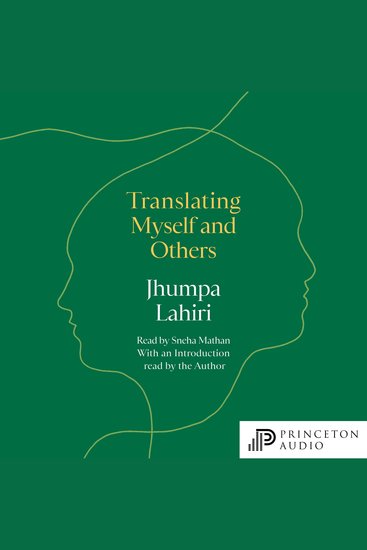
  • Translating Myself and Others - cover

    Translating Myself and Others

    Jhumpa Lahiri

    • 0
    • 0
    • 0
    Sneha Mathan narrates these luminous essays on translation and self-translation by award-winning writer and literary translator Jhumpa Lahiri
    
    With an introduction, afterword, and acknowledgements read by the author
    Translating Myself and Others is a collection of candid and disarmingly personal essays by Pulitzer Prize–winning author Jhumpa Lahiri, who reflects on her emerging identity as a translator as well as a writer in two languages.
    
    With subtlety and emotional immediacy, Lahiri draws on Ovid's myth of Echo and Narcissus to explore the distinction between writing and translating, and provides a close reading of passages from Aristotle's Poetics to talk more broadly about writing, desire, and freedom. She traces the theme of translation in Antonio Gramsci's Prison Notebooks and takes up the question of Italo Calvino's popularity as a translated author. Lahiri considers the unique challenge of translating her own work from Italian to English, the question "Why Italian?," and the singular pleasures of translating contemporary and ancient writers.
    
    Featuring essays originally written in Italian and published in English for the first time, as well as essays written in English, Translating Myself and Others brings together Lahiri's most lyrical and eloquently observed meditations on the translator's art as a sublime act of both linguistic and personal metamorphosis.
    Show book
  • French History - The French Revolution and Napoleon - cover

    French History - The French...

    History Retold

    • 0
    • 0
    • 0
    In a land steeped in history and lore, there lies a tale of revolution and empire. A tale that echoes through the ages, and whispers its secrets to those with ears to hear. "French History: The French Revolution and Napoleon" is a chronicle of an extraordinary era. 
    Journey into the heart of France during a time of upheaval and transformation, where the old order crumbled before the force of the people's will. You shall bear witness to the birth of a revolution, as the fires of change swept through the realm, toppling the mighty and raising the downtrodden. 
    In the pages of this tome, you shall encounter heroes and villains, visionaries and despots. Learn the story of the revolutionaries who risked all for liberty, equality, and fraternity. Their tale is one of daring, sacrifice, and fierce determination in the face of seemingly insurmountable odds. 
    But the chronicle does not end there, for it also tells of the rise of a legendary figure, Napoleon Bonaparte. Stand beside him on the battlefield as he wields his genius to forge an empire that would span across Europe. Behold the triumphs and tragedies that would mark his reign, as he ascended to the heights of power, only to be cast down by fate's cruel hand. 
    This book is a tapestry of unforgettable characters and events, brought to life by the rich and evocative prose that guides you through the labyrinth of history. It is a tale that beckons you to immerse yourself in the world of a bygone era, to walk the streets of Paris during its darkest hour, and to stand on the fields of Austerlitz as the fate of nations hangs in the balance. 
    Embark on this epic journey through the annals of French history, and discover the wonders, the wisdom, and the heartache of a time when the world was remade. Secure your copy today, and let the adventure begin.
    Show book