Join us on a literary world trip!
Add this book to bookshelf
Grey
Write a new comment Default profile 50px
Grey
Subscribe to read the full book or read the first pages for free!
All characters reduced
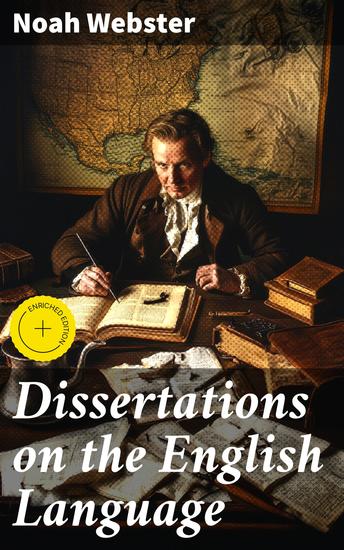
Dissertations on the English Language - Including Historical and Critical Notes & Essay on a Reformed Mode of Spelling - cover

Dissertations on the English Language - Including Historical and Critical Notes & Essay on a Reformed Mode of Spelling

Noah Webster

Publisher: Good Press

  • 0
  • 0
  • 0

Summary

In "Dissertations on the English Language," Noah Webster embarks on a passionate exploration of linguistic identity and the evolution of American English, positing that language is fundamental to national character. Written in the late 18th century, this foundational text employs a clear and persuasive style, invoking reason and evidence to advocate for a distinct American dialect and orthography. Webster's work emerged during a period of burgeoning American nationalism, reflecting the desire to solidify a unique cultural identity while grappling with the linguistic hegemony of British English. His incisive arguments are bolstered by thorough research, making this book not only a pivotal linguistic treatise but also a significant historical document. Noah Webster, recognized as the 'ÄúFather of American English,'Äù was driven by his belief that a unified language could foster unity and independence among the newly formed states. His extensive background in education and lexicography, as well as his role in the founding of American public schooling, culminated in his desire to establish language as a means of cultural sovereignty. Webster'Äôs lifelong commitment to reforming American education underpinned his rigorous academic pursuit, making this work a culmination of his beliefs and aspirations. "Dissertations on the English Language" is an essential read for linguists, historians, and anyone intrigued by the origins of American English. Webster's arguments remain relevant in contemporary discussions surrounding language and identity, providing a compelling narrative that underscores the significance of linguistic evolution in shaping cultural heritage. Readers will find in this work a rich tapestry of intellectual thought that elevates the study of language to a matter of national importance.
Available since: 10/12/2023.
Print length: 244 pages.

Other books that might interest you

  • Sophia the Supergirl - She Knows How to Fight Dyslexia - Her Secret Power Revealed - cover

    Sophia the Supergirl - She Knows...

    Scarlett Moffatt

    • 0
    • 0
    • 0
    Help Your Child Fight Dyslexia and Read/Write Her Favorite Stories 
    I know how much it is difficult for a Dyslexic child to excel in studies, having suffered from it in my childhood. But I fought this bravely with the help of my inspiring teacher, who always supported me. 
    So, I took the opportunity to create a book that could share my stories with other struggling children to inspire them to become brave. 
    Sophia the Supergirl is a story about a princess who was born with a special gift. She was very happy with her power of making things dance and swing in her mind until it became a problem. 
    When she started reading and writing, the letters started dancing too, so she could not read and write properly. She became very sad and exactly then her angel came to help her. 
    Now she can read and write easily. After all, she took control of her mind's eye with the help of her angel. This book reveals her secret so your princess can become a Supergirl too. 
    Order Now To Give This Special Gift To Your Special Child.
    Show book
  • The Myths of the Maya - Cosmic Legends and Sacred Rituals - cover

    The Myths of the Maya - Cosmic...

    Julia Blacksmith

    • 0
    • 0
    • 0
    The Maya civilization, one of the most sophisticated and enduring cultures of Mesoamerica, flourished for thousands of years, leaving behind a rich legacy of myth, ritual, and cosmic understanding. Their world was deeply interconnected with the supernatural, where gods, spirits, and celestial forces played vital roles in everyday life. Through sacred texts, oral traditions, and intricate ceremonial practices, the Maya passed down their myths—stories that explained the origins of the universe, the struggles of gods and heroes, and the sacred cycles of time. These legends were not merely tales; they formed the foundation of their spiritual and societal structures, influencing everything from kingship to agriculture.  
    At the heart of Maya society was a profound connection between myth and ritual. Unlike many cultures that viewed myths as separate from daily life, the Maya saw them as living forces that required constant renewal through ceremonies, sacrifices, and offerings. Bloodletting, a sacred act performed by rulers and priests, was believed to nourish the gods and maintain cosmic balance. Grand pyramids and temple complexes, aligned with celestial events, served as sacred theaters where rituals reenacted the struggles of deities, ensuring harmony between the human and divine realms. The famous Popol Vuh, often regarded as the Maya "Book of Creation," recounts the epic journey of the Hero Twins as they navigate the treacherous underworld, triumphing over the forces of chaos and death. This myth, like many others, reflected the Maya’s deep understanding of duality, rebirth, and the cosmic order.  
    Deciphering Maya mythology has been a long and complex journey, shaped by archaeological discoveries, linguistic breakthroughs, and the resilience of indigenous communities.
    Show book
  • Life Is Short - An Appropriately Brief Guide to Making It More Meaningful - cover

    Life Is Short - An Appropriately...

    Dean Rickles

    • 0
    • 0
    • 0
    Why life's shortness—more than anything else—is what makes it meaningful 


    Death might seem to render pointless all our attempts to create a meaningful life. Doesn't meaning require transcending death through an afterlife or in some other way? On the contrary, Dean Rickles argues, life without death would be like playing tennis without a net. Only constraints—and death is the ultimate constraint—make our actions meaningful. In Life Is Short, Rickles explains why the finiteness and shortness of life is the essence of its meaning—and how this insight is the key to making the most of the time we do have. 


    Life Is Short explores how death limits our options and forces us to make choices that forge a life and give the world meaning. But people often live in a state of indecision, in a misguided attempt to keep their options open. This provisional way of living—always looking elsewhere, to the future, to other people, to other ways of being, and never committing to what one has or, alternatively, putting in the time and energy to achieve what one wants—is a big mistake, and Life Is Short tells listeners how to avoid this trap. By reminding us how extraordinary it is that we have any time to live at all, Life Is Short challenges us to rethink what gives life meaning and how to make the most of it.
    Show book
  • Common Sense - cover

    Common Sense

    Thomas Paine

    • 0
    • 0
    • 0
    Common Sense was a pamphlet written by Thomas Paine in 1775-1776 advocating independence from Great Britain to people in the 13 Colonies. Writing in clear and persuasive prose, Paine marshaled moral and political arguments to encourage common people in the Colonies to fight for egalitarian government. It was published anonymously on January 10, 1776, at the beginning of the American Revolution, and became an immediate sensation.  
    It was sold and distributed widely and read aloud at taverns and meeting places. In proportion to the population of the colonies at that time (2.5 million), it had the largest sale and circulation of any book published in American history. As of 2006, it remains the all-time best-selling American title, and is still in print today.  
    Common Sense made public a persuasive and impassioned case for independence, which before the pamphlet had not yet been given serious intellectual consideration. Paine connected independence with common dissenting Protestant beliefs as a means to present a distinctly American political identity, structuring "Common Sense" as if it were a sermon. Historian Gordon S. Wood described "Common Sense" as "the most incendiary and popular pamphlet of the entire revolutionary era".
    Show book
  • Behind the Bill of Rights - Timeless Principles that Make it Tick - cover

    Behind the Bill of Rights -...

    Jeremy Nelson Bill Norton

    • 0
    • 0
    • 0
    The principles behind the Bill of Rights have helped elevate human civilization to a level of liberty never seen in history. The American experiment inspired the spread of written constitutions and declarations of rights throughout the world, which has raised billions out of poverty, chaos, and oppression. However, without understanding the principles behind the Bill of Rights, all nations, including our own, continue to struggle. 
    Behind the Bill of Rights uncovers the timeless principles that make the Bill of Rights tick. The authors reveal lost meanings, elaborate on new understandings, and bring to light many fundamentals that have been overlooked for decades. 
    You will discover hidden gems that will invigorate your mind. For example:The paradox of toleranceThe mindset that leads to slaveryThe voting rights timeline you never knewReligious freedom: both sides are right-and wrongThe Third Amendment is a pattern for all laws, not just the quartering of troopsThe fascinating history of the jury & how it protects usThe lost meaning of the Ninth AmendmentAnd much more 
    Knowing these principles will give you a profound appreciation for the genius of the first ten amendments to the Constitution, and a greater ability to protect your own rights.
    Show book
  • The Power of Story - On Truth the Trickster and New Fictions for a New Era - cover

    The Power of Story - On Truth...

    Harold R. Johnson

    • 0
    • 0
    • 0
    Award-winning Indigenous author Harold R. Johnson discusses the promise and potential of storytelling. 
    Approached by an ecumenical society representing many faiths, from Judeo-Christians to fellow members of First Nations, Harold R. Johnson agreed to host a group who wanted to hear him speak about the power of storytelling. This book is the outcome of that gathering. In The Power of Story, Johnson explains the role of storytelling in every aspect of human life, from personal identity to history and the social contracts that structure our societies, and illustrates how we can direct its potential to re-create and reform not only our own lives, but the life we share. Companionable, clear-eyed, and, above all, optimistic, Johnson’s message is both a dire warning and a direct invitation to each of us to imagine and create, together, the world we want to live in.
    Show book