Join us on a literary world trip!
Add this book to bookshelf
Grey
Write a new comment Default profile 50px
Grey
Subscribe to read the full book or read the first pages for free!
All characters reduced
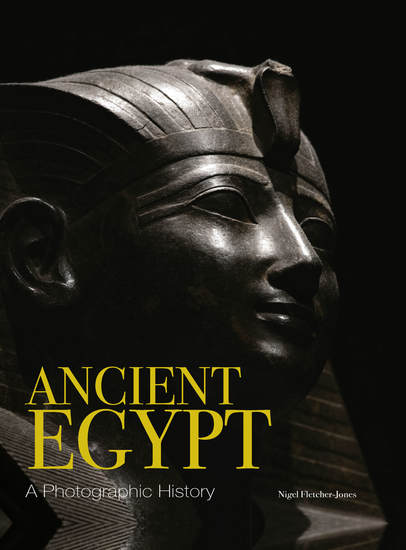
Ancient Egypt - A Photographic History - cover

Ancient Egypt - A Photographic History

Nigel Fletcher-Jones

Publisher: Amber Books Ltd

  • 0
  • 0
  • 0

Summary

First appearing around the mighty River Nile in the fourth millennium BC, Ancient Egypt is one of the great wellsprings of human civilization. Egyptian culture developed around a complex system of religious rituals tied to the agricultural seasons, with the pharaoh a living deity at the centre. Mighty pyramids, tombs and monuments were built to celebrate the pharaohs, many of which can still be seen in all their splendour today.
 
Arranged chronologically, Ancient Egypt offers a compact photographic guide, from the 4000 BC Naqada culture to the end of the Ptolemy dynasty with the suicide of Cleopatra in 30 BC. In between, discover the Narmer Palette, a 31st century BC stone tablet that records the unification of Upper and Lower Egypt by King Narmer; learn about Amenhotep the Magnificent, during whose reign Egypt reached the peak of its artistic and international power; marvel at the massive, rock-cut temples of Abu Simbel, dedicated to Pharaoh Ramesses II (“the Great”), marking the southern extent of the Egyptian empire and celebrating his victory over the Hittites at the Battle of Kadesh; and discover how Egypt was ruled by Archaemenid Persia for almost 200 years, until the arrival of Alexander the Great and his all-conquering Macedonian army.
 
Colourful, engaging and illustrated throughout with more than 180 photographs, Ancient Egypt is a vivid pictorial introduction to 4,000 years of Ancient Egyptian civilization.
Available since: 05/01/2024.
Print length: 224 pages.

Other books that might interest you

  • Master the Art of Influence: Speak and Captivate Instantly - "Elevate your speaking skills with dynamic audio lessons crafted to boost your influence and captivation!" - cover

    Master the Art of Influence:...

    Clinton Marwood

    • 0
    • 0
    • 0
    Master the Art of Influence: Speak and Captivate Instantly   
    ⭐⭐ Simplified Guide & Explanations Included ⭐⭐   
    Are you striving to advance in your career and enhance your expertise in powerful communication skills? 
    Are you in search of an all-encompassing guide that equips you with all the essentials to transform conversations and relationships through effective communication? 
    Your quest ends here! 
    This guide is your ultimate resource for deepening your understanding, honing your skills, and engaging in practical exercises. With this, you're set up for success. 
    Updated for the latest in powerful communication strategies. 
    Key features of this enhanced guide include: 
    - In-depth insights into the art of influence and impactful communication.   
    - Comprehensive explanation of transforming conversations and relationships.   
    - Proven strategies for preparation and effective communication techniques.   
    Our guide stands out with its thorough coverage, which is vital for achieving your communication goals. Concepts are explored in detail rather than merely glossed over.   
    Structured for clarity and ease of understanding, our guide on mastering communication ensures smooth transitions between topics. Say goodbye to complex terminology and embrace clear, concise, and technically accurate content.   
    So, why wait? Click the BUY NOW button, secure your guide, and embark on your journey to mastering the art of influence and captivating communication!
    Show book
  • Tricksters are out to get you - Dealing with the bullies narcissists predators robbers stalkers dictators energetic vampires and other stress generators in our lives - cover

    Tricksters are out to get you -...

    François De Kock

    • 0
    • 0
    • 0
    This audiobook serves as a guide to understand and deal with all pernicious and invisible forms of abuse. It provides keys to deal with their appearance in your own life. 
    Violence is too often acknowledged only when there is material proof of it. Abuse with physical damage gets the news and make authorities react. However, the earliest stages are invisible. You don't see them coming. Abuse is mental, emotional and energetic. Predators and emotional vampires should not be underestimated, since they are omnipresent in the shadows of our everyday lives. 
    The author had a 20 years career in the music business (that was before Internet), before leading a 30 years career as a renowned personal and spiritual coach in the French speaking parts of the world. He proposed an array of workshops and published two books. He now starts his third career, sharing his accumulated insights and wisdom in his "Wise" audiobook series. This is the first book of the series. 
    Cover illustration by Lisa Yount via Pixabay, AI generated.
    Show book
  • The Treasure Of Treasures For Alchemists - cover

    The Treasure Of Treasures For...

    Paracelsus The Great

    • 0
    • 0
    • 0
    This is a collection of five alchemical tracts written by one of the most famous alchemists who was said to have discovered the Philosopher's Stone. In these writings Paracelsus attempts to educate the reader about the nature of the Philosopher's Stone and the scientific principles from which we can be assured of its existence and understand how it works. Like all alchemical tracts, the language is very cryptic and allegorical so as to be unintelligible to the unworthy.
    Show book
  • Leviathan - cover

    Leviathan

    Thomas Hobbes

    • 0
    • 0
    • 0
    Leviathan is a book written by Thomas Hobbes and published in 1651. It is one of the most important works in political philosophy and is considered a cornerstone of modern political thought. 
    The main argument of Leviathan is that humans are fundamentally selfish and violent, and that without a strong government to control them, they would inevitably descend into a state of chaos and conflict. Hobbes famously characterized this state as "the war of all against all." 
    In order to avoid this scenario, Hobbes argued that individuals must surrender their natural rights to a sovereign authority. This sovereign, which Hobbes called the Leviathan, would have absolute power to enforce its will upon the people, and in exchange would provide them with security and protection. 
    Hobbes believed that the ideal form of government was an absolute monarchy, where the sovereign's power was not limited by any laws or institutions. He argued that any attempt to limit the power of the sovereign would be doomed to failure, as it would only lead to the re-emergence of the state of nature and the breakdown of society. 
    Leviathan is also notable for its contributions to social contract theory, which argues that individuals enter into a contract with their government in order to protect their rights and maintain order in society. Hobbes' social contract theory was influential in the development of political thought and continues to be studied and debated today.
    Show book
  • When Money Destroys Nations - How Hyperinflation Ruined Zimbabwe How Ordinary People Survived and Warnings for a World that is Printing Money - cover

    When Money Destroys Nations -...

    Philip Haslam, Russell Lamberti

    • 0
    • 0
    • 0
    The collapse of the Zimbabwe dollar in 2009 after years of rampant money printing is an alarming example of what lies in store for countries that print money to pay national debts, bail out banks and enrich political elites. 
    When Money Destroys Nations tells the gripping story of the disintegration of the once-thriving Zimbabwean economy and the inspiring and tragic accounts of how ordinary people survived in turbulent circumstances. Philip Haslam and Russell Lamberti give a straightforward and revealing account of the causes and consequences of Zimbabwe's hyperinflation and how they apply to you in our world today. 
    Zimbabwe's economic collapse is not an isolated tragedy. It holds lessons for all countries and for all political leaders tempted to take shortcuts to prosperity. Zimbabwe's lessons must not be ignored. 
    This is the story of When Money Destroys Nations.
    Show book
  • The Discovery of Tutankhamun's Tomb - Archaeology and Legacy - cover

    The Discovery of Tutankhamun's...

    Omar Khalil

    • 0
    • 0
    • 0
    The search for Tutankhamun’s tomb was one of the most ambitious archaeological pursuits of the early 20th century. For years, Egyptologists and explorers had scoured the Valley of the Kings, believing that the burial site of the young pharaoh remained hidden beneath the desert sands. Despite previous excavations yielding little success, one man remained convinced that the tomb had yet to be discovered. 
    Howard Carter, a British archaeologist, had spent decades working in Egypt, developing an unmatched expertise in excavation. His belief in the existence of Tutankhamun’s tomb was fueled by fragments of artifacts bearing the young pharaoh’s name, suggesting that his final resting place was still untouched. However, funding such an extensive search required a patron, and it was Lord Carnarvon, a wealthy British aristocrat, who provided the financial backing. In 1917, Carter’s systematic excavation of the Valley of the Kings began, but after several years of fruitless digging, Carnarvon grew impatient. 
    By 1922, with resources nearly depleted, Carter convinced Carnarvon to allow him one final season of excavation. It was in November of that year that Carter’s persistence paid off. While investigating an area near the tomb of Ramses VI, workers uncovered a set of steps leading down into the earth. Clearing away the debris, Carter discovered a sealed doorway marked with the insignia of Tutankhamun. Excitement and caution filled the air as he realized that the tomb had remained undisturbed for centuries.
    Show book