Join us on a literary world trip!
Add this book to bookshelf
Grey
Write a new comment Default profile 50px
Grey
Subscribe to read the full book or read the first pages for free!
All characters reduced
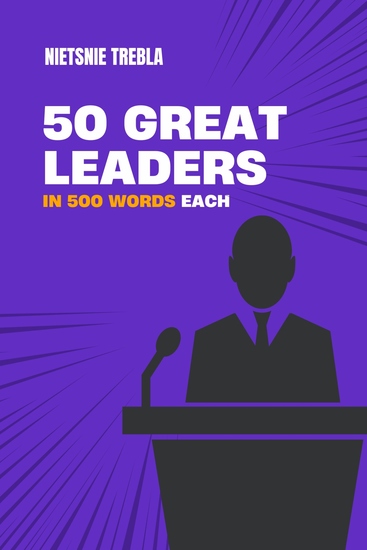
50 Great Leaders in 500 Words Each - cover

50 Great Leaders in 500 Words Each

Nietsnie Trebla

Publisher: Shelf Indulgence

  • 0
  • 0
  • 0

Summary

Dive into history without drowning in details! Ever wished you could get the inside scoop on history's most influential figures without having to wade through massive biographies? "50 Great Leaders in 500 Words Each" is your shortcut to understanding the lives and legacies of 50 icons who shaped our world.
 
From Julius Caesar and Genghis Khan to Malala Yousafzai and Oprah Winfrey, this book delivers concise and captivating portraits that are perfect for busy readers. In just minutes, you can discover: 
 
- How Nelson Mandela fought for equality.
 
- The secrets to Steve Jobs' innovative genius.
 
- Why Marie Curie's scientific discoveries changed the world.
 
- And much more!


This book is the perfect companion for: 
 
Trivia buffs: Ace your next quiz night with fascinating facts and insights. 
 
History lovers: Explore the past through the lives of those who shaped it. 
 
Curious minds: Satisfy your thirst for knowledge with bite-sized biographies. 
 
Anyone seeking inspiration: Discover how these leaders overcame challenges and made their mark on history.


"50 Great Leaders in 500 Words Each" is the first instalment of a series of books by Nietsnie Trebla called "In 500 words", and is available in more than 10 languages - Get your copy today and unlock a world of knowledge!
Available since: 01/26/2025.
Print length: 100 pages.

Other books that might interest you

  • Worrying Is Optional - Break the Cycle of Anxiety and Rumination That Keeps You Stuck - cover

    Worrying Is Optional - Break the...

    LCSW Ben Eckstein, PhD Lisa W....

    • 0
    • 0
    • 0
    We live in an increasingly uncertain world, and if you struggle with worry, you aren't alone. You should also know that there's nothing wrong with worry. Worry happens to all of us—and it can even be helpful at times. But excessive worrying—the kind that keeps us up at night, interferes with our thinking during the day, and hijacks our ability to make decisions—is a big problem. The good news is that, while worry is inevitable, worrying is completely optional. This book will show you how to break free from the unhelpful thinking habits that keep you stuck in a loop of rumination and anxiety. 


    With help from this guide, you'll learn to build your own customizable, anti-worrying toolbox using skills and strategies from metacognitive therapy, acceptance and commitment therapy (ACT), and cognitive behavioral therapy (CBT). You'll discover the science behind why you worry, and how to put the brakes on unhelpful rumination and anxious thoughts—before they kick your worry and anxiety into high gear. 


    There's no one-size-fits-all treatment, but by assembling an arsenal of tools, skills, and strategies, excessive worry can be managed. This book will help you get started now. 


    Contains mature themes.
    Show book
  • Did Columbus discover America? - How was America discovered? - cover

    Did Columbus discover America? -...

    Shreyas Pande, Sharad Baggonkar

    • 0
    • 0
    • 0
    Christopher Columbus was an explorer, fine mapmaker and navigator. He also had deep interest in geography, astronomy, and history. Columbus loved sailing the high seas and was keen to explore a sea passage to the East which would help him reach India. With that in mind he went to the King of Spain in with a proposal in 1492 who immediately approved the plan. Thus began Columbus's voyage to reach India but little did he know that it was not going to be India but a completely different continent, that was waiting to be discovered.
    Show book
  • DIY Brain - The Mindset Makeover Manual for Peak Performance - cover

    DIY Brain - The Mindset Makeover...

    Dr. Roger Hall

    • 0
    • 0
    • 0
    Change Your Habits by Changing Your Thoughts 
    Learning to recognize erroneous thinking can help you beat bad habits, and replace them with better ones. Through mental rehearsal and with some help from mental connections to everyday elements of daily life, the brain’s wiring can actually reroute itself. Replacing negative and unhelpful thoughts with more accurate ones will lead to different actions. 
    Dr. Roger Hall shows how:Stories make learning a concept easier, especially complex ones.Your thoughts control your emotions–not the other way around.Your habits can change your life–in fact they are changing your life. 
    DIY Brain will help you understand how your mind works and how to improve your thoughts to improve your life. 
    “Dr. Roger Hall thinks like no one else. The key principles in DIY Brain have enabled me to shift my approach to life’s challenges and make the most of every opportunity.” —Brad Gibson, President, Sound Capital Management LLC 
    Dr. Roger Hall is a business psychologist, author, consultant, and speaker. He has one trick: he trains leaders to monitor and manage their thinking. His clients are entrepreneurs, professionals, and business owners. Dr. Hall has worked with leaders from little companies with a few people all the way up to behemoths that dominate their industries. His work helps leaders become better versions of themselves so they can lead their people better. 
    Dr. Hall is the author of Staying Happy, Being Productive: The Big 10 Things Successful People Do. He and his wife, Patty, live outside Boise, Idaho.
    Show book
  • The Book of Tea - cover

    The Book of Tea

    Okakura Kakuzō

    • 0
    • 0
    • 0
    The Book of Tea was written by Okakura Kakuzo in the early 20th century. It was first published in 1906, and has since been republished many times. - In the book, Kakuzo introduces the term Teaism and how Tea has affected nearly every aspect of Japanese culture, thought, and life. The book is noted to be accessible to Western audiences because though Kakuzo was born and raised Japanese, he was trained from a young age to speak English; and would speak it all his life, becoming proficient at communicating his thoughts in the Western Mind. In his book he elucidates such topics as Zen and Taoism, but also the secular aspects of Tea and Japanese life. The book emphasizes how Teaism taught the Japanese many things; most importantly, simplicity. Kakuzo argues that this tea-induced simplicity affected art and architecture, and he was a long-time student of the visual arts. He ends the book with a chapter on Tea Masters, and spends some time talking about Sen no Rikyu and his contribution to the Japanese Tea Ceremony.
    Show book
  • Two Points East - A View of Maritime Norfolk - cover

    Two Points East - A View of...

    Judith Ellis

    • 0
    • 0
    • 0
    Have you ever wondered just what was the Hanseatic League?, How malt was made, or how eels get to the Sargasso Sea? The answers to these and many other questions will be found in this book. 
    Spanning the period from the Anglo-Saxons to the coming of the railway, two Points East is about the boats, the fishing and some of the lives lived on the North sea coast of Norfolk, from the once world-famous herring fishery in Great Yarmouth to the extraordinary rescues of Cromer’s famous lifeboatman Henry Blogg. 
    Judith Ellis lives in Norfolk with an insatiable curiosity and some very fine memories of sailing off the East Anglian coast. A lifelong interest in traditional boats combined with a love of history and sketching has found expression in this book.
    Show book
  • Your Life Is in God's Hands! - cover

    Your Life Is in God's Hands!

    Pastor Philip

    • 0
    • 0
    • 0
    The story of King Hezekiah reminds us that we should not wait until tomorrow to do what we can do today. Don't waste the time He has given you. Do something meaningful with your life to give God a reason to keep you alive! Glorify God with your life today and He will enable you to do it again tomorrow. Your life is not yours to do with as you please. It is God's gift to you! The song at the end of the sermon "Wonderful Grace", sung by Chey, gives the listener time to reflect on Pastor Philip's message.
    Show book