Join us on a literary world trip!
Add this book to bookshelf
Grey
Write a new comment Default profile 50px
Grey
Subscribe to read the full book or read the first pages for free!
All characters reduced
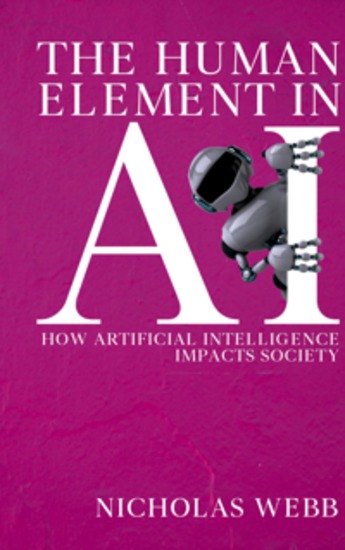
The Human Element in AI - How Artificial Intelligence Impacts Society - cover

The Human Element in AI - How Artificial Intelligence Impacts Society

Nicholas Webb

Publisher: Lulu.com

  • 0
  • 0
  • 0

Summary

As artificial intelligence continues to integrate into our lives, its influence reaches far beyond technology and business—it is reshaping society itself. The Human Element in AI: How Artificial Intelligence Impacts Society explores the profound ways AI is transforming our world, from the way we work and communicate to how we understand privacy, ethics, and human connection.

This book examines both the opportunities and challenges AI brings to society, discussing its effects on employment, education, healthcare, and daily life. It also addresses the ethical questions surrounding AI, such as biases in algorithms, data privacy concerns, and the potential consequences of increasingly autonomous systems. The Human Element in AI offers a balanced perspective, blending insights from experts in technology, sociology, and philosophy to help readers understand the societal implications of AI.

Perfect for those interested in technology, social sciences, and the future of humanity, this book provides a thought-provoking look at the role AI plays in shaping our collective future. Discover the impact of artificial intelligence on society and explore the ways in which we can navigate this transformative era with wisdom and foresight.
Available since: 10/16/2024.
Other books that might interest you

  • Beyond Measure - The Hidden History of Measurement from Cubits to Quantum Constants - cover

    Beyond Measure - The Hidden...

    James Vincent

    • 0
    • 0
    • 0
    A vibrant account of how measurement has invisibly shaped our world, from ancient civilizations to the modern day. 


    From the cubit to the kilogram, the humble inch to the speed of light, measurement is a powerful tool that humans invented to make sense of the world. In this revelatory work of science and social history, James Vincent dives into its hidden world, taking listeners from ancient Egypt, where measuring the annual depth of the Nile was an essential task, to the intellectual origins of the metric system in the French Revolution, and from the surprisingly animated rivalry between metric and imperial, to our current age of the "quantified self." At every turn, Vincent is keenly attuned to the political consequences of measurement, exploring how it has also been used as a tool for oppression and control. 


    Beyond Measure reveals how measurement is not only deeply entwined with our experience of the world, but also how its history encompasses and shapes the human quest for knowledge.
    Show book
  • The Rise of the US Environmental Health Movement - cover

    The Rise of the US Environmental...

    Kate Davies

    • 0
    • 0
    • 0
    “Tells the story of anger, disillusionment, and determination of Americans to develop a political movement to fight chemical pollution . . . timely.” —The Huffington PostThis book, named one of Booklist’s Top 10 books on sustainability in 2014, is the first to offer a comprehensive examination of the environmental health movement, which unlike many parts of the environmental movement, focuses on ways toxic chemicals and other hazardous agents in the environment effect human health and well-being. Born in 1978 when Lois Gibbs organized her neighbors to protest the health effects of a toxic waste dump in Love Canal, New York, the movement has spread across the United States and throughout the world. By placing human health at the center of its environmental argument, this movement has achieved many victories in community mobilization and legislative reform. In The Rise of the U.S. Environmental Health Movement, environmental health expert Kate Davies describes the movement’s historical, ideological, and cultural roots and analyzes its strategies and successes.“Kate Davies’ excellent book focuses on the role of health in the environmental health movement and encourages us to consider its origins and accomplishments . . . The Rise of the U.S. Environmental Health Movement looks both back and forward to challenge us to consider our current direction. In the future this book will provide readers with an important perspective on how the environmental health movement shaped our society.” —Toxipedia“A well-done history of America’s environmental health movement . . . offers readers valuable information on how grassroots organizing prevents harm from toxic exposures and leads to safe and healthy communities.” —Lois Marie Gibbs, Executive Director, Center for Health, Environment & Justice
    Show book
  • How To Think About AI - A Guide For The Perplexed - cover

    How To Think About AI - A Guide...

    Richard Susskind

    • 0
    • 0
    • 0
    In recent years, there has been massive public and professional interest in Artificial Intelligence. But people are confused about what AI is, what it can and cannot do, what is yet to come, and whether AI is good or bad for humanity and civilization—whether it will provide solutions to mankind's major challenges or become our gravest existential threat. There is also confusion about how we should regulate AI and where we should draw moral boundaries on its use. 


    In How To Think About AI, Richard Susskind draws on his experience of working on AI since the early 1980s. For Susskind, balancing the benefits and threats of artificial intelligence is the defining challenge of our age. He explores the history of AI and possible scenarios for its future. His views on AI are not always conventional. He positions ChatGPT and generative AI as no more than the latest chapter in the ongoing story of AI and claims we are still at the foothills of developments. He argues that to think responsibly about the impact of AI requires us to look well beyond today's technologies, suggesting that not-yet-invented technologies will have far greater impact on us in the 2030s than the tools we have today. This leads Susskind to discuss the possibility of conscious machines, magnificent new AI-enabled virtual worlds, and the impact of AI on the evolution of biological humans.
    Show book
  • How Software Fails - The Hidden Laws of Complex Systems - cover

    How Software Fails - The Hidden...

    Engin Yöyen

    • 0
    • 0
    • 0
    This audiobook is narrated by an AI Voice.   
    How Software Fails: A Field Guide to Understanding Complex System Disasters 
    Software failures aren't accidents, they're inevitabilities. In a universe governed by probability rather than certainty, even cosmic rays from distant stars can flip bits in computer memory, causing election machines to miscount votes or video game characters to jump impossibly high. But cosmic interference is just the beginning of how our most critical systems fail in spectacular and unpredictable ways. 
    Through gripping real-world case studies, this field guide reveals the hidden laws governing complex system disasters. Discover how Knight Capital lost $460 million in 45 minutes due to a single misplaced software flag. Learn why the Therac-25 radiation machine killed patients despite passing every safety test.Understand how a 40-kilobyte configuration file crashed 8.5 million computers worldwide, grounding flights and shuttering hospitals across the globe. 
    What You'll Learn 
    Based on complexity theorist Richard Cook's groundbreaking principles, you'll discover: 
    - Why testing can never guarantee perfection, and what to do instead 
    - How "reasonable" decisions combine to create unreasonable disasters 
    - Why complex systems always run in degraded mode, and why that's actually normal 
    - How scale transforms rare impossibilities into daily certainties 
    - Why the search for "root causes" consistently leads us astray 
    But this isn't just about understanding failure, it's about building resilience. Explore practical strategies from organizations that have learned to thrive in chaos: 
    - NASA's Mars rovers that adapt and learn from component failures, operating decades beyond their planned lifetimes 
    - The internet's routing protocols that automatically heal themselves when damaged 
    - Netflix's chaos engineering that deliberately breaks their own servers to build antifragile systems 
    - The ethical frameworks for deciding what level of failure is acceptable when lives are at stake
    Show book
  • HowExpert Guide to Becoming a Math Teacher - 101 Tips to Discover How to Become a Math Teacher Teach Mathematics and Help Students Learn Math - cover

    HowExpert Guide to Becoming a...

    HowExpert, Jennifer Schneid

    • 0
    • 0
    • 0
    If you want to discover how to become a math teacher, teach mathematics, and help students learn math, then checkout HowExpert Guide to Becoming a Math Teacher. 
    Whether you’re a math tutor, a newly minted math teacher about to start your first job, or a seasoned educator who has already been in the classroom a while, those who desire to become effective mathematics educators would benefit from this guide. Even teachers of other disciplines could learn some new information and techniques. With helpful tips and tricks from a math educator who taught in a community college for seventeen years and tutored math for over twenty years to students from kindergarten up to college undergraduate level, you will gain new knowledge to help you reach your students better, get them to be more cooperative, and make your job easier and more fun! You will learn some new information and techniques that will help you engage your students better and simplify your own tasks so that you have more time for them and your own life. 
    HowExpert Guide to Becoming a Math Teacher encourages you to get to know your students, your resources, your standards, and your technology before you ever design your lessons. It helps you to understand what topics need further research and what is important to prioritize. It also provides many helpful websites and strategies to use right away to resolve problems that may arise or save you time by providing something helpful for you to use. It is not all-inclusive, but it gives you a great place to start to get your teaching career off the ground or improve what it already is. 
    Check out HowExpert Guide to Becoming a Math Teacher to discover how to become a math teacher, teach mathematics, and help students learn math. 
    HowExpert publishes quick how to guides on all topics from A to Z by everyday experts.
    Show book
  • Machine Learning with Python Guide for Beginners - A Beginner's Roadmap - cover

    Machine Learning with Python...

    Robert Francis

    • 0
    • 0
    • 0
    Dive into the fascinating realm of Machine Learning with 'Machine Learning with Python Guide for Beginners.' This comprehensive guide is crafted for individuals eager to embark on a journey into the dynamic field of machine learning using the versatile programming language, Python. 
    'Machine Learning with Python Guide for Beginners' is your passport to mastering the art and science of machine learning with Python. Unlock the potential of data and algorithms, and empower yourself to make a lasting impact in the world of technology. 
      
     
    Show book