Join us on a literary world trip!
Add this book to bookshelf
Grey
Write a new comment Default profile 50px
Grey
Subscribe to read the full book or read the first pages for free!
All characters reduced
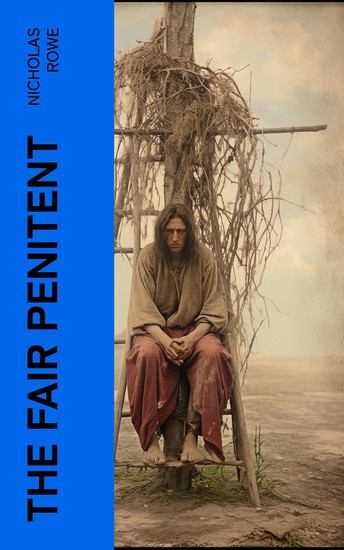
The Fair Penitent - cover

The Fair Penitent

Nicholas Rowe

Publisher: e-artnow

  • 0
  • 0
  • 0

Summary

"The Fair Penitent" by Nicholas Rowe. Published by e-artnow. e-artnow publishes a wide range of titles that encompasses every genre. From well-known classics & literary fiction and non-fiction to forgotten−or yet undiscovered gems−of world literature, we issue the books that need to be read. Each e-artnow edition has been meticulously edited and formatted to boost readability for all e-readers and devices. Our goal is to produce eBooks that are user-friendly and accessible to everyone in a high-quality digital format.
Available since: 12/06/2023.
Print length: 42 pages.

Other books that might interest you

  • The Morning Light - never passes us by - cover

    The Morning Light - never passes...

    Brian Lisus

    • 0
    • 0
    • 0
    Poetic, engaging and original, The Morning Light is a charming story of discovering the ancient and shared voice within each of us. 
    A violin maker’s story of music, craftsmanship and the seeking of serenity set against homelessness, twists of fate and a never ending desire to reproduce the sweet and soulful sound of a grandfather’s violin, fine-tuned to play with a resonance that connects the heart. 
    The chapters are interspersed with gorgeous pieces of music played on instruments created in Brian's studio in Ojai, California. https://www.themorninglight.org/ or https://www.lisusviolins.com/
    Show book
  • The Tragedy of Timon of Athens - cover

    The Tragedy of Timon of Athens

    William Shakespeare

    • 0
    • 0
    • 0
    The Tragedy of Timon of Athens (The Life of Tymon of Athens) is a play by William Shakespeare, probably written in collaboration with Thomas Middleton in about 1605–1606, which was published in the First Folio in 1623. It is about the fortunes of an Athenian named Timon. The central character is a beloved citizen of Athens who through tremendous generosity spends his entire fortune on corrupt hangers-on only interested in getting the next payout.
    The earliest-known production of the play was in 1674, when Thomas Shadwell wrote an adaptation under the title The History of Timon of Athens, The Man-hater. Multiple other adaptations followed over the next century, by writers such as Thomas Hull, James Love and Richard Cumberland. The straight Shakespearean text was performed at Smock Alley in Dublin in 1761, but adaptations continued to dominate the stage until well into the 20th century.
    ... Flavius arrives. He wants the money as well, but he also wants Timon to come back into society. Timon acknowledges that he has had one true friend in Flavius, a shining example of an otherwise diseased and impure race, but laments that this man is a mere servant. He invites the last envoys from Athens, who hoped Timon might placate Alcibiades, to go hang themselves, and then dies in the wilderness. Alcibiades, marching on Athens, then throws down his glove, and ends the play reading the bitter epitaph Timon wrote for himself, part of which was composed by Callimachus:
    "Here lies a wretched corpse of wretched soul bereft:
    Seek not my name: a plague consume you wicked caitiffs left!"
    Here lie I, Timon, who alive, all living men did hate,
    Pass by, and curse thy fill, but pass and stay not here thy gait...
    Among the most significant works William Shakespeare: Hamlet, Othello, King Lear, Macbeth, Orpheus, Romeo and Juliet, Julius Caesar, Troilus and Cressida, The Tempest, Venus and Adonis, Antony and Cleopatra, Measure for Measure, The Winter's Tale and many more.
    Show book
  • amuk - cover

    amuk

    Khairani Barokka

    • 0
    • 0
    • 0
    Khairani Barokka's uncompromising third collection of poetry amuk sheds light on the devastating and ongoing effects of a single word's mistranslation, and emphasises what exists in opposition to such hostile histories and presents: hope, resistance, and joy.
    Groundbreaking in its use of form and poetics, amuk deconstructs the brutal workings of oppressive systems to examine how, "through macheted etymology", violence and suffering is replicated through (mis)translation. These radical poems of fury and prayer look towards the vital, living resistance of persisting languages, and resilient peoples.
    Show book
  • The Span of a Small Forever - Poems - cover

    The Span of a Small Forever - Poems

    April Gibson

    • 0
    • 0
    • 0
    With echoes of Audre Lorde’s The Cancer Journals and Susan Sontag’s Illness as Metaphor, an extraordinary debut collection from a prize-winning poet that chronicles a Black woman’s journey through disability, the byzantine healthcare system, life-giving, taking, and sacrifice. 
    With breathtaking lyricism and a vulnerability that pierces the heart, April Gibson journeys through the emotional abysses, the daily pleasures, the frustrations, and the joys of being a Black woman living with chronic illness.  
    Gibson offers a unique perspective on “the body,” viewing disability and healthcare through both feminist and socio-economic lenses filtered by race and faith. Through gorgeous sensory language that migrates memories, from carefree innocence to the ravages formed in its absence, Gibson bears witness to grief, courage, and resistance to redefine herself on her own terms.   
    Gibson presents her body as a “looking glass” that re-envisions illness, womanhood, motherhood, religious relics and collective loss through her physicality, through her lamenting, through her unearthing, reckoning and rebirth. Not only do we see her, but see the “we” in her. The Span of a Small Forever is both testimony and transformation—heart-shattering in its honesty, it ultimately offers us transcendent beauty, nourishment, and the strength we need to go on in our lives.
    Show book
  • A Ballad of Death - A poetic examination of grief and lost love - cover

    A Ballad of Death - A poetic...

    Algernon Charles Swinburne

    • 0
    • 0
    • 0
    Algernon Charles Swinburne was born on April 5th, 1837, in London, into a wealthy Northumbrian family.  He was educated at Eton and at Balliol College, Oxford, but did not complete a degree.  
    In 1860 Swinburne published two verse dramas but achieved his first literary success in 1865 with Atalanta in Calydon, written in the form of classical Greek tragedy. The following year "Poems and Ballads" brought him instant notoriety. He was now identified with "indecent" themes and the precept of art for art's sake.  
    Although he produced much after this success in general his popularity and critical reputation declined. The most important qualities of Swinburne's work are an intense lyricism, his intricately extended and evocative imagery, metrical virtuosity, rich use of assonance and alliteration, and bold, complex rhythms.  
    Swinburne's physical appearance was small, frail, and plagued by several other oddities of physique and temperament. Throughout the 1860s and 1870s he drank excessively and was prone to accidents that often left him bruised, bloody, or unconscious. Until his forties he suffered intermittent physical collapses that necessitated removal to his parents' home while he recovered.  
    Throughout his career Swinburne also published literary criticism of great worth. His deep knowledge of world literatures contributed to a critical style rich in quotation, allusion, and comparison. He is particularly noted for discerning studies of Elizabethan dramatists and of many English and French poets and novelists. As well he was a noted essayist and wrote two novels. 
    In 1879, Swinburne's friend and literary agent, Theodore Watts-Dunton, intervened during a time when Swinburne was dangerously ill. Watts-Dunton isolated Swinburne at a suburban home in Putney and gradually weaned him from alcohol, former companions and many other habits as well.  
    Much of his poetry in this period may be inferior but some individual poems are exceptional; "By the North Sea," "Evening on the Broads," "A Nympholept," "The Lake of Gaube," and "Neap-Tide."  
    Swinburne lived another thirty years with Watts-Dunton. He denied Swinburne's friends access to him, controlled the poet's money, and restricted his activities. It is often quoted that 'he saved the man but killed the poet'.  
    Swinburne died on April 10th, 1909 at the age of seventy-two.
    Show book
  • My Land of Freedom - A poem of war and freedom - cover

    My Land of Freedom - A poem of...

    Ifeanyi Njoku

    • 0
    • 0
    • 0
    This poem is a powerful reflection on war, displacement, and the struggle for freedom. It tells the tragic story of a people who fought for liberation but were met with violence, loss, and eventual surrender. Likely referencing the Igbo experience during the Nigerian Civil War, it captures the pain of oppression and the resilience of those who endured it. 
    The poem begins with a contradiction: "In my land of freedom, I walked with fear." This highlights the irony of living in a place meant to be free but being consumed by anxiety. The people demand justice, yet their cries are silenced by violence. The line "Killing our brothers, and leaving us undone" conveys both physical loss and emotional devastation. 
    The imagery of "scorching soil" and "separated from families" paints a picture of suffering and displacement. War does not just take lives—it tears families apart and leaves hearts unable to thrive. The mention of "refugee camps" emphasizes how many were forced from their homes, left to question their identity: "Are we unlucky, to be Igbo?" This speaks to a deep sense of abandonment and injustice. 
    The poem also highlights betrayal, as leaders fail to protect their people. "Everyone was a soldier, in this war we couldn't win." This line captures the grim reality of a war where survival itself was a battle. Despite their bravery, they were up against overwhelming forces. 
    The final lines are heartbreaking: "We had to surrender, and say goodbye to our pride." This is not just a loss of battle but a loss of dignity. Yet, even in surrender, their story lives on. This poem is a tribute to resilience, a reminder of suffering, and a call to remember those who fought, even when the world turned away.
    Show book