Join us on a literary world trip!
Add this book to bookshelf
Grey
Write a new comment Default profile 50px
Grey
Subscribe to read the full book or read the first pages for free!
All characters reduced
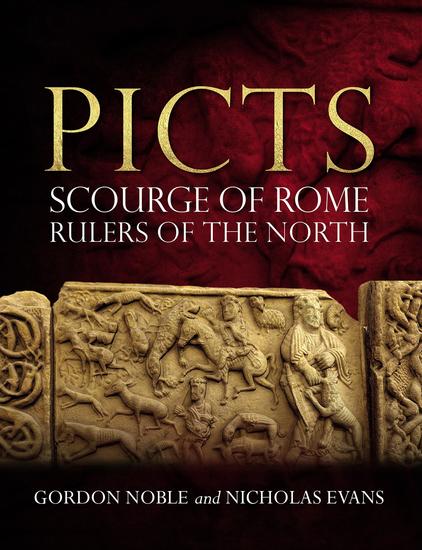
Picts - Scourge of Rome Rulers of the North - cover

Picts - Scourge of Rome Rulers of the North

Nicholas Evans, Gordon Noble

Publisher: Birlinn

  • 0
  • 0
  • 0

Summary

Shortlisted for the EAA Book Prize and the Current Archaeology Book of the Year Award
The Picts have fascinated for centuries. They emerged c. ad 300 to defy the might of the Roman empire only to disappear at the end of the first millennium ad, yet they left major legacies. They laid the foundations for the medieval Scottish kingdom and their captivating carved stones are some of the most eye-catching yet enigmatic monuments in Europe. Until recently the Picts have been difficult to trace due to limited archaeological investigation and documentary sources, but innovative new research has produced critical new insights into the culture of a highly sophisticated society which defied the might of the Roman Empire and forged a powerful realm dominating much of northern Britain.
This is the first dedicated book on the Picts that covers in detail both their archaeology and their history. It examines their kingdoms, culture, beliefs and everyday lives from their origins to their end, not only incorporating current thinking on the subject, but also offering innovative perspectives that transform our understanding of the early history of Scotland.
Available since: 11/03/2022.
Print length: 336 pages.


Other books that might interest you

  • School of Errors - Rethinking School Safety in America - cover

    School of Errors - Rethinking...

    David P. Perrodin, Danny Woodburn

    • 0
    • 0
    • 0
    School of Errors: Rethinking School Safety in America establishes another voice in the discussion of how to promote safe schools. It challenges the unchecked expansion of school fortification and questions the realized benefit of inter-agency collaboration during a sentinel event. This book offers an alternative to traumatizing simulations by providing clear options for improving school safety by the empirically-proven effective measures of leakage detection (preventive) and sensemaking (reactive). School of Errors restores the scientific method to school safety and clears a path through the media rhetoric fogging this vital topic. 
    School of Errors is hailed as "the most honest book ever written about the $3 billion school safety industrial complex." 
    *This audiobook has a companion PDF document.
    Show book
  • The Vanishing Church - How the Hollowing Out of Moderate Congregations Is Hurting Democracy Faith and Us - cover

    The Vanishing Church - How the...

    Ryan P. Burge

    • 0
    • 0
    • 0
    Many people take it for granted: Evangelicals are Republican, Democrats aren't religious, and moderate Christians may as well not exist. But it wasn't always this way. Those who grew up evangelical in the 1980s were just as likely to sit next to a Democrat as a Republican at church. What happened in the decades that followed?Data scientist Ryan Burge demystifies the recent polarization of American pews, helping listeners understand why the religious landscape has changed so much in the last fifty years and how this divide impacts every aspect of society. Burge argues that Americans prioritized their political parties over their denominations amid the culture wars. As many churches embraced conservative politics, moderate and liberal Christians left the church in droves.Yet Burge shows us that returning to church may be just what America needs. Many Americans want to be people of faith and believe deeply in the principles of religion. Churches provide support systems for needy families. And statistically, churchgoers tend to be more tolerant and have better mental health than Americans who don't attend church. Blending personal narrative and carefully presented data, Burge urges listeners to rebuild faith communities that can reach across the aisle.
    Show book
  • Anaximander - Secrets of the First Scientist in History - cover

    Anaximander - Secrets of the...

    Hector Davidson

    • 0
    • 0
    • 0
    Anaximander’s legacy is vast and multifaceted, cementing his place as one of the pioneering figures in the history of philosophy and science. As a pre-Socratic philosopher from Miletus, Anaximander made significant contributions that laid the groundwork for future scientific and philosophical inquiry. 
    Anaximander is best known for his revolutionary ideas about the cosmos. He proposed that the universe originated from the apeiron, an indefinite or boundless substance, which he believed was the source of all things. This concept marked a significant departure from the mythological explanations of the cosmos prevalent in his time, suggesting instead a naturalistic origin of the universe. His cosmological model, which included the idea of a cylindrical Earth suspended in space, demonstrated a sophisticated understanding of celestial mechanics for his era. 
    Often regarded as the first true scientist, Anaximander applied rational and empirical approaches to understand natural phenomena. He was one of the first to propose that natural laws govern the world, an idea that forms the cornerstone of scientific inquiry. His work in biology suggested that life originated in water and that humans evolved from fish-like ancestors, anticipating evolutionary theory millennia before Darwin.
    Show book
  • Shadows of Salem - Witch Hunts Hysteria and the Making of American Fear - cover

    Shadows of Salem - Witch Hunts...

    Davis Truman

    • 0
    • 0
    • 0
    In 1692, a small Puritan community in Massachusetts became the stage for one of the darkest episodes in American history. The Salem Witch Trials, fueled by superstition, religious zeal, and the fear of the unknown, led to over 150 accusations, countless shattered lives, and the executions of innocent men and women. But beyond the gallows and confessions lies a deeper story, one of resistance, power, and the origins of collective fear in America. 
    In Shadows of Salem, readers are taken inside the trials to witness how hysteria spread, how law was bent to justify injustice, and how individuals, like Giles Corey, chose silence and suffering over submission. Drawing on historical records, legal precedents, and cultural analysis, this book uncovers how Salem’s legacy shaped America’s enduring relationship with fear, authority, and social control. 
    From the use of spectral evidence to the crushing weight of peine forte et dure, Shadows of Salem explores not just what happened in 1692, but why it continues to haunt the American imagination. It is a story of mass panic and manipulation, but also of defiance and resilience, an essential lens for understanding both the past and the patterns of fear that still echo in modern society. 
    Perfect for readers of history, law, and cultural studies, Shadows of Salem offers a compelling examination of how hysteria becomes power, and how silence can be the most powerful act of resistance.
    Show book
  • 100 Amazing Facts about Italy - At the Heart of Mediterranean Legends - cover

    100 Amazing Facts about Italy -...

    Marc Dresgui

    • 0
    • 0
    • 0
    Discover Italy like never before with “100 Amazing Facts about Italy,” a captivating journey through the mysteries, legends, and riches of one of the world’s most fascinating countries! 🇮🇹 
    Have you ever wondered:What strange natural phenomenon transforms Venice’s lagoon each year?What are the mysterious singing stones of Sardinia?Why are the olive trees of Puglia so ancient?What secrets lie under Rome's streets in the catacombs?What rare butterfly only lives on Italy’s Mount Vulture?Why do some lakes near Mount Etna bubble continuously? 
    Why “100 Amazing Facts about Italy” is the perfect choice for young readers and teens:Captivating Content: Each fact is presented in a way that sparks curiosity, with accessible and engaging stories that keep attention and make every discovery thrilling.A Journey through History and Nature: From volcanic histories to ancient Italian traditions, this book spans a wide variety of topics to give a complete, fascinating picture of Italy.A Treasure of Cultural and Scientific Wonders: Each fact is carefully chosen to enrich general knowledge and introduce readers to geological, historical, and natural marvels.A Window to Global Diversity: By exploring Italy’s unique regional features, this book provides insights into the diversity of nature and cultures, promoting tolerance and respect.Accessible and Engaging Style: The language is clear, precise, and pedagogical, making this book suitable for young readers and intriguing to curious adults alike. 
    Dive into the extraordinary with “100 Amazing Facts about Italy” and let young readers discover the richness of this timeless country!
    Show book
  • Mughal Empire - The Early Modern Islamic Empire in South Asia - cover

    Mughal Empire - The Early Modern...

    Kelly Mass

    • 0
    • 0
    • 0
    The Mughal Empire, also referred to as the Mogul or Moghul Empire, was one of the most powerful and influential early modern Islamic empires in South Asia. Established in the 16th century, it controlled vast regions for over two centuries, encompassing territories from the peripheries of the Indus basin in the west, extending to northern Afghanistan, Kashmir in the north, present-day Bangladesh in the east, and stretching as far south as the Deccan Plateau's uplands.The origins of the Mughal Empire trace back to 1526 when Babur, a warrior chieftain from what is now Uzbekistan, founded the empire. Babur's military strategy combined traditional cavalry tactics with the latest artillery techniques, using matchlock guns and cast cannons acquired with Ottoman assistance. These advancements, alongside his strategic acumen, led him to a decisive victory against the Sultan of Delhi, Ibrahim Lodhi, at the First Battle of Panipat. This battle marked a turning point, allowing Babur to establish his dominance over northern India and subdue rival Rajput and Afghan forces.While Babur laid the foundation of the empire, the true structure of the Mughal state is often attributed to his grandson, Akbar the Great. By the late 16th century, under Akbar's rule, the empire expanded its reach and established a well-organized imperial administration that laid the groundwork for political stability, cultural integration, and economic prosperity. Akbar's reign is particularly noted for promoting a policy of religious tolerance, encouraging a synthesis of Hindu and Muslim cultures, and setting up an efficient centralized bureaucracy.
    Show book