Join us on a literary world trip!
Add this book to bookshelf
Grey
Write a new comment Default profile 50px
Grey
Subscribe to read the full book or read the first pages for free!
All characters reduced
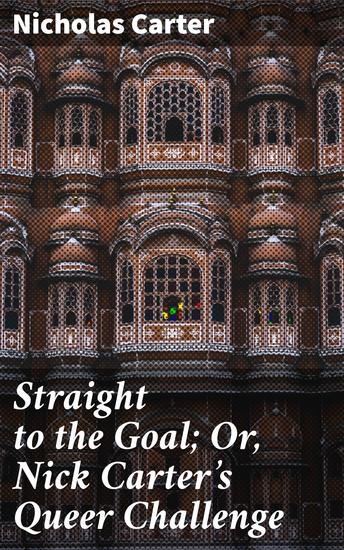
Straight to the Goal; Or Nick Carter's Queer Challenge - Unraveling Mysteries and Chasing Criminals: An Action-Packed Adventure - cover

Straight to the Goal; Or Nick Carter's Queer Challenge - Unraveling Mysteries and Chasing Criminals: An Action-Packed Adventure

Nicholas Carter

Publisher: Good Press

  • 0
  • 0
  • 0

Summary

In "Straight to the Goal; Or, Nick Carter's Queer Challenge," Nicholas Carter delivers an engrossing tale that intricately weaves adventure, mystery, and the thrills of early 20th-century detective fiction. The narrative centers on the renowned detective Nick Carter, whose uncanny ability to solve baffling cases is tested as he faces a peculiar challenge that blurs the lines between deception and reality. Carter'Äôs distinctive literary style, characterized by meticulous attention to detail and vibrant characterizations, illuminates the era's societal norms while addressing themes of justice and moral ambiguity, positioning this work within the rich tapestry of the popular pulp fiction of its time. Nicholas Carter, a pseudonymous author predominantly known for his detective stories, was influenced by the burgeoning genre of mystery and crime fiction that gained immense popularity in the late 19th and early 20th centuries. His penchant for creating dynamic characters and intricate plots reflects the cultural fascination with crime and the emerging professionalization of detectives during this period. Carter's extensive background in journalism and recognition in the pulp magazine landscape endowed him with a unique perspective on crime and its specter in society. This engaging novel is a testament to the foundational elements of the detective genre and serves as a crucial text for readers interested in the evolution of crime narrative. The suspenseful plot and the astute observations of human behavior resonate with modern investigative tales, making this book a compelling read for both fans of classic literature and enthusiasts of contemporary crime fiction.
Available since: 01/17/2022.
Print length: 85 pages.
Other books that might interest you

  • Jane Austen Collection: The Complete Novels (Sense and Sensibility Pride and Prejudice Emma Persuasion) - cover

    Jane Austen Collection: The...

    Jane Austen

    • 0
    • 0
    • 0
    This audiobook contains the complete novels of Jane Austen in the chronological order of their original publication.
    
    - Lady Susan (starts at Chapter 1)
    - Sense and Sensibility (starts at Chapter 44)
    - Pride and Prejudice (starts at Chapter 96)
    - Mansfield Park (starts at Chapter 159)
    - Emma (starts at Chapter 209)
    - Persuasion (starts at Chapter 266)
    - Northanger Abbey (starts at Chapter 292)
    - The Watsons (starts at Chapter 326)
    Show book
  • The Law of Life - cover

    The Law of Life

    Jack London

    • 0
    • 0
    • 0
    "The Law of Life" is a short story by the American naturalist writer Jack London. It was first published in McClure's Magazine, Vol.16, March, 1901. In 1902, it was published in a collection of Jack London's stories, The Children of Frost, by Macmillan Publishers.
    This short story covers the last 5 hours of the old and dying Inuit chief Koskoosh. His tribe needs to travel in search of clothing and shelter so he is left to die because of his age and inability to see properly. Even his son has to leave him because he has a new family to feed and take care of.
    However, the old Koskoosh is not dissatisfied as he knows the law of life and his desires. He accepts his fate peacefully and starts to visualize the events of his past. The images of both great famine and times of plenty vividly comes to his mind. As an experienced person he contemplates nature and ultimately accepts its individualism.
    Show book
  • New Worlds for Old (Unabridged) - cover

    New Worlds for Old (Unabridged)

    H. G. Wells

    • 0
    • 0
    • 0
    This is a pre-1923 historical reproduction that was curated for quality. Quality assurance was conducted on each of these books in an attempt to remove books with imperfections introduced by the digitization process. Though we have made best efforts - the books may have occasional errors that do not impede the reading experience. We believe this work is culturally important and have elected to bring the book back into print as part of our continuing commitment to the preservation of printed works worldwide.
    Show book
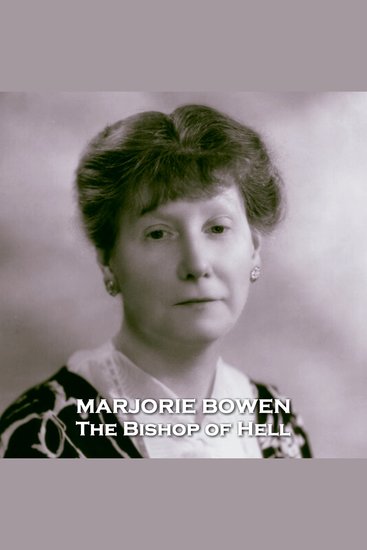
  • The Bishop of Hell - An abusive man runs off with a married woman and tragedy ensues - cover

    The Bishop of Hell - An abusive...

    Marjorie Bowen

    • 0
    • 0
    • 0
    Margaret Gabrielle Vere Campbell was born on 1st November 1885 on Hayling Island in Hampshire.  
     
    Her childhood was fraught with problems, her alcoholic father left early in her life and was later found dead on a London Street. Life thereafter was poverty with an uncaring mother. 
     
    However, her talents took her to the Slade School of Fine Art and later to study in Paris.  
     
    Her first fiction, written at a mere 16, was a violent medieval historical novel, ‘The Viper of Milan’. Initially rejected by several publishers it went on to become a best-seller  
     
    After this her prolific writings were the main financial support for the family.  Her literary output numbered over 150 volumes, mainly under the pseudonym of Marjorie Bowen but she also used the names Joseph Shearing, George R Preedy, John Winch, Robert Paye and Margaret Campbell.  Within this output she assigned the pseudonyms to the various genres she worked across, from Historical fiction to supernatural short stories.  
     
    Perhaps her best known work is the 1909 book ‘Black Magic’, a Gothic horror novel about a medieval witch. 
     
    Several of her works were also adapted into films.   
     
    She was married twice.  The first to Zefferino Emilio Constanza (they had two children), who died of tuberculosis, and then to Arthur L Long (and another two children) 
     
    Marjorie Bowen died on 23rd December 1952 at St Charles Hospital in North Kensington, London after suffering serious concussion from a fall in her bedroom.  She was 67.
    Show book
  • H G Wells - Six of the Best - Their legacy in 6 classic stories - cover

    H G Wells - Six of the Best -...

    H G Wells

    • 0
    • 0
    • 0
    Six has always been a number we group things around – Six of the best, six of one half a dozen of another, six feet under, six pack, six degrees of separation and a sixth sense are but a few of the ways we use this number. 
     
    Such is its popularity that we thought it is also a very good way of challenging and investigating an author’s work to give width, brevity, humour and depth across six of their very best. 
     
    In this series we gather together authors whose short stories both rivet the attention and inspire the imagination to visit their gems in a series of six, to roam across an author’s legacy in a few short hours and gain a greater understanding of their writing and, of course, to be lavishly entertained by their ideas, their narrative and their way with words. 
     
    These stories can be surprising and sometimes at a tangent to what we expected, but each is fully formed and a marvellous adventure into the world and words of a literary master. 
     
     1 - Six of the Best - H G Wells - An Introduction 
    2 - H G Wells - An Introduction 
    3 - The Crystal Egg by H G Wells 
    4 - The Man Who Could Work Miracles by H G Wells 
    5 - The Sea Raiders by H G Wells 
    6 - The Magic Shop by H G Wells 
    7 - The Flowering of the Strange Orchid by H G Wells 
    8 - A Dream of Armageddon - Part 1 by H G Wells 
    9 - A Dream of Armageddon - Part 2 by H G Wells
    Show book
  • The Story of An Hour - cover

    The Story of An Hour

    Kate Chopin

    • 0
    • 0
    • 0
    American author Kate Chopin's "The Story of an Hour" was written in April of 1894 and originally published in Vogue in December of that year. The title refers to the time elapsed between the moments at which the protagonist, Louise Mallard, hears that her husband is dead, then discovers that he is alive after all. The short story is a mainstay of feminist literary study.
    Show book