

Join us on a literary world trip!
Add this book to bookshelf
Grey
Write a new comment Default profile 50px
Grey
Subscribe to read the full book or read the first pages for free!
All characters reduced
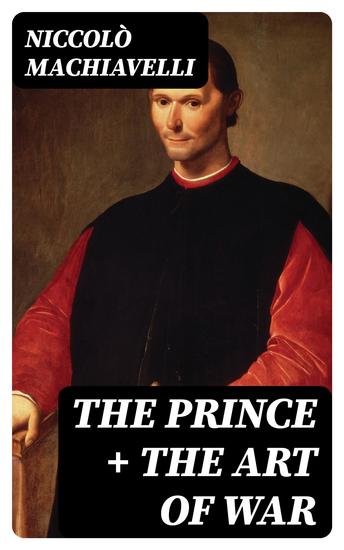
The Prince + The Art of War - Enriched edition 2 Masterpieces of Strategy - cover

The Prince + The Art of War - Enriched edition 2 Masterpieces of Strategy

Niccolò Machiavelli

Publisher: DigiCat

  • 0
  • 0
  • 0

Summary

In Niccolò Machiavelli's seminal works, *The Prince* and *The Art of War*, the author intricately examines the mechanics of power and governance, delivering profound insights into the nature of political leadership and military strategy during the Italian Renaissance. Written in a direct and pragmatic style, these texts reflect a stark realism, eschewing moralistic narratives in favor of candid advice for rulers and military leaders. The intertwining of warfare and politics is explored through Machiavelli's analytical lens, making these treatises foundational to modern political theory and military thought. Machiavelli, a diplomat and political theorist from Florence, was profoundly influenced by the tumultuous political landscape of his time, characterized by petty rivalries, shifting allegiances, and the rise and fall of city-states. His personal experiences, including his imprisonment and exile, shaped his understanding of power dynamics, making him a keen observer of human behavior and government. As a product of the Italian Renaissance, Machiavelli sought to revive classical ideas while confronting the realities of contemporary politics. *The Prince* and *The Art of War* are essential readings for anyone interested in political philosophy, history, or military strategy. Machiavelli's work remains relevant, offering critical reflections that provoke thought about authoritative governance, ethics in leadership, and the complexities of war, making this a compelling exploration for scholars and general readers alike.

In this enriched edition, we have carefully created added value for your reading experience:
- A comprehensive Introduction outlines these selected works' unifying features, themes, or stylistic evolutions.
- The Author Biography highlights personal milestones and literary influences that shape the entire body of writing.
- A Historical Context section situates the works in their broader era—social currents, cultural trends, and key events that underpin their creation.
- A concise Synopsis (Selection) offers an accessible overview of the included texts, helping readers navigate plotlines and main ideas without revealing critical twists.
- A unified Analysis examines recurring motifs and stylistic hallmarks across the collection, tying the stories together while spotlighting the different work's strengths.
- Reflection questions inspire deeper contemplation of the author's overarching message, inviting readers to draw connections among different texts and relate them to modern contexts.
- Lastly, our hand‐picked Memorable Quotes distill pivotal lines and turning points, serving as touchstones for the collection's central themes.
Available since: 05/25/2022.
Print length: 440 pages.
Other books that might interest you

  • Cosmos and Republic - Arendtian Explorations of the Loss and Recovery of Politics - cover

    Cosmos and Republic - Arendtian...

    Wolfgang R. Heuer

    • 0
    • 0
    • 0
    In 20 essays inspired by Hannah Arendt's analysis of crisis-ridden modernity, Wolfgang R. Heuer addresses aspects of depoliticization and the loss of politics, and thus of freedom. The wide-ranging essays are grouped in five sections: When Politics Vanishes, The Call of Responsibility, Images and Emotions, Federations, and From Plurality to Cosmos. They lead to the insight that the crises of our time require a common change of perspective towards ecological and political sustainability, the unity of »Cosmos and Republic«.
    Show book
  • Who Owns The Moon? - In Defence of Humanity's Common Interests in Space - cover

    Who Owns The Moon? - In Defence...

    A. C. Grayling

    • 0
    • 0
    • 0
    Silicon for microchips; manganese for batteries; titanium for missiles. 
     
    The moon contains a wealth of natural resources. So, as the Earth’s supplies have begun to dwindle, it is no surprise that the world’s superpowers and wealthiest corporations have turned their eyes to the stars. As this new Space Race begins, A.C. Grayling asks: who, if anyone, owns the moon? Or Mars? Or other bodies in near space? And what do those superpowers and corporations owe to Planet Earth and its inhabitants as a whole? 
     
    From feudal common land, through the rules of the sea, to the vast, nationless expanse of Antarctica, Grayling explores the history of the places which no one, and therefore everyone, owns. Examining the many ways this so-called terra nullius has fallen victim to ‘the tragedy of the commons’ – the tendency for communal resources to be exploited by a few individuals for personal gain at the expense of everyone else – Who Owns the Moon? puts forward a compelling argument for a bold new global consensus, one which recognises and defends the rights of everyone who lives on this planet.
    Show book
  • In Defense of Open Society: Book Summary & Analysis - cover

    In Defense of Open Society: Book...

    Briefly Summaries

    • 0
    • 0
    • 0
    This is a concise summary and analysis of In Defense of Open Society, by George Soros.
     
    It is not the original book and is not affiliated with or endorsed by George Soros.
     
    Ideal those seeking a quick and insightful overview.
     
    In a time of rising authoritarianism and political uncertainty, In Defense of Open Society explores the principles that uphold democratic societies. Drawing on personal experiences and decades of philanthropic efforts, the book examines the threats posed to open societies by nationalism, populism, and the erosion of civil liberties. Through sharp analysis and compelling arguments, it advocates for the preservation of freedom, transparency, and justice as the cornerstones of a better future.
    Show book
  • Stories are Weapons - Psychological Warfare and the American Mind - cover

    Stories are Weapons -...

    Annalee Newitz

    • 0
    • 0
    • 0
    In Stories Are Weapons, Annalee Newitz traces the way disinformation, propaganda, and violent threats have evolved from military weapons deployed against foreign adversaries into tools in domestic culture wars. Newitz delves into America's deep-rooted history with psychological operations, beginning with Benjamin Franklin's Revolutionary War–era fake newspaper and nineteenth-century wars on Indigenous nations, and reaching its apotheosis with the Cold War and twenty-first-century influence campaigns online. America's secret weapon has long been coercive storytelling. And there's a reason for that: operatives who shaped modern psychological warfare drew on their experiences as science fiction writers and in the advertising industry. 


    Now, through a weapons-transfer program long unacknowledged, psyops have found their way into the hands of culture warriors, transforming democratic debates into toxic wars over American identity. Newitz zeroes in on conflicts over race and intelligence, school board fights over LGBT students, and campaigns against feminist viewpoints, revealing how, in each case, specific groups of Americans are singled out and treated as enemies of the state. Crucially, Newitz delivers a powerful counternarrative, speaking with the researchers and activists who are outlining a pathway to achieving psychological disarmament and cultural peace.
    Show book
  • Populism Vs Liberalism - A Comparative Analysis of Political Ideologies - cover

    Populism Vs Liberalism - A...

    Arlo Holders

    • 0
    • 0
    • 0
    Political ideologies form the foundation of how societies organize governance, economics, and social structures. They are systems of ideas and beliefs that provide a framework for political thought and action, influencing policies, institutions, and the behavior of individuals and groups. Among the diverse range of ideologies, populism and liberalism have emerged as two of the most significant and often opposing forces in modern political discourse. This chapter introduces the concepts of populism and liberalism, highlights their importance, and sets the stage for the comparative analysis that follows. 
    Populism is a political approach that champions the rights and concerns of the common people against an established elite. It is often characterized by a rhetoric that emphasizes “the people” as a unified and virtuous entity, contrasted with a corrupt and self-serving elite. While populism can manifest across the political spectrum, its appeal lies in its simplicity and directness, offering solutions that often resonate with those who feel excluded or marginalized by traditional institutions. Populist movements frequently arise in periods of social upheaval or economic insecurity, presenting themselves as corrective forces against perceived injustices. 
    In contrast, liberalism is a political ideology rooted in the principles of individual rights, equality, and the rule of law. It advocates for democratic governance, free markets, and the protection of civil liberties. Liberalism’s historical development is closely linked with movements such as the Enlightenment and the rise of constitutional democracies. As a flexible and adaptive ideology, liberalism has evolved to address modern issues such as social justice, environmental concerns, and global cooperation while maintaining its foundational emphasis on freedom and equality.
    Show book
  • Securitising Decolonisation - The Silencing of Ewe and Togoland Unification under United Nations Trusteeship 1945-1960 - cover

    Securitising Decolonisation -...

    Julius Heise

    • 0
    • 0
    • 0
    With the right to petition the United Nations, the Ewe and Togoland unification movement enjoyed a privilege unmatched by other dependent peoples. Using language conveying insecurity, the movement seized the international spotlight, ensuring that the topic of unification dominated the UN Trusteeship System for over a decade. Yet, its vociferous securitisations fell silent due to colonial distortion, leaving unification unfulfilled, thus allowing the seeds of secessionist conflict to grow. At the intersection of postcolonial theory and security studies, Julius Heise presents a theory-driven history of Togoland's path to independence, offering a crucial lesson for international statebuilding efforts.
    Show book
