Rejoignez-nous pour un voyage dans le monde des livres!
Ajouter ce livre à l'électronique
Grey
Ecrivez un nouveau commentaire Default profile 50px
Grey
Abonnez-vous pour lire le livre complet ou lisez les premières pages gratuitement!
All characters reduced
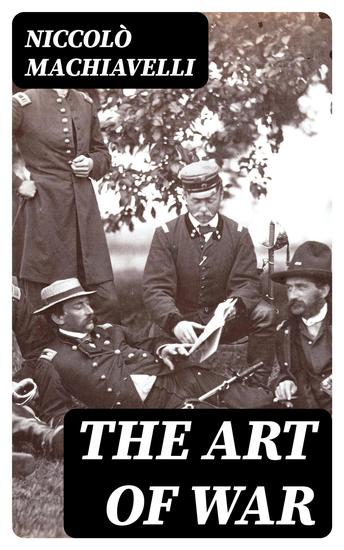
The Art of War - Enriched edition Including "The Prince" - cover

The Art of War - Enriched edition Including "The Prince"

Niccolò Machiavelli

Maison d'édition: DigiCat

  • 0
  • 0
  • 0

Synopsis

In "The Art of War," Niccolò Machiavelli presents a profound treatise on military strategy, intertwining philosophical insights with practical advice. Written in the early 16th century, this work reflects the tumultuous political landscape of Renaissance Italy, where city-states vied for power. Machiavelli's literary style is characterized by clarity and directness, employing a dialogue between a general and his student to explicate the principles of warfare, the organization of troops, and the importance of discipline and strategy. Through this dialogue, readers gain an understanding of the interplay between war and politics, uncovering the necessity of military preparedness in achieving and maintaining civic stability. Machiavelli, a diplomat and historian, drew on his experiences in the tumult of Italian wars and the collapse of traditional medieval structures to inform his writings. His keen observations on power dynamics and human nature shape his arguments in "The Art of War," where he emphasizes the importance of a well-trained citizen army over mercenaries, reflecting his belief in the tie between military prowess and civic virtue. This book is essential for anyone seeking to grasp the intricate relationship between warfare and statecraft. It serves as a foundational text for military and political strategy, revealing insights that remain relevant in contemporary discussions of governance and power. Readers will find Machiavelli's analysis not only intellectually stimulating but also practically applicable to modern strategic thought.

In this enriched edition, we have carefully created added value for your reading experience:
- A comprehensive Introduction outlines these selected works' unifying features, themes, or stylistic evolutions.
- The Author Biography highlights personal milestones and literary influences that shape the entire body of writing.
- A Historical Context section situates the works in their broader era—social currents, cultural trends, and key events that underpin their creation.
- A concise Synopsis (Selection) offers an accessible overview of the included texts, helping readers navigate plotlines and main ideas without revealing critical twists.
- A unified Analysis examines recurring motifs and stylistic hallmarks across the collection, tying the stories together while spotlighting the different work's strengths.
- Reflection questions inspire deeper contemplation of the author's overarching message, inviting readers to draw connections among different texts and relate them to modern contexts.
- Lastly, our hand‐picked Memorable Quotes distill pivotal lines and turning points, serving as touchstones for the collection's central themes.
Disponible depuis: 13/11/2022.
Longueur d'impression: 440 pages.

D'autres livres qui pourraient vous intéresser

  • Determinism - Fate Coincidence and the Question of Free Will - cover

    Determinism - Fate Coincidence...

    Hector Davidson

    • 0
    • 0
    • 0
    The question of whether humans possess free will has intrigued philosophers, scientists, and thinkers for centuries. At the heart of this debate lies the concept of determinism—the idea that every event or action is the result of preceding causes, governed by laws of nature and logic. If everything that happens is the result of a cause, can we truly say we have control over our decisions? Is free will simply an illusion? These questions challenge our sense of autonomy and personal responsibility, and they invite us to explore the complex relationship between fate, coincidence, and choice. 
    Determinism suggests that all events, including human actions, are preordained by prior causes. From a deterministic standpoint, the universe is a vast, interconnected web of cause and effect, where each moment flows seamlessly from the one before it. This view raises profound questions about the nature of human agency. If every decision we make, every thought we have, and every action we take is determined by a series of preceding events—genetic, environmental, and even cosmic—where does the space for free will lie? Are we merely puppets of fate, our strings pulled by forces beyond our control? 
    However, this deterministic view is not universally accepted. Many philosophers argue that humans can exercise free will—that we have the capacity to make choices independent of the deterministic forces at play. This belief in free will asserts that while factors such as genetics, upbringing, and circumstances may influence our decisions, we retain the ability to act in ways that transcend these influences. The challenge, then, is reconciling the possibility of free will with the idea that many of our actions may be shaped or even constrained by forces outside our conscious control.
    Voir livre
  • Talking Down The Clock - and other poems - cover

    Talking Down The Clock - and...

    Seamus Cashman

    • 0
    • 0
    • 0
    Talking Down The Clock is Seamus Cashman's fifth volume of poetry. It follows his 2015 ekphrastic book-length poem, The Sistine Gaze, from which this following quotation is taken: 
    "We are lovers of the earth, not its spouses bound or bought. We are siblings of the stars, sating history's well. Lovers live in beauty's orbit, bypassing time. We change words to love all over again; we mould our shadows with pigments; we make alternatives." (Verse 130, The Sistine Gaze) 
    Cashman Appreciated that TIME was the key challenge, and ventured two poetic sequences, intending to follow where they might lead. These sequences, 'Notebook Exits' and 'Daily Breaks', find time becoming a circus master and cracking the whip daily. Between these sequences are poems for young readersm and lyrics of people, places and sorrow each reflecting Palestine's endurance. 
    In his early collections there was a focis on village life and personal mythologies, the poet found 'fire crackling faggots / at my feet / I inhaled it's fragrance / and forgave myself. / I still could see.'. Now he seeks within, threading the ordinary through the abstract, linking the human via buttonholes of experience, philosophy and the uncertain, clearly enjoying what is encountered enroute. He relishes experiment, as in 'To The Naked Women In The Far Window', 'Be Still', 'Owl', 'Composition', 'Fractalities', 'Catastrophe Turnings' and others. 
    This collection's title poem is a spiral of excitement and image, leading readers through time's impositions and confusions – seeking to seize and to size it, facing the impossibility of ignoring it. We taste how to 'Just Be' as we observe time abseiling life within us to its own rhythms. 
    - 
    Audiobook recorded by Adam Shanahan, Dublin, Ireland.
    Voir livre
  • Stress and Anxiety - Understanding Triggers and Mastering Stress Relief Techniques - cover

    Stress and Anxiety -...

    Coral Nunez

    • 0
    • 0
    • 0
    Stress is an inevitable part of life, and everyone experiences it in different ways. It can be triggered by external factors, such as work pressures, relationship challenges, or financial difficulties, or it can stem from internal thoughts and perceptions. Understanding stress and its triggers is the first step toward managing it effectively. In this chapter, we will explore what stress is, how it impacts our well-being, and how we can recognize and understand the triggers that lead to stress. 
    At its core, stress is the body’s natural response to perceived threats or demands. When faced with a stressful situation, the body activates the "fight or flight" response, releasing hormones like adrenaline and cortisol that prepare us to take action. While this response is helpful in short bursts, prolonged stress can have serious consequences on both the mind and body. Chronic stress can lead to health problems such as anxiety, depression, digestive issues, and even heart disease. Recognizing when stress is becoming overwhelming is crucial for maintaining our health. 
    Triggers are the specific events, situations, or thoughts that set off the stress response. Triggers can vary from person to person, depending on their past experiences, personality, and current life circumstances. For one person, an argument with a loved one may be a significant trigger, while for someone else, the pressure of a looming deadline at work may be more stressful. By identifying and understanding our triggers, we can begin to take steps to manage them and prevent unnecessary stress.
    Voir livre
  • Discriminations - Achieving Peace in the Culture Wars - cover

    Discriminations - Achieving...

    A. C. Grayling

    • 0
    • 0
    • 0
    World-renowned philosopher A. C. Grayling explores the messy politics of the 'culture wars' 


    It seems like we can't talk about anything nowadays . .  . Whether it's war or something utterly inconsequential, the internet is primed for furor. And the results can be horrifying—from online pile ons and doxing to job loss and, in some cases, death. But how did we end up here? 


    Nuanced and historically grounded, A. C. Grayling searches for middle ground in an otherwise incendiary debate. Looking at the history of cancellation, from Ancient Greek 'ostracism' through hemlock cups, witch trials, and the House of Un-American Activities, Discriminations is a timely examination of the state of our public culture and the chilling effect it's having on intellectual discourse.
    Voir livre
  • Smoky God The - or A Voyage to the Inner World - cover

    Smoky God The - or A Voyage to...

    Willis George Emerson

    • 0
    • 0
    • 0
    Step into one of the most fascinating works of subterranean lore ever written. First published in 1908, The Smoky God recounts the extraordinary tale of Olaf Jansen, a Norwegian sailor who claimed to have journeyed with his father through an opening at the North Pole into a vast hidden land within the Earth. 
    Inside, they discovered a thriving civilization of giants, a lush inner sun known as “The Smoky God,” and a society far advanced in peace, longevity, and wisdom. Blending travel narrative, myth, and esoteric speculation, this gripping account has become a cornerstone of Hollow Earth theory and alternative history. 
    Is it fact, allegory, or pure imagination? That question continues to fuel its enduring mystery. What is certain is that Emerson’s book has inspired generations of explorers, mystics, and seekers to question the boundaries of geography, science, and human possibility. 
    Now brought to life in audiobook form, The Smoky God is more than a story—it is an invitation to explore the unknown and consider what wonders might lie hidden beneath our very feet.
    Voir livre
  • Visibility Interrupted - Rural Queer Life and the Politics of Unbecoming - cover

    Visibility Interrupted - Rural...

    Carly Thomsen

    • 0
    • 0
    • 0
    Today most LGBTQ rights supporters take for granted the virtue of being "out, loud, and proud." Most also assume that it would be terrible to be LGBTQ in a rural place. By considering moments in which queerness and rurality come into contact, Visibility Interrupted argues that both positions are wrong. In the first monograph on LGBTQ women in the rural Midwest, Carly Thomsen deconstructs the image of the rural as a flat, homogenous, and anachronistic place where LGBTQ people necessarily suffer. And she suggests that visibility is not liberation and will not lead to liberation. 


    Far from being an unambiguous good, argues Thomsen, visibility politics can, in fact, preclude collective action. They also advance metronormativity, postraciality, and capitalism. To make these interventions, Thomsen develops the theory of unbecoming: interrogating the relationship between that which we celebrate and that which we find disdainful—the past, the rural, politics—is crucial for developing alternative subjectivities and politics. Unbecoming precedes becoming. Drawing from critical race studies, disability studies, and queer Marxism, in addition to feminist and queer studies, the insights of this book will be useful to scholars theorizing issues far beyond sexuality and place and to social justice activists who want to move beyond visibility.
    Voir livre