
Join us on a literary world trip!
Add this book to bookshelf
Grey
Write a new comment Default profile 50px
Grey
Subscribe to read the full book or read the first pages for free!
All characters reduced
Discourses on Livy - Enriched edition - cover

Discourses on Livy - Enriched edition

Niccolò Machiavelli

Translator Ninian Hill Thomson

Publisher: DigiCat

  • 0
  • 0
  • 0

Summary

In "Discourses on Livy," Niccolò Machiavelli embarks on a profound analysis of classical republicanism, drawing inspiration from Rome's history to articulate his vision of political governance. Employing a methodical and discursive literary style, Machiavelli juxtaposes the successes and failures of ancient Rome against contemporary Italian statecraft, emphasizing the importance of civic virtue and the role of citizen engagement in a republic. His work not only contributes to the discourse on political theory but also challenges the prevailing notions of despotism and tyranny, thus marking an essential pivot between medieval scholasticism and modern political thought. Machiavelli, a seasoned diplomat and political theorist of Renaissance Florence, wrote this treatise following his experiences with the tumultuous political landscape of Italy. His exposure to varying forms of governance and his extensive study of classical texts profoundly influenced his thought process, leading him to critique the inadequacies of his time while advocating for a balanced government with mixed institutions. "Discourses on Livy" is an indispensable read for those interested in political philosophy, historical analysis, and the intricate dynamics of power. It invites readers to examine the foundations of republicanism and consider the implications of Machiavelli's insights for modern governance, making it a vital addition to any scholar's library.

In this enriched edition, we have carefully created added value for your reading experience:
- A succinct Introduction situates the work's timeless appeal and themes.
- The Synopsis outlines the central plot, highlighting key developments without spoiling critical twists.
- A detailed Historical Context immerses you in the era's events and influences that shaped the writing.
- An Author Biography reveals milestones in the author's life, illuminating the personal insights behind the text.
- A thorough Analysis dissects symbols, motifs, and character arcs to unearth underlying meanings.
- Reflection questions prompt you to engage personally with the work's messages, connecting them to modern life.
- Hand‐picked Memorable Quotes shine a spotlight on moments of literary brilliance.
- Interactive footnotes clarify unusual references, historical allusions, and archaic phrases for an effortless, more informed read.
Available since: 12/14/2023.
Print length: 495 pages.

Other books that might interest you

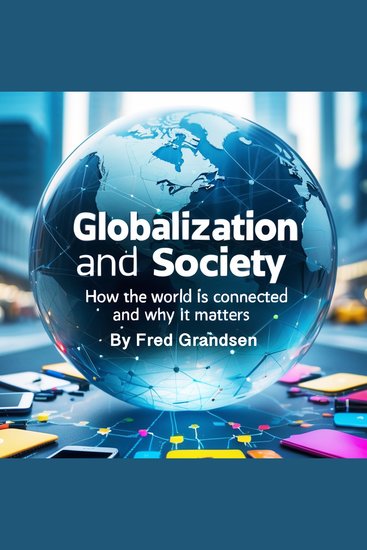
  • Globalization and Society - How the World is Connected and Why It Matters - cover

    Globalization and Society - How...

    Fred Grandsen

    • 0
    • 0
    • 0
    Globalization is a complex and multifaceted process that has shaped the modern world in profound ways. It refers to the increasing interconnectedness of societies, economies, and cultures across national borders. This phenomenon has accelerated over the past few decades due to advancements in technology, transportation, and communication, making it easier for people, goods, services, and ideas to move across the globe. While globalization is often associated with economic integration, it also has significant social, political, and cultural dimensions. 
    Historically, globalization can be traced back to ancient trade routes such as the Silk Road, which facilitated exchanges between distant civilizations. The Age of Exploration in the 15th and 16th centuries further expanded global interactions as European nations established colonies and trade networks around the world. However, modern globalization is distinct in its speed and scale. The 20th and 21st centuries have witnessed unprecedented levels of global integration, driven by technological innovations like the internet, satellite communication, and air travel. These advancements have made it possible for businesses to operate internationally, for cultures to influence one another more rapidly, and for individuals to access information from virtually anywhere.
    Show book
  • Marc Chagall: A short biography - 5 Minutes: Short on time - long on info! - cover

    Marc Chagall: A short biography...

    5 Minutes, 5 Minute Biographies,...

    • 0
    • 0
    • 0
    Marc Chagall, painter and cosmopolitan: Life and work in a short biography! Everything you need to know, brief and concise. Infotainment, education and entertainment at its best!
    Show book
  • Gestapo - The Story Behind Hitler's Machine of Terror - cover

    Gestapo - The Story Behind...

    Lucas Saul

    • 0
    • 0
    • 0
    Formed in 1933, the Gestapo became one of the most feared state forces of the Third Reich before and during World War II. 
     
    Chronicling the history of the organization, from its origins to the brutal and horrific offences that it perpetrated on hundreds of thousands of people, to its eventual downfall, Gestapo is a compelling tale of power and destruction taken to their most terrifying extremes. Familiar in films as the ominous men wearing black leather trench coats seen arresting people on the flimsiest of pretexts, the true story of the Geheime Staatspolizei (or Gestapo for short) is even more frightening. 
     
    Drawing on numerous sources, Gestapo explores how this secret state police force was born on 26 April 1933, the creation of Hermann Göring. Together with the Kriminalpolizei and the Sicherheitsdienst, the Gestapo would enforce a reign of terror on Germany and across much of Europe. Containing profiles of key figures and chilling tales of its death squads' sadistic efficiency - from the torture of Resistance members to mass murder in collaboration with the Einsatzgruppen - Gestapo shows how the organization thrived on Hitler's insecurity until, as the Allies triumphed, its members were eventually rounded up and, as far as possible, brought to justice.
    Show book
  • Getting to the Promised Land - Black America and the Unfinished Work of the Civil Rights Movement - cover

    Getting to the Promised Land -...

    Kevin W. Cosby

    • 0
    • 0
    • 0
    Too often, all oppressed people in America are lumped together under the moniker people of color, as if each group's experience under the yoke of systemic racism has the same economic and social repercussions. But the American Descendants of Slavery (ADOS) hold a unique claim to economic and reparative justice: for ADOS, after all, is the only group whose ancestors were forcibly brought to America, enslaved, built much of the wealth of the country, yet continue to be specifically excluded from the same social, political, and economic rights of other Americans. To that end, Rev. Dr. Kevin W. Cosby lays out the first theology of the ADOS movement, turning the traditional lens of Black liberation theology from Moses leading escaped Hebrew slaves in Exodus to other biblical leaders like Solomon, Daniel, and Nehemiah. 


    In the stories of Nehemiah and other biblical leaders, Cosby finds inspiration on how to rebuild Black America including the necessity of government reparations for ADOS. Cosby calls all Americans to move from a place of relative nonengagement and detachment to a place of active support of ADOS's efforts for justice and healing.
    Show book
  • Socially Psyched: A Short Book Breaking Down Over a Dozen of the Most Important Findings in Social Psychology - cover

    Socially Psyched: A Short Book...

    Bo Bennett PhD

    • 0
    • 0
    • 0
    This is a collection of what I feel are some of the most important social/cognitive psychology experiments, studies, demonstrations, biases, and systematic reviews, presented in an entertaining way while adhering to academic standards. 
     
    I have always been fascinated by how our behaviors, cognition (thoughts), and affect (how we feel) are greatly dependent upon our social environment and our imperfect brains. I find it fascinating--perhaps because I am an American who was raised in the typical American cultural environment where I learned that what we consider "the self" consists of some magic "soul" that defines who we are—our behaviors (including choices and decisions), our cognition (including thoughts and beliefs), and our feelings. This could not be further from the truth. "We" are a result of an often incomprehensible interaction between biology and environment where some traits are more greatly influenced by social factors than others. Who we are is a result of social forces—the influence of other people and the human-created systems in which we operate. We can ignore this fact, maintain an illusion of control, or face reality and learn how to navigate this world and come out on top—personally, professionally, and financially. I choose the latter. 
     
    My name is Bo Bennett, and I hold a PhD in social psychology with a passion for this subject. While this book is not about me, my interpretations and commentary do make up most of the sections of each entry based on the content written by the original authors of the research or other sources—each of which will be cited when used. 
    Enjoy this short book! 
     
    Bo Bennett, PhD
    Show book
  • The Birth of Anarchism - 1849-1887 - cover

    The Birth of Anarchism - 1849-1887

    Pierre-Joseph Proudhon, Mikhail...

    • 0
    • 0
    • 0
    Mankind can rule itself without the force of top-down authority, and freedom is more than just choosing how to meet the needs and demands of capital. Inequality is structural and intentional, not inevitable and necessary.  
    It does not have to be this way. In solidarity, we are better. 
    Think for yourself, and question authority. 
    This is the essence of anarchism, which has a bad name and reputation because it attacks the necessity of centralised power and authority. The media archetype is Tyler Durden, filled with violence and nihilism – yet anarchism is the most positive of political philosophies, one that Jesus and Buddha both preached, stating that empathy and a rejection of authority were key to human flourishing. Neither would disagree with most early anarchists. 
    Proudhon, whose “property is robbery” is perhaps the most well-known anarchist slogan, lays out the conceptual foundation for key anarchist ideas. He argues that usury (charging interest) is a fundamental harm to society, that there is enough for everyone if we simply take other values to be higher than capital gain, that mutualism is inevitable, and that all governments and ideologies make the same mistake, in trying to change society from the top. Positive change must arise from the great masses of humanity, not from their rulers. 
    Bakunin's speeches are about solidarity arising from the masses, and the ground for a global reconfiguration. 
    Louis Lingg was convicted to death with six others, for being one of the ‘Chicago Anarchists’. They were executed to make a political point, based on corrupted evidence and perjury. His statement is one of contempt for the powers that be, and his belief that mankind should be free and should fight until it is. 
    We end with Kropotkin, who firmly believed in decentralized society. He believed that the greatest strength of mankind lies in the masses, not their rulers, and exhorts us to “Act for Yourselves”.
    Show book