Join us on a literary world trip!
Add this book to bookshelf
Grey
Write a new comment Default profile 50px
Grey
Subscribe to read the full book or read the first pages for free!
All characters reduced
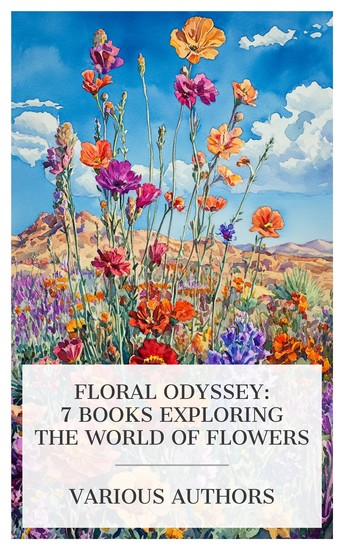
Floral Odyssey: 7 Books Exploring the World of Flowers - Flower Guide Flowers of the Southwest Deserts 100 Desert Wildflowers in Natural Color etc - cover

Floral Odyssey: 7 Books Exploring the World of Flowers - Flower Guide Flowers of the Southwest Deserts 100 Desert Wildflowers in Natural Color etc

Neltje Blanchan, C. E. Smith, Chester A. Reed, Mary Elizabeth Parsons, Natt N. Dodge, Leland F. Allen, Carl E. Jepson

Publisher: e-artnow

  • 0
  • 0
  • 0

Summary

Floral Odyssey: 7 Books Exploring the World of Flowers presents a thoughtfully curated selection that delves into the vibrant and intricate world of flowers through a myriad of literary styles and eras. This anthology masterfully captures the timeless allure of flora, ranging from poetry and botanical sketches to in-depth scientific explorations and historical accounts. Each piece offers a unique glimpse into the ethereal beauty and complex ecosystem of flowers, from their symbolic resonance in culture to their vital role in our environment. Standout works in the collection guide readers through a journey of discovery, showcasing the diverse significance of plant life across different contexts and settings. Contributing authors such as C. E. Smith, Neltje Blanchan, and Mary Elizabeth Parsons infuse their profound knowledge and appreciation for botanical studies into the anthology, weaving a rich tapestry of understanding around the subject. These scholars, rooted in various cultural and historical frameworks, draw upon global botanical traditions and the evolution of natural sciences. Collectively, their voices create a mosaic of insights that align with the broader literary movement of nature writing, celebrating the intersection of art and science in documenting plant life. Whether you are a seasoned botanist or a casual admirer of nature’s wonders, Floral Odyssey offers an unparalleled opportunity to immerse oneself in the multifaceted narratives of flowers. This anthology stands as a vital educational resource, rich in its breadth of insights and the enlightening dialogue it facilitates between diverse literary minds. Engaging in this collection will not only deepen your appreciation for the botanical world but also expand your understanding of the cultural and ecological narratives surrounding our floral companions.
Available since: 03/04/2025.
Print length: 1044 pages.

Other books that might interest you

  • Robert Shaw - An Actor's Life on the Set of JAWS and Beyond - cover

    Robert Shaw - An Actor's Life on...

    Christopher Shaw Myers

    • 0
    • 0
    • 0
    "Go for the Jaws, stay for the Shaws." —Nat Segaloff, author of The Exorcist Legacy 


    Robert Shaw unforgettably commanded attention as the weathered seaman Captain Quint in the blockbuster sensation, Jaws. But what came before and after that landmark film is as dramatic as the hunt for the great white shark itself. 


    Capturing the many facets of the vibrant, generous, and sometimes polarizing man is his nephew, Christopher, who explores the forces that shaped a dynamic personality—including Robert's indomitable mother, his deeply troubled father, and his activist sister, Joanna, with whom Robert shared an unbreakable bond. Out of the traumatic events of their childhood in the Orkney Islands and Cornwall, Mrs. Shaw pushed her children to pursue their dreams. For Robert, that dream was acting and writing. 


    Despite a storied career on the British and American stage—as both performer and playwright—and a string of hit films including From Russia with Love, A Man for All Seasons, The Sting, and The Taking of Pelham One Two Three, international celebrity eluded Robert . . . until he was summoned to star in "a little horror film" called Jaws.
    Show book
  • Eveline - From their pens to your ears genius in every story - cover

    Eveline - From their pens to...

    James Joyce

    • 0
    • 0
    • 0
    James Augustine Aloysius Joyce was born on the 2nd February 1882 in Dublin into a middle-class family, and the eldest of ten surviving siblings 
    Admired as a brilliant student he briefly attended the Christian Brothers-run O'Connell School before excelling at the Jesuit schools of Clongowes and Belvedere.  From there he went on to attend University College Dublin from 1898, studying English, French and Italian 
    In 1902, Joyce was now in his early twenties, and went to Paris to study Medicine but soon abandoned his teachings.  Back in Dublin to attend to his dying Mother he met Nora Barnacle. They bonded immediately into a life-long match. Together they decided to emigrate to Europe.  The couple lived in Trieste, Rome, Paris, and finally Zürich where Joyce pursued a variety of jobs and ventures to supplement his literary pursuits but none of these paid off.  
    After publishing a poetry volume, ‘Chamber Music’, in 1907, his short story collection ‘The Dubliners’, in 1914, helped establish his talent in the rapidly changing world.  
    Although far from home Joyce’s literary heart and works were set in his recollections of Dublin.  Characters are close resemblances of family and friends and indeed enemies.  His landmark work ‘Ulysses’, published in 1922, is set in the streets and alleyways of the city as it parallels Homer’s Odyssey in a variety of styles including its famed stream of consciousness. 
    His pen continued to produce classics of the order of ‘A Portrait of the Artist as A Young Man’ and ‘Finnegan’s Wake’ together with several volumes of poetry and a play ‘The Exiles, in 1918.   
    On the 11th January 1941, Joyce underwent surgery in Zürich for a perforated duodenal ulcer. The next day he fell into a coma. On the 13th after a brief period of lucidity in which he called for his wife and son he passed.  He was 58.
    Show book
  • A Legend - From their pens to your ears genius in every story - cover

    A Legend - From their pens to...

    Alexander Kuprin

    • 0
    • 0
    • 0
    Alexander Kuprin was born in Narovchat, Penza in Russia on 7th September 1870. 
    At 3 his Father died and he and mother moved to Moscow. By 10 he was enrolled at the Second Moscow Military High School and there his interest in literature began. The Alexander Military Academy followed and two years later he was a sub-lieutenant and posted to an Infantry Regiment for a further four years. 
    Despite his duties he was a now a keen writer and published his first short story at this time. His military duties also garnered him experiences for his breakthrough work ‘The Duel’.  Leaving the military he left for Kiev to work for local newspapers.  He continued to publish both stories and novels and by 1901 he was in St Petersburg becoming part of a group that included Chekhov, Ivan Bunin, Maxim Gorky and Leonid Andreyev.  
    In the years that followed further controversial works and acclaim followed.  His comments on the regime meant he was also put under secret police surveillance.   
    As World War I erupted, Kuprin opened a military hospital but was then given command of an infantry company in Finland. He was soon discharged on grounds of ill health.  
    The October Revolution saw him praise Lenin, but he warned that the Bolsheviks threatened Russian culture and might cause further widespread suffering to the peasants.  As Civil War raged he took his family to Helsinki and then on to Paris. 
    Exile saw his talents decline further and his succumbing to alcoholism. He became lonely and withdrawn. The family's poverty increased his malaise.   
    In May 1937, the Kuprin’s returned to Moscow.  He now saw his work published but wrote almost nothing new.  In 1938 his health rapidly deteriorated.  Already suffering from a kidney problems and sclerosis, he had now developed cancer of the oesophagus.  
    Alexander Kuprin died on 25th August 1938.
    Show book
  • The Quintessential Good Samaritan - The Authorized Biography of John Joseph Kelly Champion of Social Justice - cover

    The Quintessential Good...

    Thomas Huening, Congresswoman...

    • 0
    • 0
    • 0
    John Joseph Kelly—the quintessential Good Samaritan—changed the lives of thousands of people in need, first as a devoted Catholic priest; then as a champion of the poor and a father figure to troubled minority youth; and finally, as a one-on-one mentor offering hope and guidance to hardcore San Quentin inmates. 


    Kelly was a spiritual superstar and a role model for anyone who truly desired to make a difference in their own community. When he died in 2019 at age ninety, thousands who knew him recalled the credo that marked his life: "We need to take what God has given us, discover it, and use it for justice and good." 


    Father Kelly did exactly this when he traded his Catholic collar for a work shirt in 1979. He dropped his cassock in dramatic fashion after his final mass to pursue "justice and good" for the next forty years. Kelly showed the courage of his convictions when he struggled with Church bureaucracy, hypocrisy, internal politics, silk vestments, and processions, ultimately deciding he could help more people by being less faithful to Catholic dogma, and do more as a lay person devoted to the teachings of Jesus, Muhammad, and Krishna. Kelly then dedicated his life to inspiring others to become instrumental in helping thousands of people—many of them homeless—who were hungry and needed food, shelter, and adequate clothing.
    Show book
  • Transsexual Apostate - My Journey Back to Reality - cover

    Transsexual Apostate - My...

    Debbie Hayton

    • 0
    • 0
    • 0
    'Brave and deeply considered… Her experience, and Transsexual Apostate, shouldn't be dismissed' The Telegraph
    In a compelling first-hand account of what it means to be a transwoman – and where she feels the impulse comes from – Hayton explains why much of gender identity ideology is, in her view, false and damaging. Once a prominent member of the TUC LGBT+ committee, she charts how her views developed and put her at odds with the majority of trans activists. She issues a compassionate call to move beyond ideological conflicts, and to acknowledge the legitimate concerns that many have with an agenda that asserts that transwomen are women.
    Hayton's honest, humane and moving book shows that by accepting reality, transwomen can live their best lives based on the truth of who they are – rather than the fantasy of who they are not.
    'Brave, unflinching, insightful' - Professor Michael Bailey, author ofThe Man Who Would Be Queen
    Show book
  • Bellerophon To Anteia - From their pens to your ears genius in every story - cover

    Bellerophon To Anteia - From...

    Mary Butts

    • 0
    • 0
    • 0
    Mary Frances Butts was born on 13th December 1890 in Poole, Dorset. 
    Her early years were spent at Salterns, an 18th-century house overlooking Poole Harbour.  Sadly in 1905 her father died, and she was sent for boarding at St Leonard's school for girls in St Andrews. 
    Her mother remarried and, from 1909, Mary studied at Westfield College in London, and here, first became aware of her bisexual feelings.  She was sent down for organising a trip to Epsom races and only completed her degree in 1914 when she graduated from the London School of Economics.  By then Mary had become an admirer of the occultist Aleister Crowley and she was given a co-authorship credit on his ‘Magick (Book 4)’. 
    In 1916, she began the diary which would now detail her future life and be a constant reference point for her observations and her absorbing experiences. 
    During World War I, she was doing social work for the London County Council in Hackney Wick, and involved in a lesbian relationship.  Life changed after meeting the modernist poet, John Rodker and they married in 1918. 
    In 1921 she spent 3 months at Aleister Crowley's Abbey of Thelema in Sicily; she found the practices dreadful and also acquired a drug habit.  Mary now spent time writing in Dorset, including her celebrated book of short stories ‘Speed the Plough’ which saw fully develop her unique Modernist prose style. 
    Europe now beckoned and several years were spent in Paris befriending many artists and writing further extraordinary stories.   
    She was continually sought after by literary magazines and also published several short story collections as books. Although a Modernist writer she worked in other genres but is essentially only known for her short stories.  Mary was deeply committed to nature conservation and wrote several pamphlets attacking the growing pollution of the countryside. 
    In 1927, she divorced and the following year her novel ‘Armed with Madness’ was published.  A further marriage followed in 1930 and time was spent attempting to settle in London and Newcastle before setting up home on the western tip of Cornwall.  By 1934 the marriage had failed. 
    Mary Butts died on 5th March 1937, at the West Cornwall Hospital, Penzance, after an operation for a perforated gastric ulcer. She was 46.
    Show book