

Join us on a literary world trip!
Add this book to bookshelf
Grey
Write a new comment Default profile 50px
Grey
Subscribe to read the full book or read the first pages for free!
All characters reduced
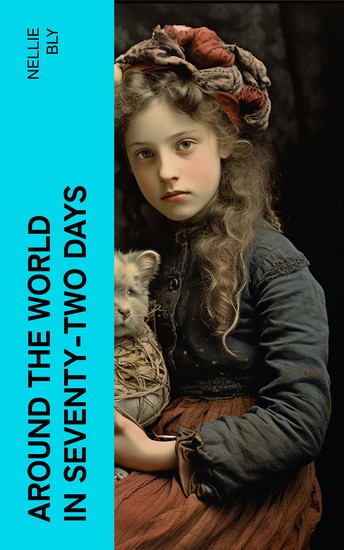
Around the World in Seventy-Two Days - cover

Around the World in Seventy-Two Days

Nellie Bly

Publisher: e-artnow

  • 0
  • 0
  • 0

Summary

Around the World in Seventy-Two Days is a book by Elizabeth Jane Cochrane. The narrative describes her long trip around the world, which was inspired by Jules Verne. She carried out the voyage for Joseph Pulitzer's tabloid newspaper, the New York World.
Available since: 12/06/2023.
Print length: 150 pages.
Other books that might interest you

  • Peter Alliss - Reflections on a Life Well Lived - cover

    Peter Alliss - Reflections on a...

    Peter Alliss

    • 0
    • 0
    • 0
    Peter Alliss was a truly monumental figure in the world of golf. His voice was the soundtrack to many who have paid even the scantest attention to the old game. This book records Peter's vivid recollections of a life well lived, looking back on his double-edged career in sport and media, one that is unlike any other and is surely never to be repeated.
    Sit back and listen to Peter Alliss do what he did best: ramble on about this and that in that famous voice of his, drawing sharp and funny observations from disparate quarters of life before inevitably tying everything neatly together and returning to the subject of golf. His memory for long-passed names and distant places remained extraordinarily sharp.
    He was also a man of his age which, naturally, meant there were more than a few facets of modern life he found confusing and exasperating. This, however, is surely true for any of us who have lived beyond the point where we wake up each day wondering what we ought to do with our lives.
    He appreciated his good fortune at being able to make a living from his 'ramblings' while, at the same time, possessing an acute awareness of his rare talent for finding the appropriate word or phrase while winging it over a television picture. His belief that, sometimes, silence is more eloquent than words flies in the noisy face of much modern broadcasting. He was all the more appreciated by many of us for sticking to this conviction and for daring to hold firm in the face of changing convention. Peter is gone now, but the spirit of kindness in which he lived his life reverberates still.
    Show book
  • The Snowstorm - Author of War & Peace Anna Karenina and countless other classics Russian realist Tolstoy brings a harsh look at life in Winter - cover

    The Snowstorm - Author of War &...

    Leo Tolstoy

    • 0
    • 0
    • 0
    Leo Tolstoy was born in 1828 in the Russian province of Tula to a wealthy noble family. As a child, he had private tutors but he showed little interest in any formal education. When he went to the University of Kazan in 1843 to study oriental languages and law, he left without completing his courses.  Life now was relaxed and idle but with some writing also taking place.  Gambling debts forced an abrupt change of path and he joined the army to fight in the Crimean War.  He was commended for his bravery and promoted but was appalled at the brutality and loss of life.  He recorded these and other earlier experiences in his diaries which formed the basis of several of his works. 
     
    In 1852 ‘Childhood’ was published to immediate success and was followed by ‘Boyhood’ and ‘Youth’. 
     
    His experience in the army and the horrors he witnessed resulted in ‘The Cossacks’ in 1862 and the trilogy ‘Sevastopol Tales’. After the war he travelled around Europe, visiting London and Paris and meeting such luminaries as Victor Hugo and Charles Darwin.  
     
    It was now that Tolstoy began his masterpiece, ‘War and Peace’. Published in 1869 it was an epic work that changed literature. He quickly followed this with ‘Anna Karenina’.  
     
    These successes made Tolstoy rich and helped him accomplish many of his dreams but also brought problems as he grappled with his faith and the lot of the oppressed poor. These revolutionary views became so popular that the authorities now kept him under surveillance.  
     
    He led a life of asceticism and vegetarianism and put his socialist ideals into practice by establishing numerous schools for the poor and food programmes. He also believed in giving away his wealth, which caused much discord with his wife.  
     
    His writing continued to bring forth classics such as ‘The Death of Ivan Ilyich’ and many brilliant and incisive short stories such as ‘How Much Land Does A Man Need’.  
     
    In 1901 Tolstoy was excommunicated from the Church and controversially deselected for the Nobel Prize for Literature. 
     
    Whilst undertaking a pilgrimage by train in October 1910 with his daughter Aleksandra he caught pneumonia in the nearby town of Astapovo.  Leo Tolstoy died on November 9th, 1910, he was 82. 
     
    In this much acclaimed short story Tolstoy’s characters are engulfed by a huge snowstorm which descends upon them and puts the successful conclusion of their journey into perilous doubt.
    Show book
  • American Legends: The Life of Roy Rogers - cover

    American Legends: The Life of...

    Editors Charles River

    • 0
    • 0
    • 0
    In the early 20th century, Westerns were one of the most popular genres in Hollywood, and one of the young stars at the forefront was Roy Rogers, who had come from an Ohio farm to transform himself into a cowboy. Regardless of his background, Rogers certainly looked the part of the quintessential cowboy, along with his wife Dale Evans and his horse Trigger. His versatile singing and acting abilities made him successful both on radio and on the screen. 
    Rogers came of age at a time when the “singing cowboy” was at the apex of his popularity, and that was favorable because he actually got his start in show business as a singer. In the early ‘30s, he bounced around several groups as a country music singer before earning national attention as a member of the Sons of the Pioneers, who were signed to Decca and had a couple of hits. As a result, when he first appeared in movies in 1935, it was usually in bit roles that required singing, but when Gene Autry threatened to quit acting in 1938, Rogers was viewed as a suitable replacement for lead roles. As it turned out, he became the premiere “singing cowboy” in Autry’s stead, and from 1939-1954, he was one of the Top 10 Western stars in Hollywood, and a Top 10 movie star overall during some of those years. 
    As Rogers evolved into the “King of the Cowboys”, he became a pop culture icon, and he was shrewd enough to capitalize on his image. All sorts of Roy Rogers merchandise hit stores, from action figures to comic strips, and Rogers even banked on the popularity of his horse Trigger by featuring him enough to make the horse a household name as well. Even today, people can find the name Roy Rogers all over the place, if only because he eventually had his name lent to a popular fast food chain in later years.
    Show book
  • A Warning to the Curious - From their pens to your ears genius in every story - cover

    A Warning to the Curious - From...

    M R James

    • 0
    • 0
    • 0
    Montague Rhodes James is cited as perhaps the greatest English writer of ghost stories, an opinion few would disagree with. 
    James was born on 1st August 1862 at Goodnestone Parsonage in Kent, where his father was Curate but at age 3 the family went to live at Livermere, near Bury St Edmunds in East Anglia.  
    From early childhood he had a passion for mediaeval books and antiques. He was educated initially as a boarder at Temple Grove School in East Sheen, west London, before gaining a scholarship to Eton and thence Cambridge where he gained a double first, becoming a distinguished linguist and mediaevalist.  
    Before the Great War vacations were usually spent touring Europe absorbing cultures and references for his later writing. 
    A man of enormous knowledge it was said he timed his breakfast egg whilst he completed the Times crossword.  
    Many of his elegant yet terrifying tales were created by discarding the prevailing gothic cliches and placing his characters and narrative in a realistic setting.  Thereby the stories gained atmosphere and menace on a grand scale and he was famed as the originator of the antiquarian ghost story. 
    Although story-telling and writing these 30 or so tales was a hobby, when published their effect transformed the genre and still chill the bones in our more modern times. 
    James was also a medievalist scholar and translator whose work remains highly respected. He was also Provost of Eton College between 1918 and 1936. 
    M R James died on 12th June 1936 at Eton in Buckinghamshire.  He was 73.
    Show book
  • No Standing on Toilet and Other Itchy Feet Travel Tales - A Whimsical Walkabout in Asia - cover

    No Standing on Toilet and Other...

    Sam Letchworth

    • 0
    • 0
    • 0
    Have you ever wondered where horse milk vodka comes from? Or how to fight off a mob of Malaysian monkeys? Is it bad luck to wash cow poop off of your shoe? Travel vicariously with Sam across the Orient to find the funny but true answers. 
    Sam savors every local culture he encounters much like Conan O’Brian and the late Anthony Bourdain — embracing the people, their food, and especially their curiosities. His humor and infatuation with humanity’s diversity fuel each story. 
    Teaching in Korea and Vietnam since 2015, Sam uses his time out of the classroom to explore the rest of Asia. His short five-book series, Itchy Feet Travel Tales in Asia, covers his adventures (and misadventures) in Cambodia, China, India, Indonesia, Japan, Korea, Malaysia, Mongolia, Myanmar, Russia, South Korea, Thailand, and Vietnam. 
    These stories of the sublime and the surreal will have you giggling and gawking as you follow Sam through the weird and wonderful world of the East.
    Show book
  • Horatio Nelson - His Life His Service His Death and His Legacy - cover

    Horatio Nelson - His Life His...

    Kelly Mass

    • 0
    • 0
    • 0
    Horatio Nelson can be seen as one of the most courageous, strategic, valiant British generals in history. His tactics in the navy have led their empire to glorious victories in the 18th and beginning of the 19th century. During the wars against Napoleon, the Scandinavians, and in the West Indies, he was an exemplary leader, strategists, and combatant. The British Empire stretched all the way from the Caribbean to Egypt and beyond. Needless to say, much help was needed in various areas in the world. 
    Learn more about this brave warrior, someone who fit exactly into that time frame to keep their empire afloat, through their navy ships, their battles, and their victories.
    Show book
