Join us on a literary world trip!
Add this book to bookshelf
Grey
Write a new comment Default profile 50px
Grey
Subscribe to read the full book or read the first pages for free!
All characters reduced
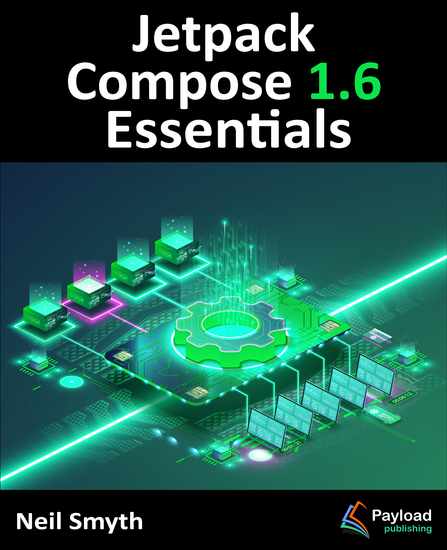
Jetpack Compose 16 Essentials - Developing Android Apps with Jetpack Compose 16 Android Studio and Kotlin - cover

Jetpack Compose 16 Essentials - Developing Android Apps with Jetpack Compose 16 Android Studio and Kotlin

Neil Smyth

Publisher: Payload Media, Inc.

  • 0
  • 0
  • 0

Summary

This book teaches you how to build Android applications using Jetpack Compose 1.6, Android Studio Iguana (2023.2.1), Material Design 3, and the Kotlin programming language.
 
The book begins with the basics by explaining how to set up an Android Studio development environment.
 
The book also includes in-depth chapters introducing the Kotlin programming language, including data types, operators, control flow, functions, lambdas, coroutines, and object-oriented programming.
 
An introduction to the key concepts of Jetpack Compose and Android project architecture is followed by a guided tour of Android Studio in Compose development mode. The book also covers the creation of custom Composables and explains how functions are combined to create user interface layouts, including row, column, box, flow, pager, and list components.
 
Other topics covered include data handling using state properties and key user interface design concepts such as modifiers, navigation bars, and user interface navigation. Additional chapters explore building your own reusable custom layout components, securing your apps with Biometric authentication, and integrating Google Maps.
 
The book covers graphics drawing, user interface animation, transitions, Kotlin Flows, and gesture handling.
 
Chapters also cover view models, SQLite databases, Room database access, the Database Inspector, live data, and custom theme creation. You will also learn to generate extra revenue from your app using in-app billing.
 
Finally, the book explains how to package up a completed app and upload it to the Google Play Store for publication.
 
Along the way, the topics covered in the book are put into practice through detailed tutorials, the source code for which is also available for download.
 
Assuming you already have some rudimentary programming experience, are ready to download Android Studio and the Android SDK, and have access to a Windows, Mac, or Linux system, you are ready to start.
Available since: 04/05/2024.
Print length: 660 pages.
Other books that might interest you

  • COPOUT - How governments have failed the people on climate - An insider’s view of Climate Change Conferences from Paris to Dubai - cover

    COPOUT - How governments have...

    Nick Breeze

    • 0
    • 0
    • 0
    ‘Wry and passionate first-hand observations from the global climate negotiations – essential for capturing the spirit of this endlessly frustrating struggle’ – Bill McKibben 
    Most people tend to turn away, perhaps understandably, from the key existential issue of the day: climate change or, some would say more accurately, climate collapse. Nick Breeze tells the engaging, very human story of successive COP conferences over the past decade: it is a tale of imperfection, failure even, but not yet defeat. 
    So far, the UN process has achieved almost the exact opposite of what it first set out to achieve at the Rio Earth Summit in 1992. Nick shows clearly that it is not Extinction Rebellion, Just Stop Oil nor any other climate protesters who are the extremists; the true extremists are the policymakers who consistently undermine faltering efforts to reduce emissions. Repeatedly claiming to be saving us whilst allowing carbon emissions to continue rising, governments have failed their people on climate. Nick shows us how, why and what we can do about it. 
    The public remains largely uninformed about climate change and, for the most part, those who seek to draw attention to the issue are seen as ‘crazy’. There remains a terrifying gap between scientific reality and political action. 
    Packed with his own experiences and insights from expert interviewees, Nick’s page-turning account is less about the intricacies of the science and more about the mainstream perception of how we are understanding and responding to the problem.
    Show book
  • The Future We're Building - How Today's Innovations Will Shape Tomorrow's World - cover

    The Future We're Building - How...

    Arlo Voss

    • 0
    • 0
    • 0
    Discover How Today's Innovations Will Shape Tomorrow's World 
     
    Embark on a journey to understand the transformative forces of our era in The Future We're Building. This book explores groundbreaking innovations redefining human experience across various domains.  
     
    In Chapter 1, discover how Artificial Intelligence is set to address modern challenges and reshape society. Chapter 2 highlights renewable energy breakthroughs tackling global energy issues, while Chapter 3 unveils biotechnology's role in advancing genetics and healthcare.  
     
    Chapter 4 ventures into space exploration, promising Earth-bound benefits, and Chapter 5 emphasizes collaborative innovation to combat climate change. Learn about the future of transportation in Chapter 6, and embrace smart cities in Chapter 7.  
     
    Chapter 8 delves into tech-driven agricultural innovations, while Chapter 9 focuses on digital learning solutions. Explore personalized medicine and global health in Chapter 10, and Chapter 11 discusses technology's role in fostering an equitable society. Chapter 12 navigates the ethical complexities of these advancements, stressing responsible development.  
     
    More than a chronicle of innovation, this book is a call to action for all dreamers, thinkers, and doers to engage with the future. Be inspired and equipped with the knowledge to shape the world on the horizon.
    Show book
  • GitHub Copilot - A comprehensive guide to GitHub Copilot - cover

    GitHub Copilot - A comprehensive...

    Et Tu Code

    • 0
    • 0
    • 0
    Unlock the power of GitHub Copilot, the revolutionary AI pair programming tool that helps you write better code faster! 
    This comprehensive guide takes you by the hand and shows you how to get started with GitHub Copilot, leveraging its advanced features to streamline your coding workflow. 
    From setup and configuration to advanced techniques for debugging, testing, and refactoring, this book covers it all. 
    Learn how to use GitHub Copilot's intelligent suggestions, code completion, and error detection capabilities to improve your coding speed and accuracy. Discover how to integrate Copilot with your favorite IDEs, including Visual Studio Code, IntelliJ, and more.
    Show book
  • Manifesto for the Revitalisation of Cities - A Solution to Portugal's Housing Crisis - cover

    Manifesto for the Revitalisation...

    Miguel Rebelo

    • 0
    • 0
    • 0
    The housing crisis in Portugal serves to illustrate a problem that has implications beyond the borders of the country, shedding light on challenges that are faced by major European and global cities. The rise in housing prices, driven by real estate speculation, the growth of tourism and the influx of foreign investment, has made it increasingly challenging for many in the population, especially the middle and lower classes, to access home ownership or renting. 
    The digitalisation of work has opened the possibility for highly qualified professionals to consider where they would like to live, regardless of the physical location of their job. Cities like Lisbon and Porto have become increasingly attractive destinations, offering a good quality of life combined with a range of professional opportunities. Nevertheless, this phenomenon has placed additional strain on the real estate market, leading to rising prices and the displacement of residents to the outskirts. 
    The housing policies that have been adopted thus far have not been as effective as might have been hoped, and in some cases may even have had the opposite effect. It seems that measures such as strict rent control, poorly targeted subsidies and the massive construction of new housing without proper urban and infrastructural planning have not solved the problem, and in some cases may have made it worse. Perhaps it would be beneficial to reconsider these approaches, acknowledging their shortcomings and adapting them to reflect the current situation. 
    It may be worth considering rehabilitating vacant buildings as a viable and sustainable solution. By restoring existing buildings, we can explore ways to increase the supply of affordable housing, revitalise run-down urban areas and preserve historical and cultural heritage to promote more inclusive and sustainable cities.
    Show book
  • Barons - Money Power and the Corruption of America's Food Industry - cover

    Barons - Money Power and the...

    Austin Frerick, Eric Schlosser

    • 0
    • 0
    • 0
    Barons is the story of seven corporate titans, their rise to power, and the consequences for everyone else. Take Mike McCloskey, chairman of Fair Oaks Farms. In a few short decades, he went from managing a modest dairy herd to running the Disneyland of agriculture. Mike benefited from deregulation of the American food industry, a phenomenon that has consolidated wealth in the hands of select tycoons, and along the way, hollowed out the nation's rural towns and local businesses. 


    Along with Mike McCloskey, listeners will meet a secretive German family that took over the global coffee industry in less than a decade, relying on wealth traced back to the Nazis to gobble up countless independent roasters. And they will learn that in the food business, crime really does pay—especially when you can bribe and then double-cross the president of Brazil. 


    These, and the other stories in this book, are simply examples of the monopolies and ubiquitous corruption that today define American food. The tycoons profiled are hardly unique: many other companies have manipulated our lax laws and failed policies for their own benefit, to the detriment of our neighborhoods, livelihoods, and our democracy itself. A fair, healthy, and prosperous food industry is possible—if we take back power from the barons who have robbed us of it.
    Show book
  • Earth in Flames - How an Asteroid Killed the Dinosaurs and How We Can Avoid a Similar Fate From Nuclear Winter - cover

    Earth in Flames - How an...

    Alan Robock, Owen Brian Toon

    • 0
    • 0
    • 0
    Sixty-six million years ago an asteroid as large as Mt. Everest hit what is now the Yucatan Peninsula at a speed ten times faster than the fastest rifle bullet. Debris from the impact blew into space, re-entered the atmosphere as a swarm of shooting stars that burned the global forests and grasslands, leaving behind a thin global layer containing rock from the asteroid and from Mexico, and smoke from the fires. This layer marks one of the greatest extinctions in Earth history including not just dinosaurs, but also fish, plankton, ammonites, and plants making up about 75% of the known species. 


    A nuclear war with just a few hundred of the world's 12,000 nuclear weapons targeted on densely populated cities could plunge Earth into the same types of conditions that the dinosaurs experienced. Even a war between India and Pakistan could kill 1 to 3 billion people from starvation due to agricultural failure, while 6 billion people might starve following a war involving Russia, NATO, and the U.S. 


    The book describes how the dinosaurs died, and how their deaths parallel what might happen to people after a nuclear war. The book reflects on the odds of future asteroid impacts, how to stop them, and ends with what the listeners personally and together can do to prevent a nuclear war, so that humans don't end up like the dinosaurs.
    Show book