Join us on a literary world trip!
Add this book to bookshelf
Grey
Write a new comment Default profile 50px
Grey
Subscribe to read the full book or read the first pages for free!
All characters reduced
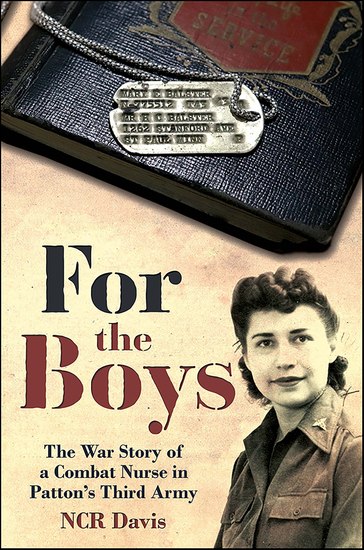
For the Boys - The War Story of a Combat Nurse in Patton’s Third Army - cover

For the Boys - The War Story of a Combat Nurse in Patton’s Third Army

NCR Davis

Publisher: Casemate

  • 0
  • 0
  • 0

Summary

"This novelistic narrative captures both the violence and trauma of WWII and its subject’s remarkable heroism."— Publishers Weekly

A month after her 24th birthday, Lt. Mary Elizabeth Balster collapses among the rubble of a shelled supply room. Has the young nurse finally succumbed to the mounting emotional toll caused from months of caring for the sick and wounded just behind the front lines of General Patton’s Third Army? On the night of November 30, 1944, holed up in the Heinrich Himmler Barracks in Morhange, France, Lt. Balster’s evac receives a typical patient load (over 200 soldiers, including wounded enemy), but this time one of the admissions is a 19-year-old tanker she’d nursed back to health five months before in Normandy. The charge nurse on Surgical gently informs the lieutenant that the private is critical, admitted with two gunshot wounds and almost half his body consumed by burns. Rising determined to save him, Balster limps toward the shelled supply room determined to search for any blood plasma bottles still intact after Luftwaffe strafing.

Recaptured from her mother’s reminiscences and letters home, N. C. R. Davis takes the reader through every heat-of-battle harrowing moment as Balster lived it, achieving a rare glimpse of one nurse’s point of view during the latter part of the European conflict.

The book mixes Lt. Balster’s observations, memories, and dreams to re-tell the true story of a richly rebellious and intense woman trying to navigate her life and nurture her sanity while nursing the wounded and dying frontline soldiers of the Third Army. Her strong-willed, beguiling personality fosters the grit necessary for her success as a combat nurse, but these same characteristics cause two men to fall in love with her. And the personal cost of war comes to a heartrending conclusion, as she must choose one man over the other to save herself.
Available since: 09/30/2023.
Print length: 256 pages.


Other books that might interest you

  • Balance - How It Works and What It Means - cover

    Balance - How It Works and What...

    Paul Thagard

    • 0
    • 0
    • 0
    Living is a balancing act. Ordinary activities like walking, running, or riding a bike require the brain to keep the body in balance. A dancer’s poised elegance and a tightrope walker’s breathtaking performance are feats of balance. Language abounds with expressions and figures of speech that invoke balance. People fret over work-life balance or try to eat a balanced diet. The concept crops up from politics—checks and balances, the balance of power, balanced budgets—to science, in which ideas of equilibrium are crucial. Why is balance so fundamental, and how do physical and metaphorical balance shed light on each other? 
     
    Paul Thagard explores the physiological workings and metaphorical resonance of balance in the brain, the body, and society. He describes the neural mechanisms that keep bodies balanced and explains why their failures can result in nausea, falls, or vertigo. Thagard connects bodily balance with leading ideas in neuroscience, including the nature of consciousness. He analyzes balance metaphors across science, medicine, economics, the arts, and philosophy, showing why some aid understanding but others are misleading or harmful. Thagard contends that balance is ultimately a matter of making sense of the world. In both literal and metaphorical senses, balance is what enables people to solve the puzzles of life by turning sensory signals or an incongruous comparison into a coherent whole. 
     
    Bridging philosophy, psychology, and neuroscience, Balance shows how an unheralded concept’s many meanings illuminate the human condition.
    Show book
  • Parenting Children With ADHD - 10 Lessons That Medicine Cannot Teach - cover

    Parenting Children With ADHD -...

    PhD Vincent J. Monastra

    • 0
    • 0
    • 0
    Over the past thirty years, Dr. Monastra has treated more than 15,000 clients who have ADHD. In this indispensable book he shares the knowledge he has gained. 


    Children with ADHD struggle so much with inattention or hyperactivity and impulsivity that they have trouble succeeding at home, at school, with friends, or on the playing field. Arranged in a series of sequential lessons to be taken "one at a time," beginning with the causes of ADHD and the most common medical treatments. 


    Engaging and straightforward, the book is directed at parents of children who have, or might have, ADHD. Dr. Monastra discusses all the relevant issues for parents, including psychological treatment, diet, educational laws, and practical coping strategies for both parents and children. Parenting Children With ADHD, now in its second edition, shows how you can become your child's best advocate, helping to improve attention, behavioral control, and social skills. 


    Updates to this edition include information on new diagnostic tests, medications, and treatments; tips to help your school district create a safe for your child; and a new chapter on teaching life values, such as generosity and kindness.
    Show book
  • Audrey Hepburn: A short biography - 5 Minutes: Short on time - long on info! - cover

    Audrey Hepburn: A short...

    5 Minutes, 5 Minute Biographies,...

    • 0
    • 0
    • 0
    Audrey Hepburn, screen legend: Life and work in a short biography! Everything you need to know, brief and concise. Infotainment, education and entertainment at its best!
    Show book
  • Urban Disaster Management - Preparing for and Responding to Crises - cover

    Urban Disaster Management -...

    Lyric Vale

    • 0
    • 0
    • 0
    Urban disasters have become an increasingly pressing concern as the world continues to urbanize at an unprecedented rate. Cities, once seen as bastions of opportunity and progress, are now at the forefront of vulnerability to both natural and human-made catastrophes. The rapid growth of urban populations, coupled with poorly planned infrastructure and environmental challenges, has created a precarious landscape where the impact of disasters can be catastrophic. 
    One of the primary drivers of urban disaster risk is the sheer scale of urbanization. By 2050, it is estimated that nearly 70% of the world’s population will reside in urban areas. This rapid urban migration often leads to the expansion of informal settlements, where millions live in overcrowded conditions with inadequate access to basic services such as clean water, sanitation, and healthcare. These areas, typically located in hazard-prone zones like floodplains and unstable hillsides, are particularly vulnerable to disasters. When disasters strike, the lack of preparedness and resilience in these communities amplifies the loss of life and property. 
    Climate change further exacerbates the threat of urban disasters. Rising global temperatures are intensifying the frequency and severity of natural hazards, such as hurricanes, floods, heatwaves, and wildfires. Coastal cities, home to millions, face increasing risks from sea level rise and storm surges, threatening vital infrastructure and displacing large populations. Additionally, the interconnected nature of urban systems means that the failure of one critical system, such as electricity or transportation, can cascade into widespread disruptions, leaving cities paralyzed in the wake of a disaster.
    Show book
  • 100 Facts About Learning Spanish - English to Spanish - cover

    100 Facts About Learning Spanish...

    Science-Based Language Learning Lab

    • 0
    • 0
    • 0
    Introduction to the 100 Facts Language Learning Series 
     
    Welcome to an innovative approach to language learning! Our series helps you master Spanish through captivating topics like art, science, and history. Each book presents 100 carefully selected facts, providing knowledge in both English and Spanish. 
     
    How It Works: 
     
    - Each fact is introduced in Spanish for initial interpretation. 
     
    - The fact appears in English on the next page, repeated in Spanish to clarify any unknown terms. 
     
    - This repetitive, yet concise format aids memorization and streamlines learning. 
     
    Benefits: 
     
    - Concise Learning: One-sentence facts make learning impactful and relevant to your interests. 
     
    - Reinforcement: Alternating languages with each fact solidifies vocabulary and grammar through constant, practical application. 
     
    - Engagement: Associating new words with passionate topics keeps learning dynamic and engaging. 
     
    - Dual Knowledge: Learn a new language and deepen your understanding of a specific subject simultaneously. 
     
    Designed for learners who thrive on clear, targeted information, this series offers an enjoyable and effective educational journey. Whether you're a curious beginner or expanding your skills, these books ensure your language learning is both educational and engaging. Embrace this journey of 100 facts and let your passions drive your progress in mastering Spanish!
    Show book
  • The Psychology of a Meatflake - cover

    The Psychology of a Meatflake

    Jemmy Borden

    • 0
    • 0
    • 0
    Discover the hidden biases that shape meatflake behavior. Have you ever been ridiculed for sticking up for animals? Or maybe some meatflake thought he was being clever by posting a picture of a steak. Have you ever wondered what causes this cringeworthy behavior? Meatflakes are a special type of snowflake. They're known to be insecure and highly threatened by vegans and vegan food. 
    Here's some fun facts about meatflakes:Meatflakes often claim they would rather die than give up meat.Meatflakes instantly turn into a "nutrition expert" whenever the subject of meat comes up.Meatflakes get easily offended when they hear anything negative about meat.Meatflakes are known to be very dismissive of plant-based food without even trying it.Meatflakes think it's clever to post a picture of a steak when someone is raising awareness about animal abuse.Male meatflakes are often insecure about their masculinity and will eat even more meat to feel more manly. 
    Chances are you have a meatflake in your life. A little psychology goes a long way in explaining a lot of the cringeworthy behavior that meatflakes are known for. This book explores the hidden biases that cloud the way they think.
    Show book