Join us on a literary world trip!
Add this book to bookshelf
Grey
Write a new comment Default profile 50px
Grey
Subscribe to read the full book or read the first pages for free!
All characters reduced
Whaling History - cover

Whaling History

Nakoa Rainfall

Translator A AI

Publisher: Publifye

  • 0
  • 0
  • 0

Summary

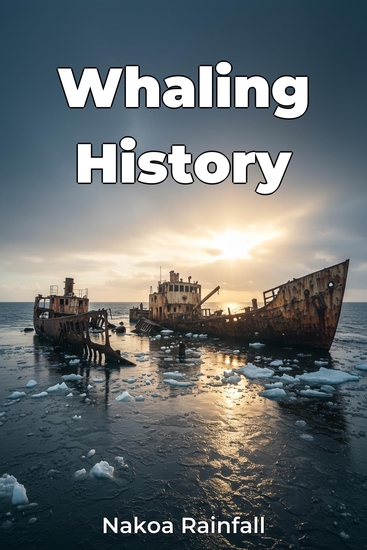
Whaling History explores the extensive history of whaling, focusing on the polar regions and its profound economic and ecological impacts. The book examines how the demand for whale products drove global trade and colonial expansion, leading to the overexploitation of species like the Bowhead whale. It highlights the devastating consequences for marine ecosystems and the ongoing efforts for marine conservation. One intriguing fact is how whale products were essential for industries ranging from lighting to fashion, showcasing the broad reach of this industry.

 
The book adopts a chronological and thematic approach, tracing the progression of whaling from early indigenous practices to industrial-scale operations. It details the technological advancements that intensified whaling efforts and analyzes the ecological consequences, including population declines and ecosystem disruptions. The narrative culminates with an examination of modern conservation efforts, such as the International Whaling Commission, and the challenges of balancing conservation with indigenous needs.

 
Drawing upon historical logs, scientific data, and indigenous knowledge, the book provides a multifaceted perspective. It serves as a critical case study of the interplay between economic activity, ecological vulnerability, and the urgent need for conservation strategies. By understanding past mistakes, Whaling History emphasizes informed decision-making for current environmental challenges, making it valuable for students, researchers, and anyone interested in environmental history.
Available since: 03/20/2025.
Print length: 68 pages.

Other books that might interest you

  • Among Typhoons And Pirate Craft - cover

    Among Typhoons And Pirate Craft

    Lindsay Anderson

    • 0
    • 0
    • 0
    Anderson served as third officer aboard the Eamont. Eamont was an opium clipper built in Cowes. Eamont was involved in the opening of Japan to foreigners in 1858, serving as a dispatch boat between Nagasaki and Shanghai, and was one of the first vessels to open up a trade with Formosa. The Eamont was employed in the negotiations for the first commercial treaty with Japan. On this occasion she ran into Nagasaki and quietly dropped anchor, in spite of the fact that opposition to the proposed commercial treaty was very strong at the time. On the following morning 150 boat-loads of Japanese attempted to tow her to sea, being evidently ignorant of an anchor's raison d'etre. But though they attempted several similar methods to get rid of her they refrained from any armed attack, and, eventually, her mission was completely successful. This was in 1858, and the Eamont's crew saw many wonderful sights in that tierra incognita. The September Typhoon of 1858 destroyed several well-known opium clippers at Double Island, including the Anonyma, Gazelle, Pantaloon, and Mazeppa. Eamont was anchored off Double Island, with "150 fathoms of chain out and a second anchor backed on it at 60 fathoms." The waves in the anchorage were estimated to be as large as 40 feet, and the Eamont’s crew had to cut away her masts. Eamont was one of only two ships in that anchorage to survive the night, the other being the Hazard. (See Wikipedia article on Eamont (schooner)) ( wikipedia and david wales)
    Show book
  • Data Warehousing for Beginners - 2 in 1 Guide - cover

    Data Warehousing for Beginners -...

    Brian Paul

    • 0
    • 0
    • 0
    In the ever-evolving world of technology, data is the driving force behind informed decision-making. "Data Warehousing for Beginners" is your indispensable guide to understanding, designing, and managing data warehouses—an exploration that caters to both beginners and seasoned professionals. This comprehensive book unravels the complexities of data warehousing, offering insights into its historical evolution, architectural frameworks, and the pivotal role it plays in organizational intelligence. 
    "Data Warehousing for Beginners" is your compass in the dynamic world of organizational intelligence. Whether you're a novice seeking an introduction or a seasoned professional aiming to refine your skills, this book provides a roadmap for building, optimizing, and future-proofing your data-driven ecosystem. Embark on a journey that empowers you to navigate the complexities of data warehousing and unlock the full potential of organizational intelligence. 
     
    Show book
  • AI: Rise of the Lightspeed Learners - cover

    AI: Rise of the Lightspeed Learners

    Charles Jennings

    • 0
    • 0
    • 0
    Powerful new autonomous machines called AIs are popping up all around us. The most important of these, says former AI industry CEO Charles Jennings, are the Lightspeed Learners--AIs with the power to learn on their own. 
    Jennings' new book, "AI: Rise of the Lightspeed Learners", explores how AIs are affecting everything from trucking to dentistry, currency trading to warfare. It grapples with the existential challenges AI presents to humanity, and concludes the biggest threat is not killer robots, but dangerous dictators. “There are potentially disastrous consequences for Americans of all political persuasions if China leaps ahead of us in AI," he says. "An AI-dominant China would ultimately take the lead in high tech, financial services, military weapons, energy systems, transportation, manufacturing and more. AI is the coolest, strangest, most dangerous, most powerful technology yet. And we Americans, funders of the crucial first fifty years of AI research, are at risk of letting it slip away.” 
    Jennings makes the case that development—and control—of “friendly AI” become an urgent political priority in the United States. But he does so less through political rants than by what he calls AI storytelling, and by taking the listener on a journey into the brave new world of AIs…a journey that includes original stories, music and poetry, as well as highly accessible explanations about how AI works, and why it matters. Visit www.lightspeedlearners.com to learn more.
    Show book
  • Velociraptor The: The History of the Popular but Misunderstood Dinosaur Genus - cover

    Velociraptor The: The History of...

    Editors Charles River

    • 0
    • 0
    • 0
    The massively popular 1990 novel Jurassic Park by Michael Crichton and its subsequent movie adaptations led to a huge resurgence in interest in dinosaurs and the prehistoric world. That interest continues to the present day, even though most of the dinosaurs in Jurassic Park weren’t actually from the Jurassic period. Triceratops, Velociraptor, Tyrannosaurus Rex and the huge sauropods such as Brachiosaurus that feature in the book and movies all actually belong to the Late Cretaceous period, more than 40 million years after the end of the Jurassic. Regardless, the movie made certain kinds of dinosaurs instantly recognizable, even if associated with the wrong era. 
    	Thanks to the movie, there has been some unwitting confusion over the identity of the Velociraptor, and this confusion was due in large part to the fact the name sounds far more scary than the creature to which the name originally belonged. Moreover, the creature to which the label was applied in the novel and movie was actually a distant cousin named Deinonychus, but as the story goes, the author, Michael Crichton, thought “Velociraptor” sounded “more dramatic.” The actual Velociraptor lived not in the badlands of North America, but in the badlands of central-eastern Asia, and it was not nearly as intimidating as Deinonychus. In fact, the main species of genus Velociraptor - Velociraptor mongoliensis - was no bigger than a turkey. Thus, in a very real sense, the Velociraptor has taken on a larger-than-life reputation.
    Show book
  • Unbelievable Followers Secret to Explosive Growth - "Elevate your growth game! Dive into dynamic audio lessons on the Unbelievable Followers Secret for remarkable results!" - cover

    Unbelievable Followers Secret to...

    Cyrus Marwood

    • 0
    • 0
    • 0
    Unbelievable Followers: Unlock the Secrets to Explosive Growth 
    Are you eager to advance your career and enhance your expertise in social media engagement?  
    Looking for a comprehensive resource that covers all the essentials for achieving rapid social growth?  
    Your search is over! 
    This guide is your ultimate companion for deepening your understanding, applying innovative strategies, and engaging in practical exercises. With this material, you’re set on a path to success. 
    Updated to align with the latest trends in social media engagement. 
    Key Features of This Enhanced Guide: 
    - In-depth insights into strategies for rapid social growth and engagement 
    - A thorough explanation of principles that drive social media success 
    - Effective tactics for preparing and executing your engagement strategies 
    Our guide stands out due to its extensive coverage, crucial for your success. Concepts are not only introduced but explored in detail for a comprehensive understanding. 
    Please note that this guide is an independent resource and is not affiliated with any official social media organization. 
    Designed with clarity and simplicity in mind, our Engagement Strategies Guide ensures smooth transitions between topics. Say farewell to convoluted terminology and embrace clear, precise, and technically sound content. 
    So, why hesitate? Click the BUY NOW button, secure your guide, and embark on your journey to social media success! 
    Don’t miss out on the opportunity to transform your social media presence and achieve explosive growth!
    Show book
  • Hubris - The Rise Fall and Future of Humanity - cover

    Hubris - The Rise Fall and...

    Thomas Trappe, Johannes Krause

    • 0
    • 0
    • 0
    Humans are the most intelligent beings this planet has ever produced. But how is it that we find ourselves faced with an existential crisis that threatens to overwhelm us? 


    Leading archaeogeneticist Johannes Krause and journalist Thomas Trappe investigate what DNA can tell us about how we got where we are and what our future might be. They show how the first humans were defeated again and again and suffered fatal setbacks, and how Homo sapiens succeeded in conquering continents, overcoming natural borders, and bringing other species under its control. But the genetic blueprint that enabled us to get to the place where we are today had one flaw: it didn't factor in planetary boundaries. Now that we are approaching those boundaries for the first time after millions of years of evolution, an urgent question arises: can we learn to live within the planetary limits, or are we doomed by our DNA to continue to expand, consume, and absorb the resources around us to the point of exhaustion, consigning ourselves and other species to extinction? 


    While the looming climate crisis does not augur well for humanity's capacity to adapt to the new situation in which it finds itself, we are not at the mercy of our DNA—or at least we don't have to be. But can we harness the lessons of the past to survive the present?
    Show book