Join us on a literary world trip!
Add this book to bookshelf
Grey
Write a new comment Default profile 50px
Grey
Subscribe to read the full book or read the first pages for free!
All characters reduced
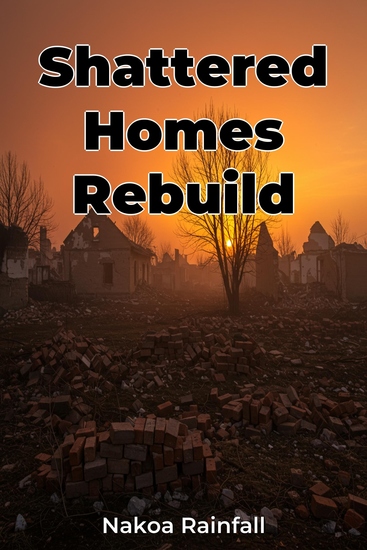
Shattered Homes Rebuild - cover

Shattered Homes Rebuild

Nakoa Rainfall

Translator A AI

Publisher: Publifye

  • 0
  • 0
  • 0

Summary

Shattered Homes Rebuild delves into the crucial processes of post-war recovery, highlighting how collective labor and resource mobilization are essential for community resilience. The book examines various post-conflict scenarios, from World War II to more recent humanitarian crises, to understand how societies rebuild homes, economies, and social structures.

 
It argues that successful reconstruction depends on harnessing collective action and fairly distributing resources, challenging top-down approaches. For example, examining how communities adapted traditional social networks or created new institutions can provide insights into effective recovery models.

 
The book unfolds by initially introducing core concepts like collective labor and resource mobilization. It then progresses through case studies of successful initiatives, explores diverse resource allocation strategies, and investigates the evolution of community structures.

 
By emphasizing local participation and ownership, Shattered Homes Rebuild offers a unique perspective on fostering sustainable recovery, shifting the focus from immediate relief to long-term resilience. The book is valuable for policymakers, aid organizations, and anyone interested in understanding effective post-conflict recovery strategies.
Available since: 02/27/2025.
Print length: 75 pages.

Other books that might interest you

  • The Heart Chakra Magic - Unlock Infinite Love Inner Peace and Lasting Transformation - cover

    The Heart Chakra Magic - Unlock...

    Elena G.Rivers

    • 0
    • 0
    • 0
    The Heart Chakra Magic is your all-in-one guide to help you reconnect with the astonishing power of your heart to manifest the life you love, desire, and deserve. No previous spiritual knowledge is required, and the methodology covered in this book is simple, effective, and open to readers of all spiritual backgrounds. 
    Inside, you will discover simple-to-follow techniques and empowerment to get your beautiful heart chakra back in balance it needs to help you manifest a happy, joyful, and abundant life. 
    With the Heart Chakra Magic, You Will Quickly Learn: 
    -The significance and magic of the heart chakra, what happens when it’s out of balance, and what to do about it; 
    -How heart chakra influences your manifestations and why healing it is the fastest way to manifest your deepest desires (the path of least resistance); 
    -Techniques to release negative energies and enjoy the flow of positive, uplifting emotions; 
    - How to unlock inner harmony, strength, courage, and confidence so that you can discover and pursue your life’s purpose; 
    -A myriad of transformative modalities and easy-to-use tools specifically for heart-chakra rebalancing (including inner work, affirmations, meditation, journaling, vibration-healing herbal essences, crystals, essential oils, sounds, and frequencies + more to support your heart-chakra journey); 
    -How to tap into the power of self-love and let it guide you (warning- it can result in most magical manifestations your mind couldn’t even comprehend); 
    -Heart Chakra magic and synchronicities through non-linear healing and gratitude practices; 
    -Specific shadow work prompts to help you release your manifesting blocks and step into your divine power. 
    It’s time to heal and master the creative Heart Chakra energy that can move mountains!
    Show book
  • COMMUNICATION SKILLS - Learn Proven Strategies for Improving Your Listening Speaking and Interpersonal Skills in Any Situation (2023 Guide for Beginners) - cover

    COMMUNICATION SKILLS - Learn...

    Mark Baker

    • 0
    • 0
    • 0
    "Communication Skills" is a comprehensive guide to mastering the art of effective communication. Written by a leading expert in the field, this book provides readers with a step-by-step approach to improving both verbal and nonverbal communication skills. Whether you're looking to improve your listening skills, speak more confidently, or navigate tricky interpersonal dynamics, this book has something for you. 
    This book will help you:Learn the key principles of effective communication and how to apply them in any situation.Discover powerful strategies for improving your listening skills and understanding the perspective of others.Learn how to use body language, tone of voice and other nonverbal cues to communicate more effectively.Understand the psychology behind communication and how to navigate tricky interpersonal dynamics with ease.Get practical tips and exercises to help you put your new skills into action. 
    And Much More!... 
    With clear explanations, real-life examples, and practical exercises, this book is a must-read for anyone looking to improve their communication skills. Whether you're a student, a professional, or simply looking to improve your relationships, "Communication Skills" will give you the tools you need to communicate more effectively in any situation. 
    So, if you're looking to boost your confidence and make more meaningful connections with others, "Communication Skills" is the perfect guide for you. It will help you to improve your verbal and nonverbal communication skills, and to navigate tricky interpersonal dynamics with   ease. 
      
    Click the “Buy Now” button to proceed!!! 
     
    Show book
  • The Huguenots - Resistance Beliefs and Persecution - cover

    The Huguenots - Resistance...

    Kelly Mass

    • 0
    • 0
    • 0
    An important chapter in history is that in which the Catholic Church was being questioned by the commoners. People were standing up against tyranny and illogical rules. They had had it with hypocrisy and double standards. The abuse in the church wasn’t representing the text in the Bible. Too much corruption had crept into the clergy, or so the narrative went about across the entire European continent. 
    The Huguenots were a spiritual group of French Protestants who complied with the Reformed, or Calvinist, Protestant custom. The expression originates from the name of a Swiss politician, Genevan burgomaster Bezanson Hugues (from about 1491 - 1532) and was commonly used in Europe by the 16th century. Huguenot was a term used throughout the Protestant Reformation to describe members of the Reformed Church of France. It came from the Dutch “huisgenoten” and was used throughout the revolution that led to the entire Reformation. 
    Today, we will explore what that meant, and how history took a turn in this important time frame.
    Show book
  • The Joyful Wisdom - cover

    The Joyful Wisdom

    Friedrich Nietzsche

    • 0
    • 0
    • 0
    "The Joyful Wisdom," written in 1882, just before "Zarathustra," is rightly judged to be one of Nietzsche's best books. Here the essentially grave and masculine face of the poet-philosopher is seen to light up and suddenly break into a delightful smile. The warmth and kindness that beam from his features will astonish those hasty psychologists who have never divined that behind the destroyer is the creator, and behind the blasphemer the lover of life. In the retrospective valuation of his work which appears in "Ecce Homo" the author himself observes with truth that the fourth book, "Sanctus Januarius," deserves especial attention: "The whole book is a gift from the Saint, and the introductory verses express my gratitude for the most wonderful month of January that I have ever spent." Book fifth "We Fearless Ones," the Appendix "Songs of Prince Free-as-a-Bird," and the Preface, were added to the second edition in 1887.
    Show book
  • Napoleon Bonaparte’s Most Decisive Land Battles: The History of Austerlitz the French Invasion of Russia Leipzig and Waterloo - cover

    Napoleon Bonaparte’s Most...

    Editors Charles River

    • 0
    • 0
    • 0
    Nearly 50 years after Napoleon met his Waterloo, generals across the West continued to study his tactics and engage their armies the same way armies fought during the Napoleonic Era. Despite advances in military technology and the advent of railroads for transportation, all of which made defensive warfare more effective, acclaimed military geniuses like Robert E. Lee used flank attacks and infantry charges against superior numbers in an effort to win decisive victories, and it would not be until World War I that concepts of modern warfare made the Napoleonic Era of the early 19th century outdated. 
    For those questioning why generals continued using tactics from the Napoleonic Era even as technology changed the battlefield, the Battle of Austerlitz may provide the best answer. Napoleon is regarded as one of history’s greatest generals, and Austerlitz was his greatest victory. In 1805, Britain, Austria, and Russia allied together to form the Third Coalition against the French, and the Third Coalition’s forces consisted of armies from Austria and Russia, with Britain providing naval support as well as its financial powers. Napoleon had already defeated and mostly destroyed an Austrian army in October at Ulm before it could link up with the Russians, setting the stage for the Battle of Austerlitz to be the culmination of the war against the Third Coalition as a whole in early December. Despite the smashing victory at Ulm, Napoleon’s French army would still be well outnumbered at Austerlitz by a joint Russo-Austrian army in a battle that would also come to be known as the Battle of Three Emperors.  
    At Waterloo, however, it would end disastrously, as Napoleon’s armies were unable to dislodge Wellington and unable to keep the Prussians from linking up with the British. The battle would end with the French suffering nearly 60% casualties, the end of Napoleon’s reign, and the restructuring of the European map.
    Show book
  • Transgender Rights vs Women’s Rights - From Conflicts to Co-Existence - cover

    Transgender Rights vs Women’s...

    Robert Wintemute

    • 0
    • 0
    • 0
    “Trans rights are human rights!” “Women’s rights are human rights!” Yes, but the human rights of two groups often conflict. The only way to resolve these conflicts is through calm, rational, public debate. Freedom of expression protects the right of women to question certain demands by trans rights activists, even if this might offend. Raising conflicts between transgender rights and women’s rights is not “transphobic”, because disagreement is not hatred. The concept of “transphobia” should be defined narrowly as statements or acts indicating hostility or prejudice towards transgender persons. If the right to speak about conflicts is protected, and we start by acknowledging the broad areas of agreement about the human rights of transgender people, we can turn to the substance of these conflicts. 
      
    Should it be possible for an individual to change their legal sex? If so, how easy should it be? Should it be changeable only after a diagnosis of gender dysphoria and a waiting period? Or should it be sufficient to “self-identify” as a person of the opposite sex? Or should sex be removed from birth certificates, so that there is nothing to change?  
      
    Robert Wintemute carefully examines these conflicts, considers the differences between transgender rights and lesbian, gay and bisexual (LGB) rights, and proposes ways to achieve co-existence between transgender rights and women’s and children’s rights. 
      
    "Wintemute expertly illuminates the transgender debate. His journey through time and evolving views is clear and insightful, and he examines legal, policy, and ethical challenges with depth. In an increasingly polarised environment, his respect for all rights is very refreshing."—Debbie Hayton, author of Transsexual Apostate
    Show book